
LEPTON Series Single-pixel VPD PbSe MWIR Detectors

REQUEST PRICING AND AVAILABILITY
- Get your individual quote.
- Technical compatibility review included.
- Volume discounts available.
No obligation. Direct access to our engineering team.
Product information "LEPTON Series Single-pixel VPD PbSe MWIR Detectors"
Wavelength Range 1.0-5.0 µm MWIR; Detector Size 1x1, 2x2 mm; Time Constant <2 µs; Responsivity 9x10³, 4.5x10³ V/W; Element Resistance 0.1-2.0 MΩ
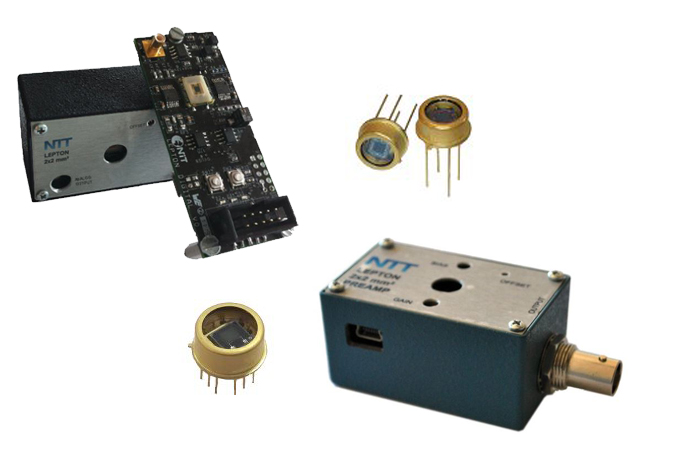
New Infrared Technologies’ (NIT) LEPTON Series of single-pixel VPD PbSe MWIR detectors are available uncooled as well as with integrated TECs (thermoelectric cooling elements), with different geometries, packaging solutions and preamplifier boards. LEPTON Series single-pixel detectors come in two standard sizes: 1 mm × 1 mm or 2 mm × 2 mm.
LEPTON Series uncooled single-pixel PbSe MWIR detectors can be ordered packaged in SMD or TO-5 housings (with cap, hermetic) with sapphire window. These detectors are operational at room temperature and don’t require any cooling devices.
LEPTON Series cooled single-pixel PbSe MWIR detectors are hermetically packaged in a TO-8 can housing with cap and sapphire window and include one or two thermoelectric cooler (TEC) stages for higher sensitivity as well as a thermistor. A calibration curve for the thermistor is available.
NIT’s LEPTON Series also includes two low-noise preamplifier boards that are 5-V-powered via mini-USB connector: The LEPTON ANALOG PREAMP provides rotary switches to manually select the detector biasing voltage (4 steps from 1.25 V to 10 V) as well as the transimpedance gain (4 steps from 104 to 107 V/A). This preamp outputs a ±10 V analog voltage on a BNC connector. The LEPTON PREAMP WITH USB OUTPUT allows to digitally select the values for detector biasing voltage and transimpedance gain via software. Here, the output is a digital 14 Bit signal with a maximum sampling rate of 20 ksps. This preamp also features an analog output for the preamplifier stage on SMB or BNC connector.
For more pixels, linear and two-dimensional array MWIR cameras are available from New Infrared Technologies – please refer to the LUXELL series of linear array MWIR cameras and TACHYON series of high-speed imaging MWIR cameras respectively.
Key Features:
- Detector Sensing Material: VPD Polycrystalline PbSe
- Uncooled and TEC-cooled (1-stage, 2-stages) Versions Available
- Square Pixels, Available Pixel Geometries: 1 x 1 mm, 2 x 2 mm
- Packaging: SMD (10x10 mm) Non-hermetic, TO-5 (9.14 mm Dia.) Hermetic With Cap, TO-8 (15.24 mm Dia.) Hermetic With Cap
- Sapphire Window
- IR Detection Band: MWIR, 1.0 µm to 5.0 µm
- Peak Wavelength of Detection: 3.7 µm
- D* (λpeak) Uncooled: 2x10⁹ Jones Typical
- D* (λpeak, 1,000 Hz, 1.2 Hz) Cooled: 1x10¹⁰ Jones
- Time Constant: <2 µs
- Biasing Voltage: 5 V, 10 V Typical
- Element Resistance: 0.1 to 2.0 MΩ
- Responsivity (@Vb = 10 V): 9x10³ V/W (1x1 mm), 4.5x10³ V/W (2x2 mm)
- Power: 1 mW
- Read-out Electronics External (Not Included)
- Customizable
- Operating Temperature: +5 °C to +70 °C (SMD), -40 °C to +85 °C (TO-5, TO8)
- Amplifier Board Transimpedance Gain: 104 to 107 V/A, Adjustable Manually or per Software
- Amplifier Board Dark Current Cancellation: 1.24 µA to 1 mA, Adjustable Manually or per Software
- Amplifier Board Power Supply: 5 VDC, 60 mA (mini-USB Connector)
- Amplifier Board Output: Analog (±10 V), Digital (14 Bit)
- Amplifier Board Noise: 5 pA @1 kHz, 107 V/A
- Amplifier Board Dimensions: 75.90 x 35.10 x 28.70 mm (Analog), 89.30 x 35.10 x 26.30 mm (USB Output)
Applications: Gas & Flame Detection; Laser Detection
Customers also viewed

1260-1620 nm; IL 1.0, 1.2 dB; WDL ≤0.3 dB; Switching Speed ≤250 µs; Repeatability ±0.1°; RL ≥55 dBLunas’ PSG-001 high-speed polarization state generator (PSG) module generates six states of polarization (-45°, 0°, 45°, 90°, RHC & LHC) across the Poincaré sphere in less than 250 μs, with a repeatability of less than 0.1 degrees.In addition, PSG-001 comes as a compact module ideal for integration into systems that require precise generation of these six polarization states or precise 90° polarization rotation. The PSG-001 polarization state generator is easily controlled with a 6-bit TTL signal either from a microcontroller or a computer.Key Features:Digitally Switched State of Polarization (SOP)SOP Switching Speed: ≤250 µsSOP Repeatability: ±0.1° on Poincaré Sphere6-bit TTL ControlWavelength Range: 1260 to 1340 nm, 1480 to 1620 nmInsertion Loss (IL): 1.0, 1.2 dB TypicalWavelength Dependent Loss (WDL): ≤0.3 dBReturn Loss (RL): ≥55 dBAngle Between SOP States: 90 ±10° on Poincaré SphereTransient Loss: ≤0.6 dB/bitDimensions: 135 x 70 x 19 mmApplications: Mueller matrix-based measurements; Polarization OTDR; Swept Frequency Component Measurement
REQUEST PRICING AND AVAILABILITY
- Get your individual quote.
- Technical compatibility review included.
- Volume discounts available.
No obligation. Direct access to our engineering team.

Wavelength 600-2300 nm; Bandwidth 0.05-1.2 nm; Reflectivity 5-99%; SLSR >8 dB; Fiber Type SM, PM, Double Clad, LMA, Custom; Fiber Pigtail Length ≥0.5, CustomGreitlex Photonics’ GTL-FBG-TB-890 tunable fiber Bragg gratings (FBGs) are a good solution for many applications – including those requiring a corrected central Bragg wavelength. An FBG’s central wavelength strongly depends on applied stress, with the mechanically induced strain linearly shifting the FBG’s central wavelength.The tunable fiber Bragg grating wavelength’s relative strain sensitivity is 0.78 * 10-6 µstrain-1. GTL-FBG-TB-890 tunable fiber Bragg gratings are boxed and operated manually. Athermal performance with an adjustment range of 2 nm is also possible. The gratings are available as bare fibers or with a variety of optical connectors. These FBGs replace similar products from the former FORC Photonics. The following configurations can be changed at the customer's request, please contact AMS Technologies to discuss a customized tunable fiber Bragg grating solution tailored to your project’s requirements.Key Features:Wavelength Range: 600 nm to 2300 nmWavelengths to Quick Order [nm]: 633, 780, 794, 797, 799, 801, 809, 830, 852, 895, 940, 976, 1030, 1057, 1060, 1064, 1080, 1125, 1150, 1178, 1240, 1270, 1310, 1484,1510 - 1580, 1650, 1900, 1908, 1952, 2300Fiber Type: Single Mode (SM), Polarization Maintaining (PM), Double Clad, LMA, CustomThermal Wavelength Stability (0°C to +60°C): <0.18 nmReflectivity: 5% to 99%Bandwidth (WFHM): 0.05 nm to 1.2 nmFBG Length: 1 mm to 20 mmAdjustment Range: 2 nmSLSR: >8 dBFBG Pigtail Length: ≥0.5 mFBG Recoating: On Customer Request Tensile Strength: >100 kpsiOptical Connector: Bare Fiber, FC/APC, LC/APC, CustomPackage Dimensions: 66 x 18 x 16 mmApplications: Where Corrected Central Bragg Wavelength is Necessary
REQUEST PRICING AND AVAILABILITY
- Get your individual quote.
- Technical compatibility review included.
- Volume discounts available.
No obligation. Direct access to our engineering team.