
Other Discrete Detectors and Arrays

AIP/PIP/MIP/FIP/SIP Configurable Line Infrared Detection Modules
Frequency Bandwidth up to 0.25, 1 GHz; Low Cut-off Frequency DC-10 kHz; High Cut-off Frequency 100 kHz-1 GHz; Transimpedance 0.5-200 kV/A; Output Impedance 50 Ω; Output Voltage Swing ±1-±10 V Vigo System’s AIP, PIP, MIP, FIP and SIP configurable line series of infrared (IR) detection modules integrate the infrared photodetector and the preamplifier in a common package. This integration makes the detectors less vulnerable to over-bias, electrostatic discharge, electromagnetic interference (EMI) and other environmental exposures. Additional advantages of the integration are improved high-frequency (HF) performance, output signal standardization, miniaturization, and cost reduction. Vigo System’s broad line of transimpedance preamplifiers is especially designed for integration with each type of the supplier’s IR detectors. The configurable line of modules enables the selection of the active area, type of preamplifier and bandwidth of the detection module. This makes it possible to adapt the module to the needs of your own application. To obtain the most optimal parameters of integrated module each preamplifier is individually matched to the selected detector. The parameters of each integrated set will be known after final evaluation (matching, adjustment and final tests). If you need any assistance in selecting Vigo System products that are appropriate for your application, please contact the AMS Technologies IR detector specialists. Vigo System’s AIP series is a new generation of transimpedance, AC or DC coupled preamplifiers. It is designed to operate with either biased or non-biased Vigo System detectors. AIP is „all‑in-one” device – a preamplifier is integrated with a fan and a thermoelectric cooler controller in a compact housing. It is very convenient and user‑friendly device, thus can be easily used in a variety of applications. AIP series modules can be equipped with thermoelectrically cooled models of the PC, PCI, PV, PVI, PVM and PVMI IR detector series. Vigo System’s PIP series comprises programmable, “smart” preamplifiers, offering extreme flexibility combined with superior signal parameters and high reliability. A built-in voltage monitor allows to check and optimize the working conditions (supply voltages, detector bias voltage, first and last stage output voltage offset etc.). It is also possible to change the gain, coupling (AC/DC), optimize the first stage transimpedance and manually or automatically suppress the voltage offset. Optimized parameters are stored into the internal EEPROM memory and automatically loaded after the power is on. Reset to default settings is available at any time. For proper operation, the PTCC-01 TEC controller is required. PIP series modules can be equipped with thermoelectrically cooled models of the PC, PCI, PV, PVI, PVM and PVMI IR detector series. Vigo System’s MIP series provides medium-size transimpedance, DC or AC coupled preamplifiers, intended to operate with either biased or non-biased Vigo System IR detectors. MIP series modules are equipped with a fan, do not require any additional external heatsink and are one of the most user-friendly preamplifier series which surely facilitates work. MIP series modules can be equipped with thermoelectrically cooled models of the PC, PCI, PV, PVI, PVM and PVMI IR detector series. Vigo System’s FIP series of high-speed transimpedance, AC-coupled preamplifiers is intended to operate with the biased, TE-cooled IR detector models of Vigo System’s PV and PVI series. Thi series’ fast preamplifier enables precise I-V conversion, detector biasing up to 800 mV and simultaneously maintains compact size and keeps current noise low. FIP series modules are equipped with a fan and do not require additional heat dissipation. They are suitable for applications requiring wide frequency bandwidth. An additional DC output is available as an option. Vigo System’s SIP series of ultra-small transimpedance, AC- or DC-coupled preamplifiers is designed to operate with either biased or non-biased detectors. It is compatible with uncooled IR detectors (in TO39 package, SIP-TO39) or thermoelectrically cooled IR detectors (in TO8 package, SIP-TO8) of the PC, PCI, PV, PVI, PVM and PVMI series. SIP series modules are dedicated for OEM applications, require external heatsinks and provide a possibility to adjust gain (devices with a frequency bandwidth up to 100 MHz). Key Features: Integrated Fan (AIP, MIP, FIP) Integrated TEC Controller (AIP) DC Monitor (AIP, Optional for FIP) Frequency Bandwidth up to 250 MHz, 1 GHz (FIP) Optimized for Effective Heat Dissipation Compatible with Optical Accessories Universal, Versatile & Flexible, Convenient to Use Parameters Configurable by the User (PIP): Output Voltage Offset; Gain (in 40 dB Range); Bandwidth (150 kHz/1.5 MHz/20 MHz, 1.5 MHz/15 MHz/100 MHz); Coupling AC/DC; Detector’s Parameters (Temperature, Reverse Bias etc.) Very Small Size (SIP) Adjustable Gain as an Option (SIP) Low Cut-off Frequency flo: DC to 10 kHz High Cut-off Frequency fhi: 100 kHz to 1 GHz Transimpedance Ki: 0.5 kV/A to 200 kV/A Output Impedance Rout: 50 Ω Output Voltage Swing Vout: ±1 V-, ±2 V, ±10 V Power Supply Voltage: +5 VDC, +12 VDC, ±9 VDC, ±15 VDC, +12/-5 VDC Max. Power Supply Current: ±50 mA, +100/-50 mA Signal Output Socket: SMA, MMCX DC Output Socket: SMA Power Supply & TEC Control Socket: DC 2.1/5.5, DC 2.5/5.5, LEMO Female (PIP, MIP FIP), AMP2x4 (Male) Applications: Industrial; Medical; Automotive; Environmental; Laser Power Control and Calibration; Gas Analysis; Mid-IR Spectroscopy; Gas Leak Detection; Air Quality Analysis; Water Quality Control; Engine Emission Monitoring and Control; Fuel Quality Assessment; Analysis of Temperature Distribution; Railway Transport Safety; Plastic Sorting; Security and Defense
REQUEST PRICING AND AVAILABILITY
- Get your individual quote.
- Technical compatibility review included.
- Volume discounts available.
No obligation. Direct access to our engineering team.
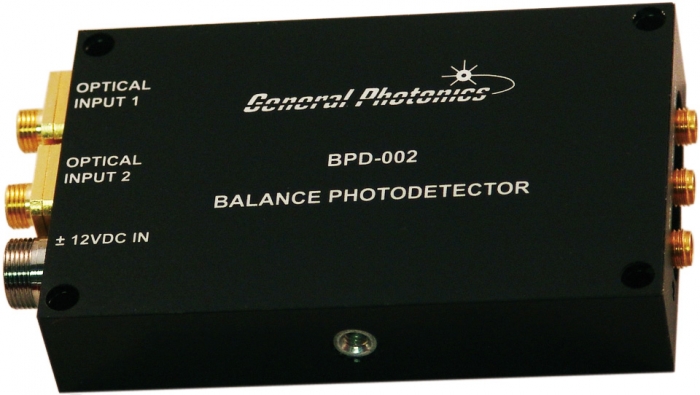
BPD-002 Balanced Photodetector
InGaAs Photodetector; 1060, 1310, 1550 nm; Aluminium Enclosure; Responsivity 0.7 mA/mW; RF Bandwidth 0-200 MHz; Transimpedance Gain 3×10⁴ V/A OCT and sensor systems require high-performance balanced photodetectors to increase system signal-to-noise ratio (SNR). General Photonics’ BPD-002 balanced photodetector module is specially designed for use in research and development, with ease of use and high performance as the primary design goals. The BPD-002 device is fully enclosed in a compact, sturdy aluminium box with two optical input ports, a balanced RF output port, two 1 MHz monitor ports and a power supply port. With a bandwidth up to 200 MHz, a transimpedance gain larger than 30K and a saturation power larger than 130 µW, the BPD-002 balanced photodetector is ideal for integration into laboratory or commercial OCT, fiber sensor, and high-performance optical measurement systems. Key Features: Low Noise and High Common Mode Rejection Ratio (CMRR) High Conversion Gain Wide RF Output Bandwidth (3dB): DC to 200, 100, 50, 10 or 5 MHz Wavelength Range: 1060, 1310 or 1550 nm ±50 nm Compact Size: 97 x 61 x 19 mm Photodetector Type: InGaAs Photodetector Responsivity: 0.7 mA/mW @1310 nm Transimpedance Gain: 3×10⁴ V/A CW Balanced Saturation Power: >130 μW @ 1310 nm PD Input Power (linear range): 0 to 1 mW @ 1310 nm PD Power Damage Threshold: 20 mW Common Mode Rejection Ratio: >25 dB RF Output Voltage Range (at 50 Ω): ±1.8 V Applications: Optical Coherence Tomography; Fiber Sensing Interrogator; Instrumentation; Research and Development
REQUEST PRICING AND AVAILABILITY
- Get your individual quote.
- Technical compatibility review included.
- Volume discounts available.
No obligation. Direct access to our engineering team.
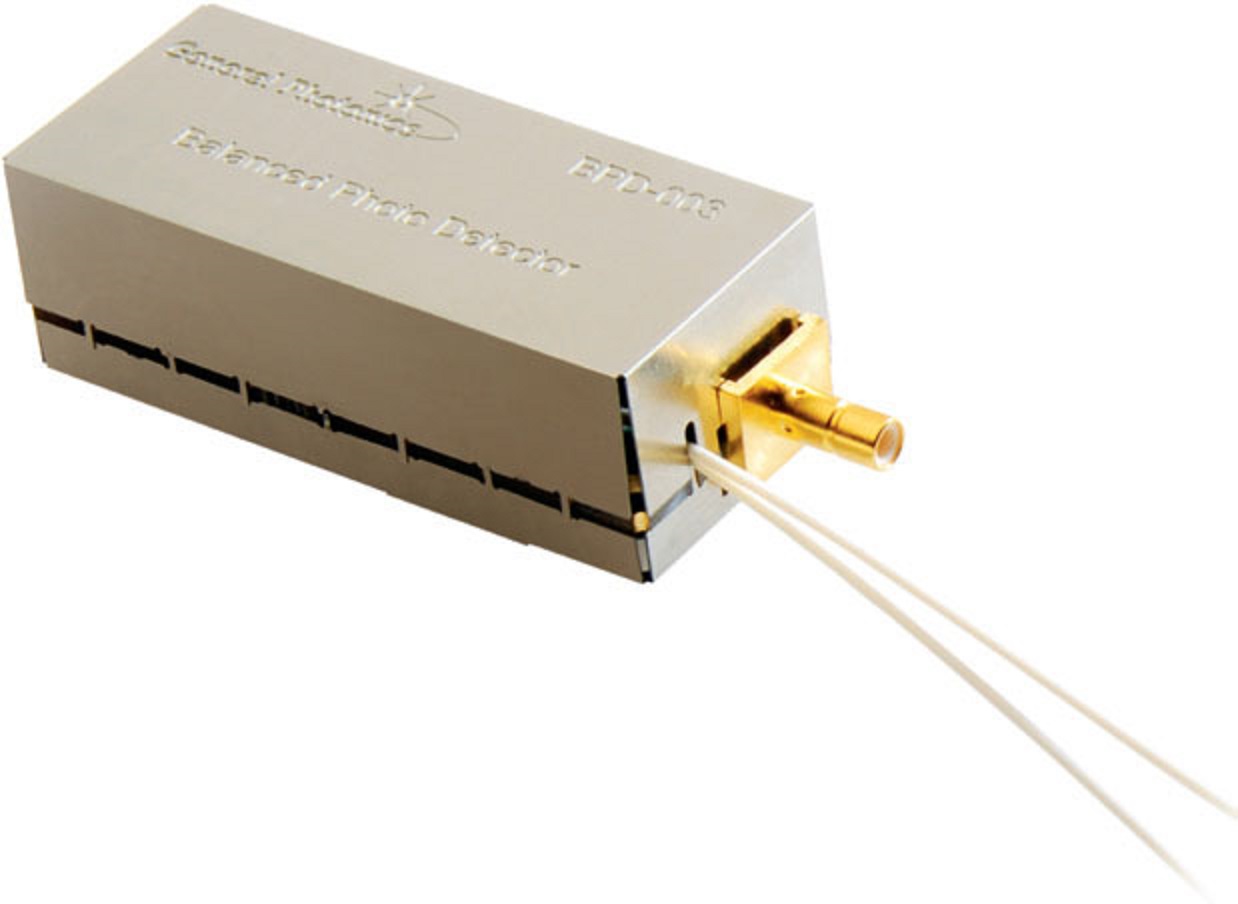
BPD-003 OEM Balanced Photodetector
InGaAs Photodetector; 1060, 1310, 1550 nm; Aluminium Enclosure; Responsivity >0.5->0.8 mA/mW; RF Bandwidth 0-200 MHz; Transimpedance Gain 100×103 V/A OCT and sensor systems require high performance balanced photodetectors to boost system signal-to-noise ratio (SNR). General Photonics’ BPD-003 OEM balanced photodetector module is specially designed for OEM applications in such fields, engineered for low cost and small size as well as high performance. The BPD-003 device consists of an optical head and a post-amplification board with an SMA or SMB RF output connector. The optical head has two input fibers aligned with a pair of matched photodetectors, selected for high CMRR and sensitivity, followed by an integrated low-noise transimpedance amplifier (TIA) placed immediately after the photodetectors to amplify received signals with low noise and enhanced CMRR. The integrated post-amplification circuit further conditions and amplifies the output of the detectors to a range of ± 3.5 V maximum. With a bandwidth of up to 200 MHz and a high conversion gain, the BPD-003 is ideal for integration into OCT, fiber sensor and high-performance optical measurement systems. Key Features: Very Low Noise Excellent Common Mode Rejection Ratio (CMRR): >15 (40 to 200 MHz), >35 dB (DC to 40 MHz) Photodetector Type: InGaAs Photodetector Responsivity: >0.5 to >0.8 mA/mW High Conversion Gain: >50 to >80 x 10³ mV/mW Wide RF Output Bandwidth: DC to 200 MHz Wavelength Range: 1060, 1310 or 1550 nm ±50 nm Polarization Dependent Loss (PDL): <0.2 dB Return Loss (RL): >45 dB Maximum Input Power: 10 mW Transimpedance Gain: 100 x 10³ V/A Fiber Type: SMF-28, HI1060 Compact Size: 49.5 x 21.6 x 16.5 mm Applications: Sensor Systems; Optical Coherence Tomography (OCT) Systems; Optical Measurement Systems; Fiber Sensing Interrogator; Instrumentation; Research and Development
REQUEST PRICING AND AVAILABILITY
- Get your individual quote.
- Technical compatibility review included.
- Volume discounts available.
No obligation. Direct access to our engineering team.

BPX65-100 Fiber Optic Receivers
400 to 1000 nm; Detector Responsivity 0.5 A/W; Amplifier Gain 14 kΩ; Power Supply 5 V; Max. Operating Voltage 6 V; Max. Data Rate 100 Mbps OSI Optoelectronics’ BPX65-100 series of fiber optic receivers contains a BPX-65 ultra-high-speed photodiode coupled to an NE5212 (Signetics) transimpedance amplifier. Standard products include versions with no fiber connector as well as ST (BPX65-100ST) and SMA (BPX65-100SMA) connector versions. Key Features: Bandwidth: 140 MHz Differential Trans-resistance: 14 KΩ Spectral Range: 400 to 1000 nm 2.5 pA/√Hz Transimpedance Amplifier Applications: 100 Mbps Optical Communications; Fiber Patchcord Coupling; Silicon-based Optical Receivers
REQUEST PRICING AND AVAILABILITY
- Get your individual quote.
- Technical compatibility review included.
- Volume discounts available.
No obligation. Direct access to our engineering team.
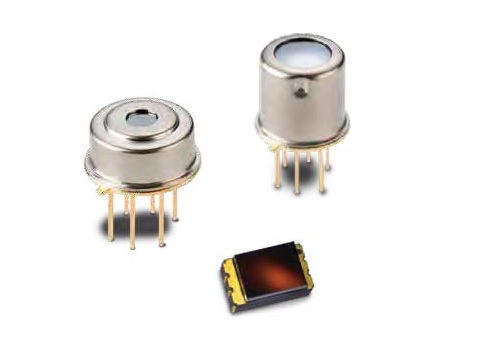
CaliPile™ Thermopile Sensors
FoV 5°, 120°; Sensitivity 41-400 Counts/K; Noise 8 Counts/K; Time Constant 15, 30 ms; Package ISOthermal TO-5, TO-39, Ceramic SMDExcelitas’ CaliPile™ thermopile sensors offer leading-edge, non-contact temperature measurement for applications in smart home, smart appliances, intelligent thermostats and HVAC control systems, and ear and forehead thermometers.Excelitas’ CaliPile™ thermopile sensors represent the latest innovation in thermal IR sensing. The only one of its kind, CaliPile is an intelligent, multifunction thermal infrared sensor series. In addition to traditional non-contact temperature measurement capabilities, CaliPile offers motion detection and presence monitoring across short to medium ranges… all from a single and compact unit.TPMI has become an industry wide established Excelitas functionality. The CaliPile™ series include specially designed electronic circuitry to provide the algorithm and calibration for temperature measurement, digital output and functionality.This thermopile sensor series provides integrated features that enable measurement as well as presence detection applications. The product line of SMD (surface mount device) thermopiles offer significant space efficiency and streamlined integration.Featuring a thermopile sensor chip connected to internal circuitry within TO packaging with integral lens options, the CaliPile™ sensor TPiS 1T 1086 L5.5 is suited for highly effective, extended-range, multi-function sensing. Equipped with a highly sensitive thermopile detector, onboard processing electronics and a focusing lens for a narrow field-of-view, the TPiS 1T 1086 L5.5 sensor represents the TO housing version of the award-winning CaliPile™ IR Sensor Series.The TPiS 1T 1086 L5.5 is calibrated for temperature ranges up to +350 °C in temperature measurement applications. Higher temperature ranges are optionally available. Users may reference the maximum temperature setting as trigger level since the interrupt function will alert users when the level is exceeded.Featuring a thermopile sensor chip connected to internal circuitry and housed in an ultra-compact SMD package, the CaliPile™ SMD sensor TPiS 1S 1385 is suited for highly effective, near-distance sensing (up to 3 m) without supplemental lensing. This sensor represents Excelitas’ smallest and smartest thermal infrared device to date. To enable these individual functions from a single compact sensor, CaliPile's integrated electronics provide digital conversion and further filtering and processing.The TPiS 1S 1385 is the SMD version of the award-winning CaliPile Series providing I2C bus communication and signal output. An additional interrupt can serve as a ‘Yes/No’ output for the motion, presence and temperature applications. If the application is high remote temperature sensing, we recommend the TPiS 1S 0185 with a higher dynamic range.Applications: Remote or Short-range Temperature Measurement; Fast Remote Over-temperature Protection; Near- or Mid-field Human Presence Sensing; Far-field Human Motion Detection; Passive Light-barrier for People Counting; Space-efficient Integration into Smart Home Products; Optimized for Wake-up Battery-operated Thin DevicesPlease note that Excelitas products are available from us only in Denmark, Finland, Iceland, Norway, and Sweden.
REQUEST PRICING AND AVAILABILITY
- Get your individual quote.
- Technical compatibility review included.
- Volume discounts available.
No obligation. Direct access to our engineering team.
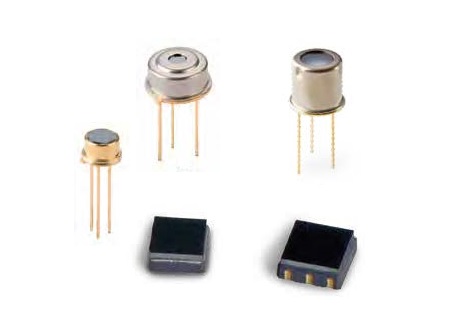
DigiPile Thermopile Sensors
Digital Output; FoV 5°, 84°, 120°; Sensitivity 85-530 Counts/K; Noise 8 Counts/K; Time Constant 15, 45 ms; Package ISOthermal TO-5, TO-46, SMD 3x3, SMD 3.8x3.8Excelitas’ DigiPile® thermopile sensors offer leading-edge, non-contact temperature measurement for applications in smart home, smart appliances, intelligent thermostats and HVAC control systems, and ear and forehead thermometers.TPMI has become an industry wide established Excelitas functionality. The DigiPile series include specially designed electronic circuitry to provide the algorithm and calibration for temperature measurement, digital output and functionality.Excelitas DigiPile was the first digital output thermopile sensor enabling direct connection to your microprocessor and streamlining integration. The DigiPile line of thermal IR detectors are designed specifically for non-contact temperature measurement and are available in traditional TO metal housings as well as in SMD (Surface Mount Device), offering significant space efficiency and streamlined integration.The DigiPile family offers the known high sensitivity together with a 17-bit digital output. Within the bit stream the thermopile signal is followed by another signal given by an internal temperature reference diode. The digital output achieves low interference of electric disturbance to enable optimal performance across many applications and integrations.Excelitas' TPiS 1T 1252B DigiPile sensor features a thermopile sensing chip connected to an internal ADC for amplification and digital conversion. This device engineered into a special TO-46 type housing constriction with Excelitas’ patented ISOthermal design provides improved performance under thermal shock situation.The Excelitas TPiS 1T 1256 L5.5 DigiPile sensor features a thermopile sensing chip connected to an internal ADC for amplification and digital conversion. All included in TO type housing with integral lens.Housed in a compact SMD carrier with optical window, the Excelitas TPiS 1S 1051 / 1252 DigiPile sensor series features thermopile sensing chips connected to an internal ADC to provide amplification and digital conversion. The TPiS 1S 1051 combines the smallest thermopile chip with the smallest housing of any Excelitas thermopile sensor. The TPiS 1S 1252 model delivers higher sensitivity in a modestly larger housing with built-in thermopile chip.Applications: Ear Thermometry; General-purpose Thermometry; Non-contact Temperature MeasurementsPlease note that Excelitas products are available from us only in Denmark, Finland, Iceland, Norway, and Sweden.
REQUEST PRICING AND AVAILABILITY
- Get your individual quote.
- Technical compatibility review included.
- Volume discounts available.
No obligation. Direct access to our engineering team.

EOPC Photodiode Chips
525-1300 nm; Visible, IR; Active Area 0.071-2.32 mm²; Responsivity 0.08-1 A/W; Dark Current 0.005-20 nA A selection of photodiode chips with sensitivities in the visible and infrared spectral range is available for customer-specific designs. Low dark current, reliability and high sensitivity are the advantages of these products. The EOPC series includes GaP, Si, InGaAs and AlGaAs photodiode chips. For more standard applications, EPIGAP Optronic’s photodiode components are also available housed in molded plastic, hermetic TO and SMD packages (EOPD series) with high degradation stability and good matching with LEDS. The supplier’s diversity of chips in terms of wavelength, chip size and polarity allows the selection and adaptation to the specificity of the application. Please contact the AMS Technologies photodiode experts to find the right solution that meets your design project’s requirements. We would like to support you and look forward to your inquiries! Key Features: Product Max. Sensitivity Package Active Area Responsivity Dark Current Downloads EOPC-525-0.86 525 nm 0.57 mm2 0.08 A/W 5 pA Datasheet EOPC-880-0.9-1 880 nm 0.72 mm2 0.25 A/W 1 nA Datasheet EOPC-940-1.5 940 nm 2.32 mm2 0.6 A/W 8 nA Datasheet EOPC-940-0.1 940 nm 0.1 mm2 0.6 A/W 0.05 nA Datasheet EOPC-1300-0.3 1300 nm 0.071 mm2 1 A/W 0.3 nA Datasheet EOPC-1300-1.0 1300 nm 0.785 mm2 0.95 A/W 20 nA Datasheet Applications: Optical Communications; Safety Equipment; Light Barriers; Colorimeters; Currency Authentication; Spectroscopy Equipment; Fluorescence; Optical Power Monitor PD
REQUEST PRICING AND AVAILABILITY
- Get your individual quote.
- Technical compatibility review included.
- Volume discounts available.
No obligation. Direct access to our engineering team.

FCI-GaAs-XXM GaAs Photodiode Arrays
650 to 850 nm; Active Area 0.004 mm2; AA Dia. 0.070 mm, Pitch 0.25 mm; Responsivity 0.63 A/W; Capacitance 0.65 pF; Package Wraparound Ceramic Submount OSI Optoelectronics’ FCI-GaAs-XXM series include 4 and 12 element GaAs PIN photodetector arrays designed for high-speed fiber receiver and monitoring applications. The 70 µm diameter elements are capable of 2.5 Gbps data rates. Anti-reflective (AR) coated and sensitive to telecommunication wavelengths, this array is a perfect receiver for single mode (SM) or multi mode (MM) fiber ribbon with a 250 µm pitch. The FCI-GaAs-XXM comes standard on a wraparound ceramic submount. Board level contacts have a 0.5mm pitch. If you need a custom array or require special testing for your OSI Optoelectronics part, please contact the AMS Technologies applications team. Key Features: High Speed High Responsivity Anti-reflective (AR) Coated Elements Active Area Diameter 70 µm Pitch 250 µm Wraparound Ceramic Submount Spectral Range 650 to 860 nm Applications: Fiber Optic; DWDM Monitors; SM or MM Fiber Ribbons; Parallel Interconnects
REQUEST PRICING AND AVAILABILITY
- Get your individual quote.
- Technical compatibility review included.
- Volume discounts available.
No obligation. Direct access to our engineering team.

FCI-H125/250G-GaAs-100 GaAs Photodiode-Amplifier Hybrids
650 to 850 nm; Active Area 0.008 mm2; AA Dia. 0.1 mm; Responsivity 1,000 to 1,700 V/W; Transimpedance 2,800 Ω; Package TO-46, TO-52 OSI Optoelectronics’ FCI-H125/250G-GaAs-100 series with active area sizes of 100 µm is a compact integration of OSI Optoelectronics’ high-speed GaAs photodetector with a wide dynamic range transimpedance amplifier (TIA). Combining the detector with the TIA in a hermetically sealed 4-pin TO-46 or TO-52 package provides ideal conditions for high-speed signal amplification. Low capacitance, low dark current and high responsivity from 650 to 860 nm make these devices ideal for high bit rate receivers used in LAN, MAN and other high-speed communication systems. TO packages come standard with a lensed cap to enhance coupling efficiency or with a broadband double-sided anti-reflective (AR) coated flat window. The FCI-H125/250G-GaAs-100 series is also offered with FC, SC, ST and SMA receptacles. Key Features: GaAs Photodetector / Low-noise Transimpedance Amplifier Hybrid High Bandwidth Wide Dynamic Range Hermetically Sealed TO-46 or TO-52 Can Single +3.3 to +5 V Power Supply Spectral Range 650 to 850 nm Differential Output Applications: High-speed Optical Communications; Gigabit Ethernet; Fibre Channel; ATM; SONET OC-48 / SDH STM-16
REQUEST PRICING AND AVAILABILITY
- Get your individual quote.
- Technical compatibility review included.
- Volume discounts available.
No obligation. Direct access to our engineering team.

LDPA 0003R PINFET Optical Receiver Module
1310, 1550 nm; Sensitivity -54 dBm Max.; Min. Responsivity 0.9 A/W; Min. Bandwidth 3.0 MHz; Output Impedance 10 Ω OSI LaserDiode’s LDPA 0003R PINFET optical receiver module provides an excellent solution for optical receiver systems that require both high sensitivity and wide dynamic range. Applications include telecommunications line-terminating equipment or repeaters and optical sensor systems where a user adjustable gain may be desirable for optimizing system performance. Key Features: High Sensitivity Wide Dynamic Range User-adjustable Gain 1310 nm, 1550 nm Operation 850 nm Option Available Control Voltage: -4.5 V to 0.0 V Minimum Bandwidth (3 dB): 3.0 MHz Vo Limit: 0.5 Vpp to 1.0 Vpp Minimum Optical Input Overload: -6 dBm Supply Voltage: 5 VDC (4.5 to 5.5 VDC) Minimum Transimpedance: 1,100.0 kΩ Minimum Responsivity (@1550 nm): 0.9 A/W Maximum Optical Sensitivity (@1550 nm): -54 dBm Output Impedance: 10 Ω Typical Load Impedance: 1,000 Ω Typical Hermetic Package – Industry Standard 14-pin DIP Package Custom MIL or IEC Screening RoHS Compliant Operating Temperature: -40 °C to +70 °C Dimensions: 20.8 x 12.7 x 4.7 mm (w/o Fiber Pigtail) Applications: Telecommunications Line-terminating Equipment; Repeaters; Optical Sensor Systems
REQUEST PRICING AND AVAILABILITY
- Get your individual quote.
- Technical compatibility review included.
- Volume discounts available.
No obligation. Direct access to our engineering team.

LDPF/LDPW/LDSF PINFET Optical Receiver Modules
850, 1310, 1550 nm; Data Rate 1-350 Mb/s; Sensitivity -60—32 dBm; Responsivity 0.5-0.95 A/W; Min. Bandwidth 1-250 MHz; Output Impedance 10 Ω With the LDPF/LDPW/LDSF PINFET series, OSI LaserDiode provides an excellent solution for optical receiver systems that require both high sensitivity and wide dynamic range. Applications include telecommunication line-terminating equipment or repeaters and optical sensor systems. The PINFET optical receiver modules’ package offers high reliability which satisfies Telcordia specifications. The term “PINFET” (p-intrinsic-n, field-effect transistor) indicates the integration of a PIN photodiode and a discrete, high-performance transimpedance amplifier stage. Light is coupled into the detector stage through a multi mode (MM) optical fiber pigtail, which allows excellent coupling with either single mode (SM) or multi mode (MM) fiber systems. Key Features: 850 nm, 1310 nm, 1550 nm Operation Custom Bandwidths Available Minimum Bandwidth: 1 MHz to 250 MHz Suggested Data Rate: 1 Mb/s to 350 Mb/s Dark Current @-5 VDC: 0.5 nA Typical, 1 nA Maximum Detector Responsivity: 0.5 A/W (@850 nm, LDSF series), 0.90 A/W (@1300 nm, LDPF/LDPW series), 0.95 A/W (@1550 nm, LDPF/LDPW series) High Sensitivity: -60 dBm to -32 dBm Sensitivity Derating Over Temperature: <1 dB Maximum Optical Input @-5 VDC: Sensitivity Level (dBm) +25 dB (LDSF/LDPF series), -3 dBm to 0 dBm (LPDW series) Maximum Output Signal Level: 2.5 Vpp (LDSF/LDPF series), 0.8 Vpp (LPDW series) Typical High Overload Power Wide Dynamic Range: 25 dB to 57 dB Typical Supply Voltage: 5 VDC (4.5 to 5.5 VDC) Transimpedance: 10 kΩ to 1,120 kΩ Output Impedance: 10 Ω Load Impedance: 1 kΩ Hermetic Package: Industry Standard 14-pin DIP Package GR-468-CORE Telcordia Qualified MIL or IEC Screening Available upon Request Operating Temperature: -40 °C to +70 °C Applications: Line-Terminating Equipment; Repeaters; Optical Sensor Systems
REQUEST PRICING AND AVAILABILITY
- Get your individual quote.
- Technical compatibility review included.
- Volume discounts available.
No obligation. Direct access to our engineering team.

PBPD-001 Polarization Diverse Balanced Photodetector
Polarization Diverse Photodetector; 1310, 1550 nm; Aluminium Enclosure; Signal Conversion Gain >30 V/mW; RF Bandwidth 0-210 MHz; Transimpedance Gain 3x10⁴ V/AOCT and sensor systems require high-performance balanced photodetectors to increase system signal-to-noise ratio (SNR). Polarization-sensitive OCT and similar applications require separate analysis of the two polarization components of a signal.Lunas’ PBPD-001 polarization diverse balanced photodetector module is specially designed for use in such systems and adds polarization sensitivity to the balanced photodetector circuitry of the BPD-002 or BPD-003 balanced photodetector modules.The PBPD-001 polarization diverse balanced photodetector is fully enclosed in a compact, sturdy aluminium box with two optical input ports, a balanced RF output port and two monitor ports for each polarization component and a 12 VDC power supply port.With a bandwidth up to 200 MHz, a transimpedance gain larger than 30K and a saturation power larger than 130 μW, the PBPD-001 polarization diverse balanced photodetector is ideal for integration into laboratory or commercial OCT, fiber sensor, and high performance optical measurement systems with polarization dependent detection requirements.Key Features:Low NoiseHigh Common Mode Rejection Ratio (CMRR): >25 dBHigh Signal Conversion Gain: >30 V/mW (Interference Signal)Wide RF Output Bandwidth (3dB): DC to 210 MHzWavelength Range: 1310 or 1550 nm ±50 nmCompact Size: 100 x 80 27 mmPolarization Crosstalk: <25 dBTransimpedance Gain: 3×10⁴ V/ACW Balanced Saturation Power (At Input): >150 μWCommon Mode Rejection Ratio: >25 dBRF Output Voltage Range (at 50 Ω): ±1.75 VApplications: Polarization Sensitive OCT Systems; Polarization Resolved Sensing; Fiber Optic Distributed Sensing; Instrumentation; Research and Development
REQUEST PRICING AND AVAILABILITY
- Get your individual quote.
- Technical compatibility review included.
- Volume discounts available.
No obligation. Direct access to our engineering team.

PC/PCI HgCdTe (MCT) Photoconductive Detectors
1-15 µm; Active Area 0.000625-16 mm²; Detectivity ≥9.0×10⁶- 4.0×1010 cm·Hz1/2/W; Resistance ≤120-≤1,200 Ω; Package TO39, BNC, TO8, TO 66 Vigo System’s PC/PCI range of photoconductive detectors is based on the photoconductive effect. Infrared radiation generates charge carriers in the semiconductor active region decreasing its resistance. The resistance change is sensed as a current change by applying a constant voltage bias. The PC/PCI series devices are characterized by near linear current-voltage characteristics. The electric field in photoconductors is constant across the device. These components are based on sophisticated HgCdTe heterostructures for the best performance and stability and optimized for the maximum performance at λopt. Vigo System’s PC series features 1 µm to 12 μm HgCdTe uncooled, ambient temperature IR photoconductive detectors. The devices should operate in optimum bias voltage and current readout mode. Performance at low frequencies is reduced due to 1/f noise. The 1/f noise corner frequency increases with the cut-off wavelength. PC series devices are also available thermoelectrically cooled by two-stage (PC-2TE series), three-stage (PC-3TE series) or even four-stage (PC-4TE series) TEC structures, resulting in 1 µm to 14 μm (PC-2TE), 1 µm to 15 μm (PC-3TE) or 1 µm to 16 µm (PC-3TE) HgCdTe photoconductive detectors. These series are protected by a 3° wedged sapphire (wAl2O3, PC-2TE) or zinc selenide anti-reflection coated (wZnSeAR) window, preventing unwanted interference effects. The PCI series is optically immersed in order to further improve the parameters of the devices. This series’ cut-on wavelength is limited by GaAs transmittance (~0.9 μm). Corresponding to the PC series, PCI series components are also available either as 1 µm to 12 μm HgCdTe uncooled, ambient temperature IR photoconductive detectors or as 1 µm to 15 µm (PCI-4TE: 16 µm) HgCdTe photoconductive detectors that are thermoelectrically cooled by two-stage (PCI-2TE series), three-stage (PCI-3TE series) or even four-stage (PCI-4TE series) TEC structures, again with a 3° wedged sapphire (wAl2O3, PC-2TE) or wedged zinc selenide anti-reflection coated (wZnSeAR) window, preventing unwanted interference effects. For its range of PC/PCI HgCdTe (MCT) photoconductive detectors, Vigo System provides a broad range of selected line or configurable line infrared (IR) detection modules that integrate the IR photodetector with the preamplifier and – depending on the module series – also signal processing electronics, optics, heat dissipation systems and other components in a common package. Key Features: High Detectivity Low Speed High Stability and Reliability, Long Lifetime and MTBF 1/f Noise Corner Frequency fc: ≤10 kHz to ≤20 kHz Active Element Material: Epitaxial HgCdTe Heterostructure Optimal Wavelength λopt: 5.0 to 14.0 μm With or Without Immersion Microlens Technology Uncooled, Room Temperature Operation or Thermoelectrically Cooled (2-Stage, 3-Stage or 4-Stage) Detectivity D*: ≥1.9x10⁷ to ≥4.0×1010 cm·Hz1/2/W (λpeak, 20 kHz), ≥9.0×10⁶ to ≥2.0×1010 cm·Hz1/2/W (λopt, 20 kHz) Different Sizes of Active/Optical Area A(O): 25×25 µm² to 4×4 mm² Current Responsivity-Active (Optical) Area Length Product Ri(λopt)·L(O): ≥0.001 to ≥3.0 A·mm/W Time Constant τ: ≤2 ns to ≤20,000 ns Bias Voltage Active Area Length Ration Vb/L: ≤0.15 V/mm to ≤24.5 V/mm Resistance R: ≤120 to ≤1,200 Ω Active Element Temperature Tdet: ~195 to ~230 K (TE-cooled Versions) Different Acceptance Angles Φ: ~36° to ~124° Different Packages: TO39, BNC, TO8, TO 66 Different Infrared Windows: None, wAl2O3, wZnSeAR Wide Range of Dedicated Preamplifiers and Accessories Available Applications: Industrial; Medical; Automotive; Environmental; Laser Power Control and Calibration; Gas Analysis; Mid-IR Spectroscopy; Gas Leak Detection; Air Quality Analysis; Water Quality Control; Engine Emission Monitoring and Control; Fuel Quality Assessment; Analysis of Temperature Distribution; Railway Transport Safety; Plastic Sorting; Security and Defense
REQUEST PRICING AND AVAILABILITY
- Get your individual quote.
- Technical compatibility review included.
- Volume discounts available.
No obligation. Direct access to our engineering team.

PCAS/PVAS InAs/InAsSb Superlattice Detectors
1.6-10.5 µm; Active Area 0.01, 1 mm²; Responsivity 0.04-4.4 A/W; Detectivity 1.2x10⁸-9.0×109 cm·Hz1/2/W; Resistance 28-5,000 Ω; Package TO39, TO8 Vigo System develops and produces a variety of MWIR and LWIR type II superlattice (T2SL) photoconductive (PC, PCAS series) and photovoltaic (PV, PVAS series) IR detectors, operating at room temperature or thermoelectrically cooled. These detectors achieve excellent parameters without cryogenic cooling (LN2). They do not contain mercury or cadmium and are complying with the RoHS Directive. The PCAS series of InAs/InAsSb type II superlattice photoconductive IR detectors contains 2-stage (PCAS-2TE series) or 3-stage (PCAS-3TE series) thermoelectrically (TE) cooled detectors with excellent parameters. Photoconductive detectors should operate in optimum bias voltage and current readout mode. Performance at low frequencies is reduced due to 1/f noise. A 3° wedged zinc selenide anti-reflection (AR) coated window (wZnSeAR) prevents unwanted interference effects. Some models additionally feature anti-reflection (AR) coating applied to the active element. For detection of CW radiation, the use of an optical chopper system is recommended. The PVAS series of InAs/InAsSb type II superlattice photovoltaic IR detectors contains uncooled or 2-stage (PVAS-2TE series) thermoelectrically (TE) cooled detectors with excellent parameters. The PVAS-2TE series features a 3° wedged sapphire window (wAl2O3) preventing unwanted interference effects. Key Features: Active Element Material: Epitaxial InAs or InAsSb Superlattice Hetereostructure Wide Spectral Range: 1.6 µm to 10.5 μm High Responsivity Excellent Linearity Cut-on Wavelength λcut-on (10%): 1.6 to ≤2.0 μm ±0.2 (±0.5) µm Peak Wavelength λpeak: 4.0 to 11.0 μm ±0.3 (±0.5) µm Cut-off Wavelength λcut-off (10%): 5.8 to 15.0 μm ±0.3 µm Detectivity D*: ~1.2x10⁸ to ~9.0×109 cm·Hz1/2/W (λpeak) Current Responsivity Ri(λpeak): ~0.04 to ~4.4 A/W Time Constant τ: ~3 to ~17 ns Resistance R: ~28 Ω to ~5,000 Ω Environmentally Friendly, Complying With the RoHS Directive No Bias Required (PVAS Series) Bias Voltage Vb (PCAS Series): 0.5, 0.6 V Typ. No 1/f Noise (PVAS Series) 1/f Noise Corner Frequency fc (PCAS Series): 20 to 300 kHz Typ. Uncooled, Room Temperature Operation or 2-Stage / 3-Stage Thermoelectrically (TE) Cooled Versions Active Element Temperature Tdet: ~210 ,~230 K (TE-cooled Versions) Size of Active Area A: 0.1×0.1 mm², 1x1 mm² Acceptance Angle Φ: ~70°, ~90° Package: TO39, TO8 Infrared Windows: None, wZnSeAR, wAl2O3 Applications: Industrial; Medical; Automotive; Environmental; Laser Power Control and Calibration; Gas Analysis; Mid-IR Spectroscopy; Gas Leak Detection; Air Quality Analysis; Water Quality Control; Engine Emission Monitoring and Control; Fuel Quality Assessment; Analysis of Temperature Distribution; Railway Transport Safety; Plastic Sorting; Security and Defense
REQUEST PRICING AND AVAILABILITY
- Get your individual quote.
- Technical compatibility review included.
- Volume discounts available.
No obligation. Direct access to our engineering team.

PV/PVI/PVM/PVMI/PEM/PEMI HgCdTe (MCT) Photovoltaic Detectors
2-13 µm; Active Area 0.0025-16 mm²; Responsivity ≥0.1-≥1.5 A/W; Detectivity ≥1.0x10⁷-1.0×1012 cm·Hz1/2/W; Resistance 10-1,500 Ω; Package TO39, BNC, TO8, TO 66, PEM-SMA, PEM-TO8 Vigo System’s range of photovoltaic detectors (photodiodes) is based on semiconductor structures with one (PV/PVI) or multiple (PVM/PVMI) homo- or heterojunctions. Absorbed photons produce charge carriers that are collected at the contacts, resulting in external photocurrent. Photovoltaic detectors have complex current/voltage characteristics. The devices can operate either at flicker-free zero bias or with reverse voltage. Reverse bias voltage is frequently applied to increase responsivity, differential resistance, reduce the shot noise, improve high frequency performance and increase the dynamic range. Vigo System’s PV, PVI, PVM and PVMI series are based on sophisticated HgCdTe heterostructures for the best performance and stability. The devices are optimized for the maximum performance at λopt. The PV series features 2.5 µm to 6.5 μm HgCdTe uncooled, ambient temperature IR photovoltaic detectors. Cut on wavelength can be optimized upon request. Reverse bias may significantly increase response speed and dynamic range. It also results in improved performance at high frequencies, but 1/f noise that appears in biased devices may reduce performance at low frequencies. PV series devices are also available with 2 µm to 12 μm HgCdTe detectors that are thermoelectrically cooled by two-stage (PV-2TE series), three-stage (PV-3TE series) or even four-stage (PV-4TE series) TEC structures. These series are protected by a 3° wedged sapphire (wAl2O3) or zinc selenide anti-reflection coated (wZnSeAR) window, preventing unwanted interference effects. The PVI series is optically immersed in order to further improve the parameters of the devices and also available either as 2.5 µm to 6.5 μm HgCdTe uncooled, ambient temperature IR photovoltaic detectors or as 2 µm to 12 μm HgCdTe detectors that are thermoelectrically cooled by two-stage (PVI-2TE series), three-stage (PVI-3TE series) or even four-stage (PVI-4TE series) TEC structures, again with a 3° wedged sapphire (wAl2O3) or zinc selenide anti-reflection coated (wZnSeAR) window, preventing unwanted interference effects. Vigo System’s PVM series comprises of multiple junction uncooled, ambient temperature photovoltaic detectors, especially useful as large active area detectors operating within the spectral range of 2 µm to 13 μm. PVM series devices are also available as 2 µm to 12 μm HgCdTe two-stage thermoelectrically cooled photovoltaic multiple junction detectors (PVM-2TE series), protected by a 3° wedged zinc selenide anti-reflection coated (wZnSeAR) window, preventing unwanted interference effects. The PVMI series is optically immersed in order to further improve the parameters of the devices. Corresponding to the PVM series, PVMI series components are also available either as 2 µm to 12 μm HgCdTe uncooled, ambient temperature multiple junction IR photovoltaic detectors or as 2 µm to 13 μm HgCdTe multiple junction detectors that are thermoelectrically cooled by two-stage (PVMI-2TE series), three-stage (PVMI-3TE series) or even four-stage (PVMI-4TE series) TEC structures, again with a 3° wedged zinc selenide anti-reflection coated (wZnSeAR) window, preventing unwanted interference effects. Vigo System’s PEM series includes 2 µm to 12 μm HgCdTe uncooled, ambient temperature photovoltaic IR detectors based on the photoelectromagnetic effect in the semiconductor – spatial separation of optically generated electrons and holes in the magnetic field. The PEMI series features the optically immersed versions of these devices. Both series are designed for the maximum performance at 10.6 μm and especially useful as a large active area detectors to detect CW and low frequency modulated radiation. These devices are mounted in specialized packages with an incorporated magnetic circuit inside. 3° wedged zinc selenide anti-reflection coated (wZnSeAR) windows prevent unwanted interference effects and protect against pollution. For its range of PV/PVI/PVM/PVMI/PEM/PEMI HgCdTe (MCT) photovoltaic detectors, Vigo System provides a broad range of selected line or configurable line infrared (IR) detection modules that integrate the IR photodetector with the preamplifier and – depending on the module series – also signal processing electronics, optics, heat dissipation systems and other components in a common package. Key Features: High Performance, Reliability and Repeatability in Mass Production Cost-effective Solutions Fast Delivery Active Element Material: Epitaxial HgCdTe Heterostructure Optimal Wavelength λopt: 3.0 to 10.6 μm With or Without Immersion Microlens Technology Uncooled, Room Temperature Operation or Thermoelectrically Cooled (2-Stage, 3-Stage or 4-Stage) Detectivity D*: ≥2.0x10⁷ to ≥1.0×1012 cm·Hz1/2/W (λpeak, 20 kHz), ≥1.0×10⁷ to ≥8.0×1011 cm·Hz1/2/W (λopt, 20 kHz) Different Sizes of Active/Optical Area A(O): 0.05×0.05 mm² to 4×4 mm² Current Responsivity Ri(λopt): ≥0.1 to ≥1.5 A/W Current Responsivity-Active (Optical) Area Length Product Ri(λopt)·L(O) (PVM, PVMI (Non-TE), PEM, PEMI Series): ≥0.002 to ≥0.04 A·mm/W Resistance R (PVM, PVMI, PEM, PEMI Series): 20 to 1,500 Ω Resistance-Active (Optical) Area Product (RxA(O)): ≥0.0001 to ≥30,000 Ω·cm2 Short Time Constant τ: ≤1.5 ns (PVM, PVMI), ≤1.2 ns (PEM, PEMI) to ≤350 ns No Bias Required PV, PVI Series Bandwidth: Tens of MHz Without Reverse Bias, ≥1GHz With Reverse Bias No 1/f Noise Active Element Temperature Tdet: ~195 to ~230 K (TE-cooled Versions) Different Acceptance Angles Φ: ~36° to ~124° Different Packages: TO39, BNC, TO8, TO 66, PEM-SMA, PEM-TO8 Different Infrared Windows: None, wAl2O3, wZnSeAR Wide Range of Dedicated Preamplifiers and Accessories Available Applications: Industrial; Medical; Automotive; Environmental; Laser Power Control and Calibration; Gas Analysis; Mid-IR Spectroscopy; Gas Leak Detection; Air Quality Analysis; Water Quality Control; Engine Emission Monitoring and Control; Fuel Quality Assessment; Analysis of Temperature Distribution; Railway Transport Safety; Plastic Sorting; Security and Defense
REQUEST PRICING AND AVAILABILITY
- Get your individual quote.
- Technical compatibility review included.
- Volume discounts available.
No obligation. Direct access to our engineering team.

PVA/PVIA InAs/InAsSb Photovoltaic Detectors
2-5.5 µm; Active Area 0.01, 1 mm²; Responsivity ≥1.3-≥1.5 A/W; Detectivity ≥5.0x10⁸-5.0×1011 cm·Hz1/2/W; Resistance ≥70 Ω-≥200 kΩ; Package TO39, TO8 Vigo System’s PVA and PVIA series feature photovoltaic detectors (photodiodes) in which the semiconductor layer is made of InAs or InAsSb materials. Absorbed photons produce charge carriers that are collected within the diodes. Photovoltaic detectors have complex current/voltage characteristics. The devices can operate either at flicker-free zero bias or with reverse voltage. PVA/PVIA series detectors are cadmium and mercury free. As a result, the detectors comply with the RoHS directive and can be used in the consumer market. Vigo System’s PVA series features 2.0 µm to 5.5 μm ambient temperature, uncooled IR photovoltaic detectors based on InAs1-xSbx alloys (epitaxial InAs or InAsSb hetereostructure). The devices are temperature stable up to +300 °C and mechanically durable. PVA series devices are also available thermoelectrically cooled by two-stage TEC structures (PVA-2TE series) with a 3° wedged sapphire (wAl2O3) window preventing unwanted interference effects. The PVIA series of 2.0 µm to 5.5 μm InAs/InAsSb IR photovoltaic detectors is optically immersed in order to further improve the parameters of the devices and also available either as uncooled, ambient temperature detectors or as two-stage thermoelectrically cooled (PVIA-2TE series) variants, again with a 3° wedged sapphire (wAl2O3) window that prevents unwanted interference effects. For its range of PVA/PVIA InAs/InAsSb photovoltaic detectors, Vigo System provides a broad range of configurable line infrared (IR) detection modules that integrate the IR photodetector with the preamplifier and – depending on the module series – also signal processing electronics, optics, heat dissipation systems and other components in a common package. Key Features: Active Element Material: Epitaxial InAs or InAsSb Hetereostructure Mechanically Durable Spectral Range: 2 µm to 5.5 μm Cut-on Wavelength λcut-on (10%): 2.1 to 2.4 μm ±0.2 µm Peak Wavelength λpeak: 2.9 to 4.7 μm ±0.3 µm Cut-off Wavelength λcut-off (10%): 3.4 to 5.5 μm ±0.2 µm Detectivity D*: ≥5.0x10⁸ to ≥5.0×1011 cm·Hz1/2/W (λpeak) Current Responsivity Ri(λpeak): ≥1.3 to ≥1.5 A/W Temperature Stable up to +300 °C Uncooled, Room Temperature Operation or 2-Stage Thermoelectrically (TE) Cooled Versions Active Element Temperature Tdet: ~230 K (TE-cooled Versions) Complying With the RoHS Directive Size of Active Area A: 0.1×0.1 mm², 1x1 mm² Resistance R (PVM, PVMI, PEM, PEMI Series): ≥70 Ω to ≥200 kΩ Time Constant τ: ≤5 to ≤60 ns No Bias Required No 1/f Noise Sensitive to IR Radiation Polarisation Immersion Microlens Technology Available (PVIA Series) Acceptance Angle Φ: ~36°, ~70°, ~90° Package: TO39, TO8 Infrared Windows: None, wAl2O3 Wide Range of Dedicated Preamplifiers and Accessories Available Applications: Industrial; Medical; Automotive; Environmental; Laser Power Control and Calibration; Gas Analysis; Mid-IR Spectroscopy; Gas Leak Detection; Air Quality Analysis; Water Quality Control; Engine Emission Monitoring and Control; Fuel Quality Assessment; Analysis of Temperature Distribution; Railway Transport Safety; Plastic Sorting; Security and Defense
REQUEST PRICING AND AVAILABILITY
- Get your individual quote.
- Technical compatibility review included.
- Volume discounts available.
No obligation. Direct access to our engineering team.
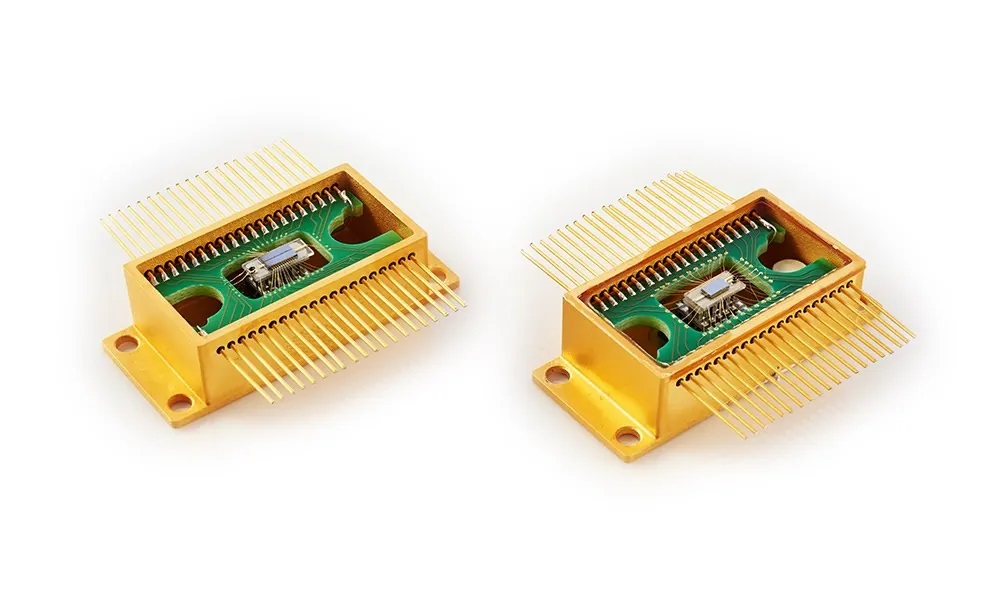
PVMQ/PCQ HgCdTe (MCT) Infrared Detector Arrays
2-12 µm; Active Area 1 mm²; Responsivity ≥0.002 A/W; Detectivity ≥9.0×10⁶-≥2.0×107 cm·Hz1/2/W; Resistance 30-≤240 Ω; Package TO8 Vigo System’s PVMQ and PCQ series comprise of HgCdTe (MCT) infrared (IR) detectors whose active surface consists of more than two elements. The offer includes quadrant geometry detectors based on photodiodes and photoconductors, ideally suited for defense and security applications as well as XY or differential measurements. PVMQ and PCQ are 2 µm to 11 μm uncooled, ambient temperature IR detectors, based on sophisticated HgCdTe heterostructures for the best performance and stability. These quadrant detectors consist of four separate active elements arranged in a quadrant geometry and optimized for maximum performance at 10.6 μm. The main application of PVMQ/PCQ detectors is laser beam profiling and positioning. PVMQ is a photovoltaic multiple junction quadrant IR detector, while PCQ is a photoconductive quadrant IR detector. The PCQ detector should operate in optimum bias voltage and current readout mode, and its performance at low frequencies is reduced due to 1/f noise. Key Features: Active Element Material: Epitaxial HgCdTe Heterostructure Wide Spectral Range: 2 to 12 μm Optimal Wavelength λopt: 10.6 μm Active Area: up to 4×4 mm2 No Bias Required (PVMQ) No 1/f Noise (PVMQ) Long Lifetime and MTBF (PCQ) Stability and Reliability Short Time Constant τ: ≤1.5 ns (PVMQ), ≤5 ns (PCQ) Operation From DC to High Frequency (PVMQ) Sensitive to IR Radiation Polarisation (PVMQ) Uncooled, Room Temperature Operation Detectivity D*: ≥1.9x10⁷, ≥2.0x107 cm·Hz1/2/W (λpeak, 20 kHz), ≥9.0×10⁶, ≥1.0×107 cm·Hz1/2/W (λopt, 20 kHz) Active Area A of Single Element: 1×1 mm² Distance between Elements: 20 µm, 200 µm Current Responsivity Ri(λopt): ≥0.002 A/W (PVMQ) Current Responsivity-Active Area Length Product Ri(λopt)·L: ≥0.001 A·mm/W (PCQ) Resistance R: 30 to ≤240 Ω Acceptance Angle Φ: ~70° Package: TO8 Window: None Applications: Laser Beam Profiling and Positioning; Defense & Security; XY or Differential Measurements; Industrial; Medical; Automotive; Environmental; Laser Power Control and Calibration; Gas Analysis; Mid-IR Spectroscopy; Gas Leak Detection; Air Quality Analysis; Water Quality Control; Engine Emission Monitoring and Control; Fuel Quality Assessment; Analysis of Temperature Distribution; Railway Transport Safety; Plastic Sorting
REQUEST PRICING AND AVAILABILITY
- Get your individual quote.
- Technical compatibility review included.
- Volume discounts available.
No obligation. Direct access to our engineering team.
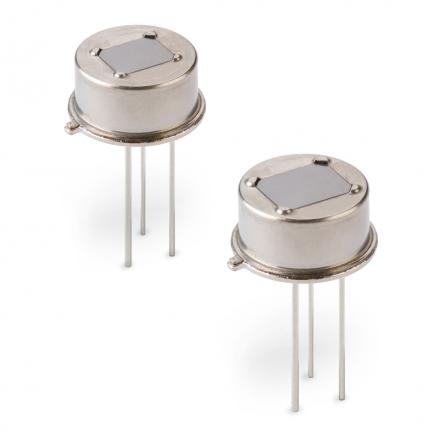
PYD DigiPyro Series Dual-element Pyrodetectors PIR
Digital Output; Responsivity 3.7, 4.0 kV/W Typ.; Max. Match 10%; Max. Noise 78, 90 µVpp; FoV Horizontal 100°-130°; FoV Vertical 90°-147°; ADC Resolution 14 bit; ADC Sensitivity 6.5 µV/Count; Operating Voltage 1.8-3.6 VDCExcelitas PYD Series of dual-element pyrodetectors (PIR) are well established as the performance standard in motion detection – now also available as “DigiPyro” variants, featuring internal integrated circuitry to convert the element signals into a 14-bit digital output.Excelitas’ design comprises two sensing elements connected to each other in reverse polarity to provide a signal with motion and common mode rejection for non-moving radiation. Users can specify various window sizes to meet desired fields-of-view. PYD DigiPyro dual-element pyrodetectors cover the advanced family of DigiPyros, including Excelitas’ low-power DigiPyros for battery-operated motion detection.Excelitas’ newly improved PYD 1788 and PYD 1798 dual-element DigiPyros are now re-engineered for improved energy efficiency of a mere 1.8 V at 5 µA power requirement, making them ideal motion detection sensors for extended service life in mobile and remote battery-operated devices. Both dual-element pyrodetectors feature two elements in series connection in TO-5 metal housing with optical window options.The PYD 1788 has the standard size window for economy and mid-range sensing, while PYD 1798 has an enlarged window enabling broader fields-of-view. The element configurations are identical, along with the internal electronic circuits. Both the PYD 1788 and PYD 1798 models include a built-in temperature diode which provides output related to the pyro’s internal temperature. This makes the output signal into a 14 +14 bit signal, communicated in one digital bit stream of 2x14-bit output via a single wire “Direct Link” connection to a suitable host microprocessor.The PYD 1794 dual-element Digipyro PIR pyrodetector is the low-profile version of the DigiPyro family and features two elements in series connection in a low-profile TO-39 metal housing with optical window. An internal diode provides output related to the pyro’s internal temperature. This makes the output signal into a 14 +14 bit signal.As the latest addition to Excelitas’ DigiPyro detector offering, the PYD 2792 dual-element PIR pyrodetector features two standard elements in parallel connection designed into a compact SMD (surface mount) housing with optical window. This design streamlines integration to the host system with significantly reduced form factor. An internal integrated circuitry converts the element signals into a 14 bit digital data output which can be viewed through the digital interface. And an internal diode provides output related to the pyro’s internal temperature. This makes the output signal into a 14 +14 bit signal.The PYD 2592 is the low-power version of PYD 2792, with dual-element pyrodetectors in a compact SMD housing. The sensor includes a fully configurable motion detection unit with an interrupt feature to wake up a sleeping host system. This allows for lowest power consumptions and is therefore ideally suitable for battery operation in compact and mobile applications.An internal diode provides output related to the pyro’s internal temperature. This makes the output signal into a 14 +14 bit signal. With its reduced voltage requirements, this device is well suited for battery operation in compact and mobile applications.With a mere 1.8 V power supply voltage and significantly reduced supply current, Excelitas’ PYD 1588 and PYD 1598 are the first real low-power enhanced DigiPyro Pyrosensors. Both are fully integrated, dual-element detectors with two different window size options, offering added features and low-current power consumption for extended remote motion detection in battery operated devices.The power requirements of the system level can be further reduced with the wake-up/sleep feature of this detector series, which also promotes power efficiency and extends service life. PYD 1588 and PYD 1598 low-power DigiPyro pyrodetectors are ideal for prolonged battery-operated motion detection. A selectable band-pass function and pulse count option further compliment the full functionality of these devices.With a diameter of 4.7 mm, the PYD 5731 miniature, dual-element DigiPyro® pyrosensor is one of the smallest designs in the Excelitas pyrodetector portfolio. The PYD 5731 features two miniaturized elements in series connection in TO-46 metal case (4.7 mm dia. X 3.3 mm height) with optical window.The PYD 5731 offers the same Direct Link interface as the regular PYD 1798 DigPyro. The miniature housing, in conjunction with a reduced element size and spacing, enables customers to reduce the size of their optics and innovate more compact product designs.The PYD 2597 Ultra-Low Power DigiPyro sensor extends the DigiPyro Series with one of the lowest power PIR detectors currently available, optimized for battery-operated and remote motion detection systems. It operates at supply voltages as low as 1.4 V and consumes only about 2 µA at 1.8 V, enabling significantly extended service life in energy-constrained designs. The device integrates two fully RoHS-compliant pyroelectric elements with on-chip digitization and a configurable Motion Detection Unit that issues an interrupt on motion detection, allowing the host system to remain in deep sleep until needed. Its single-wire digital interface simplifies host integration while a 130° field-of-view and robust EMI immunity support reliable performance in electrically noisy environments. The PYD 2597 is particularly suited for long-range motion sensing, intrusion alarms, energy-saving controls, horizontal mounting applications and other battery-powered PIR use cases where ultra-low power consumption and compact integration are priorities.Applications: Long-distance Motion Detection (With Lens); Energy Saving Applications; Intrusion Alarms; Horizontal Mounting Applications; Battery OperationPlease note that Excelitas products are available from us only in Denmark, Finland, Iceland, Norway, and Sweden.
REQUEST PRICING AND AVAILABILITY
- Get your individual quote.
- Technical compatibility review included.
- Volume discounts available.
No obligation. Direct access to our engineering team.
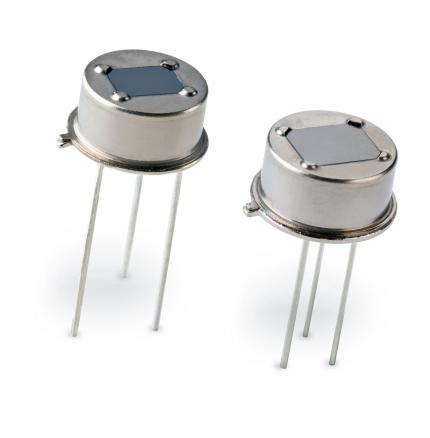
PYD Series Dual-element Pyrodetectors PIR
Analog Output; Responsivity 4.2 kV/W Typ.; Max. Match 10%; Max. Noise 50 µVpp; FoV Horizontal 71°-110°; FoV Vertical 71°-110°; Operating Voltage 2.0-10 VDCExcelitas PYD Series of dual-element pyrodetectors are well established as the performance standard in motion detection.This series’ design features two sensing elements connected to each other in reverse polarity (opposed series connection) with a FET in-source follower circuit to provide an AC-signal with motion and common mode rejection for non-moving radiation. Users can specify various window sizes to meet desired fields-of-view.Integrated into a TO-5 metal housing with a small optical window, the Excelitas PYD 1378 dual-element pyrodetector (replacement to the LHi 778) delivers exceptional economy and value for high-volume motion detection applications without sacrificing performance.PYD 1388 (replacement to LHi 878) and PYD 1398 (replacement to LHi 968) dual-element pyrodetectors represent Excelitas’ standard analog pyrodetector offering. They are integrated into a robust TO-5 metal housing with an optical window. The PYD 1388 is the base model, while the PYD 1398 is equipped with additional features such as a larger window to reduce white light sensitivity and a gate resistor for better low-temperature performance.Both sensors are available in two EMI versions. The standard version features one RC-filter at drain and source pin. For applications in heavy EMI conditions (5G and antennas close to the sensor), a version with an additional RC-filtering stage is available to further reduce interference effects of electromagnetic disturbances.PYD 1384 (replacement to LHi 874) and PYD 1394 (replacement to LHi 944) dual-element pyrodetectors are the low-profile variants of the PYD 1388/1398 standard analog PIRs in a low-profile TO-39 metal housing with optical window. The PYD 1384 is the standard base model of the low-profile series, while the PYD 1394 is equipped with a larger window that provides a wider field-of-view.An additional drain resistor and output capacitor further reduce interference effects of electromagnetic disturbances for EMI sensitive applications. Ideally suited for motion detection, the low-profile design permits two pyros to be space-efficiently integrated together to enable a 180° field-of-view.Applications: Optimal for Cost-effective Designs; Long-distance Human Motion Detection (With Lens); Energy-saving Applications; Intrusion Alarms; Horizontal Mounting ApplicationsPlease note that Excelitas products are available from us only in Denmark, Finland, Iceland, Norway, and Sweden.
REQUEST PRICING AND AVAILABILITY
- Get your individual quote.
- Technical compatibility review included.
- Volume discounts available.
No obligation. Direct access to our engineering team.
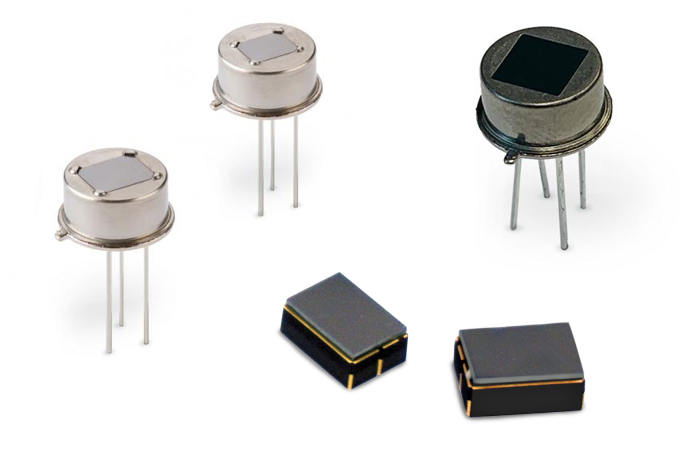
PYD/PYQ Low-power DigiPyro Series Dual- & Four-element Pyrodetectors PIR
Digital Output; Operating Voltage 1.8-3.6 VDC; Operating Current 3 µA @1.8 V; Responsivity 3.7-6.5 kV/W Typ.; Max. Match 10%; Max. Noise 78.140 µVpp; FoV Horizontal 115°-147°; FoV Vertical 107°-130°; ADC Resolution 14, 15 bit; ADC Sensitivity 6.5 µV/CountExcelitas’ PYD and PYQ DigiPyro Series of dual- and four-element pyrodetectors (PIR), that are well established as the performance standard in motion detection, are now also available as low-power “DigiPyro” variants – featuring internal integrated circuitry to convert the element signals into a 14-bit digital output as well as an extremely low power consumption for battery-operated motion detection.With a mere 1.8 V power supply voltage and significantly reduced typical supply current of only 3 µA, PYD DigiPyro Series dual-element pyrodetectors are suitable for wall-mounted applications, while PYQ DigiPyro Series four-element PIRs are perfect for mounting at ceilings. The power requirements of the system level can be further reduced with the wake-up/sleep feature of this detector series, which also promotes power efficiency and extends service life. A selectable band-pass function and a pulse count option further compliment the full functionality of these devices.The PYD 2592 dual-element low-power DigiPyro PIR pyrodetector features two standard elements in parallel connection designed into a compact SMD (surface mount) housing with optical window. This design streamlines integration to the host system with significantly reduced form factor. The sensor includes a fully configurable motion detection unit with an interrupt feature to wake up a sleeping host system. This allows for lowest power consumptions and is therefore ideally suitable for battery operation in compact and mobile applications.An internal integrated circuitry converts the element signals into a 14 bit digital data output which can be viewed through the digital interface. And an internal diode provides output related to the pyro’s internal temperature. This makes the output signal into a 14 +14 bit signal.Excelitas’ PYD 1588 and PYD 1598 in TO-5 metal housing for high EMI immunity are real low-power enhanced DigiPyro pyrosensors. Both are fully integrated, dual-element detectors with two different window size options, offering added features and low-current power consumption for extended remote motion detection in battery operated devices.The latest version of Excelitas’ PYQ Series of four-element pyrodetectors, the PYQ 1548 low-power DigiPyro pyrodetector PIR, includes the enhanced functionality as known of the dual-element versions PYD 1588 and PYD 1598, so offering a quad-element DigiPyro with sleep mode, sensitivity adjust, bandwidth selection and window time. Most of the applications for such detectors are ceiling-mount sensing devices. PYQ 1548 PIRs are also available with smaller elements of 0.8 mm x 0.8 mm - suitable for compact lenses and short detection distances.The PYQ 1548 four-element DigiPyro pyrodetector configures all four PIR elements combined to one digital output with exceptional energy-efficiency. The user selects and sets individual functions. A single-wire connection with separate input pin allows setting of sensitivity, bandpass selection, pulse count and wake up. This provides full functionality of a complete PIR sensing device when all following circuitry is in sleep mode. Part Number PYD 2592 PYD 1588 PYD 1598 PYQ 1548 PYQ 1548 Small Responsivity, min. 3.0 kV/W 3.3 kV/W 3.3 kV/W 5.4 kV/W 8.4 kV/W Responsivity, typ. 3.7 kV/W 4.0 kV/W 4.0 kV/W 6.5 kV/W 10.2 kV/W Match, max. 10 % Noise, max. 90 µVpp 78 µVpp 78 µVpp 160 µVpp 200 µVpp Noise, typ. 30 µVpp 20 µVpp 20 µVpp 40 µVpp 60 µVpp Operating Voltage 1.8 - 3.6 V Supply Current, max. 3.5 µA Supply Current, typ. 3 µA FoV, Horizontal 147° 115° 130° 119° 140° FoV, Vertical 130° 107° 130° 119° 140° Filter Size 5.5 / 3.7 mm 4.6 / 3.4 mm 5.2 / 4.2 mm 4.9 / 4.9 mm ADC Resolution 14 bit 15 bit ADC Sensitivity 6.5 µV/count ADC Offset 8,000 bitcount Download Datasheet Datasheet PYD 2592 Datasheet PYD 158 Datasheet PYD 1598 Datasheet PYQ 15 Datasheet PYQ 1548 Smal Applications: Ceiling- (Horizontal) and Wall-mount (Vertical) Sensing Applications; Long- and Mid-distance Motion Detection (With Lens); Energy Saving Applications (Light Management/Smart Home); Intrusion Alarms; Improved Pet Immunity Solutions (With Proper Lens); Battery OperationPlease note that Excelitas products are available from us only in Denmark, Finland, Iceland, Norway, and Sweden.
REQUEST PRICING AND AVAILABILITY
- Get your individual quote.
- Technical compatibility review included.
- Volume discounts available.
No obligation. Direct access to our engineering team.
PYQ Series Four-element Pyrodetectors PIR
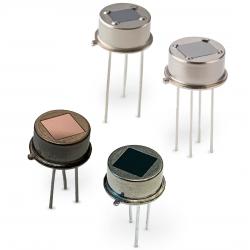
Analog or Digital Output; Responsivity 4.5-8 kV/W Typ.; Max. Match 10%, 15%; Max. Noise 75-140 µVpp; FoV Horizontal 95°-148°; FoV Vertical 87°-124°; ADC Resolution 14, 15 bit; ADC Sensitivity 6.5 µV/Count; Operating Voltage 1.8-10 VDCExcelitas’ PYQ Series of four-element pyrodetectors provides quad PIR designs in single- and dual-channel outputs, with analog outputs or with the enhanced function and streamlined integration of Excelitas’ DigiPyro product line with digital output.Pyrodetectors having four sensing elements may be configured in various geometrical forms. The most prominent design today is referenced as “quad”, which is two pairs of elements in a square form layout. With the spacing and polarity of the elements, different variations are available. Most of the applications for such detectors are ceiling-mount sensing devices.Latest versions of PYQ Series quad pyros include the enhanced functionality as known of the dual-element, low-power DigiPyro PIRs PYD 1588 and PYD 1598 , so offering a dual-channel quad DigiPyro with sleep mode, sensitivity adjust, bandwidth selection and window time.PYQ 1398, PYQ 1348 Single-Output Quad PyrosExcelitas' PYQ 1348 and PYQ 1398 single-output quad pyrodetectors provide four sensing elements in a geometric square placement. Electrically, all PIR elements are electrically connected in series to one FET in source follower connection, forming one common analog output signal.The two versions vary from each other by different window size (rectangular window or square window size) and element spacings. Different geometrical placements are available on request. When being applied with suitable lens or mirror optics, these detectors are used in ceiling mount devices.The Excelitas PYQ 2498 dual-output quad pyrodetector provides four elements separated into two pairs of two elements in a geometric square placement. Two PIR elements per pair are electrically connected in series to one FET in source follower connection forming one individual analog output signal for each pair. The TO-5 housing includes an optical window in rectangular shape. Geometrically the two pairs have a narrow spacing. For better EMI protection, the detector includes an internal RC circuit.The PYQ 1548 low-power quad-element DigiPyro pyrodetector configures all four PIR elements combined to one digital output with exceptional energy-efficiency. The user selects and sets individual functions. A single-wire connection with separate input pin allows setting of sensitivity, bandpass selection, pulse count and wake up. This provides full functionality of a complete PIR sensing device when all following circuitry is in sleep mode. PYQ 1548 PIRs are also available with smaller elements of 0.8 mm x 0.8 mm - suitable for compact lenses and short detection distances. The PYQ 1748 quad-element DigiPyro pyrodetector provides economical quad configuration with all four elements combined to one common output. This enables ceiling-mount applications when applied with suitable lens optics. TO-5 housing is provided with rectangular window to accommodate wider field-of-view. Standard geometrical element layout offers equal distance and spacing with cross polarity.PYQ 2898 and PYQ 5848 quad-element DigiPyro pyrodetectors are distinguished by two pairs of PIR sensing elements with digitized signals for each pair. Together with the signal of an internal reference diode, the output via digital link forms a 3x14 bit stream. As to the spacing of the sensing elements, various designs are available. The TO-5 housing is provided with suitable window size to accommodate the field-of-view of the element configuration.Applications: Ceiling- and Wall-mount Sensing Applications; Long- and Mid-distance Motion Detection (With Lens); Energy Saving Applications (Light Management/Smart Home); Intrusion Alarms; Improved Pet Immunity Solutions (With Proper Lens)Please note that Excelitas products are available from us only in Denmark, Finland, Iceland, Norway, and Sweden.
REQUEST PRICING AND AVAILABILITY
- Get your individual quote.
- Technical compatibility review included.
- Volume discounts available.
No obligation. Direct access to our engineering team.
PYS Series Single-element Pyrodetectors PIR
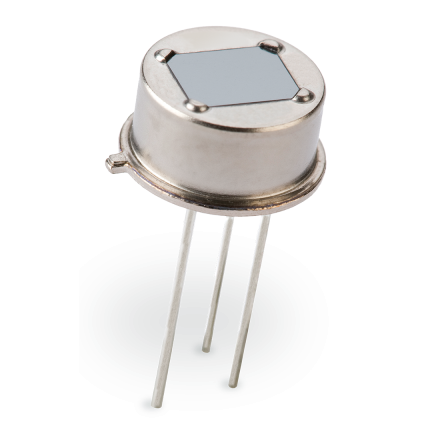
Responsivity 3.5 kV/W Typ.; Max. Noise 50 µVpp; Spec. Detectivity 17 x 107cm*√Hz/W; FoV (Horizontal/Vertical) 77°/77°, 135°/120°; Operating Voltage 2-10 VDCSingle-element pyroelectric detectors (PIR) are often applied for temperature and gas measuring applications in one-channel or dual-channel variants, which is then one output per element. Excelitas offers its PYS Series of single-element pyrodetectors as thermally compensated devices.The principle of gas monitor application is called NDIR. NDIR requires detectors with narrow-band optical filters. Excelitas provides a range of suited filter windows for those gases which show an absorption band in the IR spectral range.Excelitas’ PYS 3198 TC GX (replacement to LHi 807) is a single-channel, parallel format temperature-compensated elements PIR detector based on lithium-tantalate (Li-Ta). In the design for PYS 3198 TC, a single sensing element is placed in the center of the detector. For thermal compensation an additional element, (which is blinded from radiation), is connected in parallel.The TO-5 metal housing is equipped with an optical filter window. For gas measurement applications with Excelitas’ single-element pyrodetectors, typically the spectral range is narrowed to match the gas absorption in the IR range. As such the window is acting as a narrow-band optical filter.Almost like two detectors in one housing, the PYS 3428 (replacement to LHi 814) dual-channel, single-element pyrodetector includes two single-elements which are each thermally compensated by an additional blinded element sitting aside. Each output is optically linked to an individual optical window within the TO-5 metal housing. For each window, a variety of narrow-band optical filters are available to meet a range of specific sensing requirements.Each element has its own individual output signals, thus the name dual-channel. Since the PYS 3428 Pyrodetector has been specifically designed for gas measuring applications, it comes with narrow-band optical filter windows. Typically, one window is used as reference, for which Excelitas provides the filter version G20 as the reference window.The PYS 3928 TC digital dual-channel pyrodetector includes two single elements, both thermally compensated by an additional blinded element sitting aside. Each element is digitized and available as a 2x16-bit output at the digital link pin. Each element is optically linked to an individual optical window within the TO-5 metal housing. For each window, a selection of narrow-band optical filters is available to meet your specific detection requirements.As part of Excelitas’ DigiPyro series, this design offers the output of both sensing elements as a 2x16-bitstream of the direct link. With this 16-bit resolution, smaller noise values are given per digit. Since the PYS 3928 TC DigiPyro PIR has been designed especially for gas measuring applications, it comes with narrow-band optical filter windows. Typically, one window is used as reference, for which Excelitas provides the filter version G20. For the second window, various suited narrow-band filter windows are available.Applications: Non-dispersive Infrared (NDIR) Gas Sensing; CO2 Channel; CO2 vs. Reference ChannelPlease note that Excelitas products are available from us only in Denmark, Finland, Iceland, Norway, and Sweden.
REQUEST PRICING AND AVAILABILITY
- Get your individual quote.
- Technical compatibility review included.
- Volume discounts available.
No obligation. Direct access to our engineering team.

SMARTSens-D Digital UVC Irradiance Sensors
254, 265, 275 nm; Irradiance 20-20000 µW/cm²; Resolution 0.3 µW/cm²; SNR 104; Interface USB 2.0 Type C; Power Supply 5 VDC, 100 mALabsphere’s calibrated SMARTSens-D digital UVC irradiance sensors enable real-time UVC dose monitoring for the validation of UVC surface disinfection. Easily access dosage information on demand using Labsphere’s SMARTSens-D software platform, or integrate the digital sensors as a component in your UVGI system software using the provided firmware and APIs as the basis for developing a dashboard for multiple devices and installs.Each sensor is available for either UVC or far UVC measurements and delivers unparalleled application flexibility and measurement accuracy with irradiance responsivity calibration options for Hg sources (for disinfection at 254 nm) and LED sources, including 265 nm and 275 nm LEDs.Labsphere’s SMARTSens-D digital UVC irradiance sensors are available with one to four SSD-UVC/UVCF-2M sensors per UVC-HESC-001/002 controller. Choose the number of sensors that best monitors the UVC dose in your UVGI system design.Labsphere’s SMARTSens-D integrated digital UVC sensors UVC-HISC-001/002 feature the controller integrated into the sensor package for simplified dose monitoring and are available as single sensors that can be used to monitor UVC irradiance and dose. Multiple sensors can be networked and monitored from a central location.Not sure where to place your sensors or how many sensors you need? AMS Technologies and Labsphere have you covered with the supplier’s comprehensive radiometric modeling service. For SMARTSens products, Labsphere offers modeling of an enclosed volume such as UV-C disinfection cabinet or enclosure, as well as modeled simulations of illumination in the enclosed environment under varying lighting conditions and geometric scenarios. As a result, we can assist in determining the best locations for integrating SMARTSens UVC irradiance and dose-meter sensors to validate disinfection cabinet performance, hotspots, cold spots, and optical radiation distribution and uniformity.The modeling package includes:A Zemax model and optical radiation distribution in the chamber for up to three different lighting scenarios.Correlation between irradiance at up to five specific locations within the chamber to sensors mounted on the wall of the chamberA complete report that includes all analysis, summaries, and recommendationsKey Features:Real-time Dose Monitoring for Disinfection Confidence and Exposure SafetyInstantaneous System Performance Feedback Enables Immediate Troubleshooting and Increased Performance ConfidenceConcurrent Dose Monitoring Allows Tracking of Area Safety Levels to Optimize EfficienciesMeasures Surface IrradianceIrradiance Range: 20 µW/cm² to 20 mW/cm²Absolute Resolution: 0.3 µW/cm²Relative Resolution: 0.0015% to 1.5%, Depending on IrradianceSignal to Noise Ratio: 104f2 Directional Response: <1.5%Communication Protocol: USB 2.0 Type CHardware Sampling Rate: 10 HzUser Defined Running Average: Up to 25 ReadingsSensor Input Optics Type: Diffuser Dome, 9 mm DiameterPower Supply: USB 2.0 Type C, 5 VDC, 100 mADimensions Controllers: 41 x 41 x 24 mm (SSC-1000), 42 x 42 x 36 mm (SSC-4000)Dimensions Irradiance Sensors SSC-UVC/UVCF: 28 x 28 x 13 mmDimensions Integrated Irradiance Sensors UVC-HISC-001/002: 41 x 41 x 23 mmApplications: Real-time UVC Dose Monitoring in Medical Disinfection Enclosures, Disinfection Chambers, Rooms and Production Systems; Validation of UVC Surface Disinfection; Tracking Disinfectant Lamp Performance in HVAC Systems for UVGI Coil MaintenancePlease note that Labsphere products are available from us only in Denmark, Finland, Iceland, Italy, Norway, and Sweden.
REQUEST PRICING AND AVAILABILITY
- Get your individual quote.
- Technical compatibility review included.
- Volume discounts available.
No obligation. Direct access to our engineering team.
Thermopile Detectors
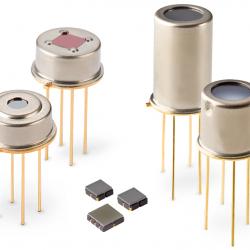
FoV 7°-120°; Sensitive Area Ø0.5, 0.7x0.7, 1.2x1.2 mm; Thermopile Resistance 50-135 kΩ; Responsivity 33-92 V/W; Sensitivity 18.6-200 µV/K; Time Constant 15, 22, 27 ms; Thermistor Resistance @25 °C 100 kΩExcelitas’ high-sensitivity thermopile detectors are available in TO-46, TO-5 and compact SMD housings, with or without an integrated focusing lens.The thermopile detectors vary by sensor-area size and housing type. With the range of specially designed sensors, Excelitas provides solutions for thermometry (isothermal construction), non-contact measurement (built-in lens) or gas monitoring (two narrowband windows, dual-channel output).Excelitas’ unique ISOthermal sensor concept significantly distinguishes the Excelitas thermopile family by utilizing patented construction to deliver improved performance and measurement accuracy under thermal shock conditions. All thermopile detector versions are equipped as standard with an internal thermistor as temperature reference for thermopile temperature compensationApplications: General-purpose Temperature Monitoring; Non-contact Temperature Measurements; Thermometry; Pyrometry; High-precision Gas Sensing and Monitoring; Space-constrained ApplicationsPlease note that Excelitas products are available from us only in Denmark, Finland, Iceland, Norway, and Sweden.
REQUEST PRICING AND AVAILABILITY
- Get your individual quote.
- Technical compatibility review included.
- Volume discounts available.
No obligation. Direct access to our engineering team.