
B-Series CMOS Cameras

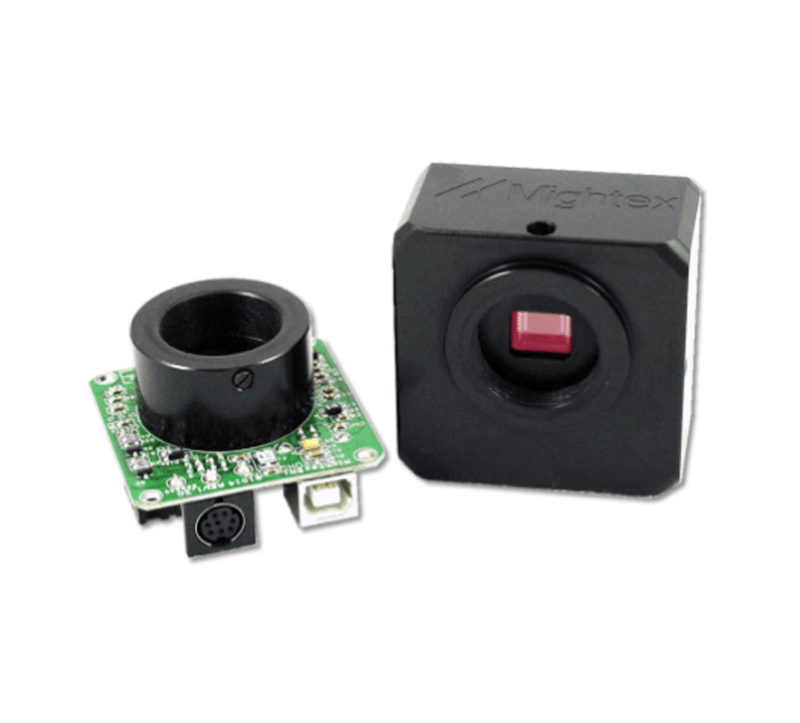
REQUEST PRICING AND AVAILABILITY
- Get your individual quote.
- Technical compatibility review included.
- Volume discounts available.
No obligation. Direct access to our engineering team.
Product information "B-Series CMOS Cameras"
0.36-5 MP; Pixel Size 2.2x2.2-6.0x6.0 µm; Sensor Size 1/3”-1/2” Diagonal; Colour or B/W; 3-310 fps; Resolution 8-12 bit; USB 2.0; Buffered; Progressive Scan; Dynamic Range >55-70 dB; Board-level or Enclosed
Mightex’s B-Series USB 2.0 CMOS cameras with frame buffers are optimized for machine-vision applications, and they can also be used for a wide variety of other applications such as digital microscopy and medical imaging, where quality, ease of use, and cost-effectiveness are crucial.
B-Series cameras are available as colour or B/W versions, with resolutions from Wide VGA (WVGA, 752x480) up to 5 MP (2592x1944) and 8, 10 or 12 bit, and they can be ordered as “naked” board-level device or pre-mounted in an enclosure. Monochrome cameras often exhibit a 20% higher spatial resolution than their colour counterparts because no pixel interpolation is necessary. Without a Bayer colour filter on the sensor, monochrome cameras are also more sensitive than colour sensors, especially in near IR and UV regions.
Mightex’s B-Series cameras feature built-in frame buffers, global shutter (Wide VGA versions), external trigger-in, strobe-out, and a powerful camera engine that supports multiple cameras. The frame rate can be as high as 60 fps in full resolution and up to 600 fps using ROI mode (depending on colour or B/W and sensor resolution).
In addition, a user-friendly GUI based application software and an SDK are provided for custom software development. A DirectShow driver and a TWAIN driver are included (except for 5 MP B/W versions), and a USB command set protocol is provided for non-Windows based applications. A Linux driver is also either included (5 MP and Wide VGA B/W versions) or available upon request.
Available models are:
- BCN-C050-U/BCN-C050-US: 5 MP, colour, lens mount C/CS, board-level
- BCE-C050-U/BCE-C050-US: 5 MP, colour, lens mount C/CS, enclosed
- BCN-B050-U/BTN-B050-U: 5 MP, B/W, 8/12 bit, lens mount C or CS, board-level
- BCE-B050-U/BTE-B050-U: 5 MP, B/W, 8/12 bit, lens mount C or CS, enclosed
- BCN-C030-U/BCN-C030-US: 3 MP, colour, lens mount C/CS, board-level
- BCE-C030-U/BCE-C030-US: 3 MP, colour, lens mount C/CS, enclosed
- BCN-B013-U/BCN-B013-US: 1.3 MP, B/W, 8 bit, lens mount C/CS, board-level
- BCE-B013-U/BCE-B013-US: 1.3 MP, B/W, 8 bit, lens mount C/CS, enclosed
- BTN-B013-U/BTN-B013-US: 1.3 MP, B/W, 10 bit, lens mount C/CS, board-level
- BTE-B013-U/BTE-B013-US: 1.3 MP, B/W, 10 bit, lens mount C/CS, enclosed
- BCN-CG04-U/BCN-CG04-US: WVGA, colour, lens mount C/CS, board-level
- BCE-CG04-U/BCE-CG04-US: WVGA, colour, lens mount C/CS, enclosed
- BCN-BG04-U/BCN-BG04-US: WVGA, B/W, 8 bit, lens mount C/CS, board-level
- BCE-BG04-U/BCE-BG04-US: WVGA, B/W, 8 bit, lens mount C/CS, enclosed
- BTN-BG04-U/BTN-BG04-US: WVGA, B/W, 10 bit, lens mount C/CS, board-level
- BTE-BG04-U/BTE-BG04-US: WVGA, B/W, 10 bit, lens mount C/CS, enclosed
Note: Board-level cameras are designed for OEM applications, when a system-level enclosure is usually provided. In order to avoid electro-static discharge (ESD) related damages, workforce handling a board-level camera should be properly grounded. ESD related damages are considered as mishandling and are not covered by product warranty. For lab use, it is strongly recommended to choose an enclosed camera instead of a board-level one.
Key Features:
- Colour or Black&White (B/W, Monochrome)
- Board-level or Enclosed Versions Available
- Ultra-compact
- Active Imaging Pixels: 0.36 to 5 MP, 752x480 to 2592x1944
- Pixel Size: 2.2 x 2.2 to 6.0 x 6.0 µm
- Sensor Size (Diagonal): 1/3” to 1/2”
- Dynamic Range: >55 to 70 dB
- Buffered, 32 MByte On-board Memory (3 to 23 Frames at Full Resolution, Depending on Sensor)
- 8, 10 or 12 bit Gray Level
- Progressive Scanning System
- Frame Rate: 3 to 310 fps
- True Global Shutter (Wide VGA Versions)
- Supports Simultaneous Image Capturing From Multiple Cameras
- 4-pin GPIOs
- Arbitrary ROI Supported (Wide VGA Versions)
- Interface: High-speed USB 2.0 (480 Mbit/s), No Need for External Power Supply
- Digital Output, No Need for Frame Grabber
- Custom Programmable With SDK Provided
- DirectShow & TWAIN Drivers
- Linux Driver (5 MP and Wide VGA B/W Versions)
- USB Command Set Protocol for Non-Windows-based Applications
- External and Software Trigger
- Strobe Output for External Flash
- Precise Frame Rate Setting (Wide VGA Versions)
- ROI (Not Wide VGA Versions) and Pixel Skipping/Binning
- OEM Versions Available
Applications: Machine Vision and Stereo Vision; Medical Imaging; Semiconductor Equipment; Test Instruments; High-quality ID Photo Capture; Document Scanners; Digital Microscopy; Web Camera and Security Video
Customers also viewed

Wavelength Band UV-SWIR, 400-2150 nm; Scalar FEM Numerical Engine; Solution in Seconds; ASCII Fiber Profile Input & Data Output; System Requirements 64-bit MS Windows Based on fiber refractive index profile data, Interfiber Analysis’ “2D Mode Solver” software package computes guided modes and mode properties, fiber bending/coiling effects, as well as mode coupling at splices. The software tool can analyze either 1-dimensional or 2-dimensional fiber index data so it can quantify the impact of any asymmetries in the fiber index profile. With this tool, you can: Compute 2-dimensional fiber modefields and mode properties Predict mode coupling at fiber splices Model fiber bending effects Quantify impact of index profile asymmetries Determine overlap between modes and cores Analyze fiber, preform, or synthetic index profiles These capabilities make the software particularly useful for customers working with high-power optical fibers. It is not only useful for existing IFA-100 users (who can use it to compute modes based on their IFA-100 data,) but also for those who use other equipment as it can be applied to fiber index data from other measurement devices (including preform profilers). This very attractively priced software tool runs on MS Windows 64-bit computers, and unlike other competing software packages, we offer multiple licenses at the customer location for the price of a single purchase. Key Features: System Requirements: MS Windows 64-bit Computer Numerical Engine: Scalar Finite Element Method (FEM) Wavelength Band: UV to SWIR (400 nm to 2150 nm) Solution Domain: 140 µm Diameter Disk Solution Time: Seconds Fiber Profile Input: ASCII Text Files (1- and 2-dimensional) Data Output: ASCII Text, PNG or PDF Images Computed Mode Properties: Electric Field, Optical Intensity, Effective Index, Group Index, Dispersion, Mode Field Diameter, Effective Area Applications: Computing of Guided Modes, Mode Properties, Fiber Bending/Coiling Effects, Mode Coupling at Splices
REQUEST PRICING AND AVAILABILITY
- Get your individual quote.
- Technical compatibility review included.
- Volume discounts available.
No obligation. Direct access to our engineering team.

Interchangeable Fixtures for Connectors, Waveguides, Bare Fibers, Other; Film Size 4 Inch Diameter; Capacity up to 8 Components; Connector Apex Offset <50 µm; Connector Radius of Curvature 5-25 mm; Connector Protrusion/Undercut: 50--120 nm KrellTech’s NOVA™ automated polishing system provides maximum flexibility for optical surface processing and supports a variety of polishing applications from connectors to waveguides, and bare fibers to custom components. NOVA™ is scalable for R&D projects, high-volume production and the rigors of harsh environments and field installation. NOVA™ workholders feature KrellTech’s patented independent suspension at each connector position for controlled pressure and uniform contact. Combined with NOVA’s Microfeed™ fixture advancement, connector “airpolishing” and epoxy removal can be performed directly in the machine. Each position is optically aligned for optimal polish geometry using KrellTech’s patented process and calibration mechanism. Connector types can also be mixed and matched in a single fixture. NOVA’s versatility provides the ability to support the polishing of many photonic components. A quick change-out of workholder fixtures provides processing capability for waveguides, optical chips, PLCs, lenses and fiber arrays. Workholders utilize a unique holding mechanism that can secure a wide range of component dimensions. The polishing angle is adjustable and custom fixtures can be fabricated for specialized applications. Bare fiber can be polished at variable angles using specialized workholders and adapters. A variety of fiber types from standard single mode (SM) to polarization maintaining (PM) and sapphire to PCF can be processed into wedge and chisel tip shapes. A quick swap-out of adapters allow the polishing of fiber diameters from 80 um to >3 mm. NOVA™ features an intuitive user interface for creating polishing programs. All parameters including cycle time, pressure and speed settings are easily inputted for all component types and desired surface geometries. A unique “manual mode” allows the adjustment of polishing parameters in real-time during NOVA™ operation. This feature streamlines process development efforts and facilitates easy and quick program creation and refinement. A new NOVA™ operation software kit is available that upgrades NOVA™ polishers with the enhanced microfeed feature. This polishing routine provides greater programming flexibility for advancing components to the polishing surface at slower and more controllable rates. While version 1 NOVA™ software was limited to 10 pre-programmed microfeed rates, with the slowest being 100 µm/s, version 2 software allows to customize rates as slow as 5 µm/min. This yields precise removal of material stock and continual component advancement. The enhanced microfeed is ideal for larger optical surfaces, delicate bare fibers, and connector air polishing. V2 also provides the ability to create "pop-up" window prompts in between each polishing step, very useful as reminder to technicians to clean fibers, inspect polishing lengths, confirm geometry, etc. before initiating the next process step. New folder management allows programs to be organized according to connector types, fiber diameters, component, etc. Bare Fiber Coning and Chisel Option The optional Orbit™ bare fiber coning and chisel system enhances NOVA™'s bare fiber processing with conical and chisel tip shaping. Unique fiber tip geometries can be formed for lensing, sensing and light guiding applications. The fiber rotation module can be mounted on standard NOVA™ variable angle and waveguide workholders. Fiber "spin" speed is user adjustable and can be set for continual rotation or the unique "360 auto-reverse" motion that prevent fiber twisting and torquing. All variables are entered and selected via a touchscreen on the Orbit™ controller. When combined with NOVA™ Auto-Angle Workholders, Orbit™ precisely positions the polishing fixture at the designed angle on a repeatable basis. Inspection Options Optional video inspection systems monitor the polishing process and inspect the polished surface directly in NOVA™. NOVA™'s Profile Videoscope allows the real-time monitoring of component polishing. This videoscope aids with bare fiber/component positioning and confirms process completion. Teamed with measurement software, this system verifies the endface geometry of a broad range of photonics components. Teamed with measurement software, this system verifies the endface geometry of fibers, waveguides and arrays. NOVA™'s Surface Videoscope allows the in-line inspection of polished surfaces while the component is still loaded in the polisher. This minimizes material handling and streamlines photonic production compared to the traditional process of transferring components to off-line inspection stations. Polishing and specification compliance can be determined in a single workcell. Key Features: Precision Optical Polishing Wireless Tablet Control With Microfeed™ Telcordia Compliant Interchangeable Fixtures for Waveguides, Bare Fibers and More Air Polishing Machine Polishing Pressure: Programmable & Automated, Linear Displacement With Micron Positioning Control Polishing Speed and Cycling Time: Program Selectable Polishing Motion: Random Orbital Polishing Routines: Programmable (Step by Step Prompts), Microfeed™ Controlled Advancement, Manual Mode With Full Process Control Film Size: 4 Inch Diameter Connector Support: All Industry Standard Connectors, MIL-spec Termini and Ferrules, UPC & APC Geometries Connector Capacity: Up to 8 Components – Selections Can Be Mixed & Matched in Same Workholder Fixture Connector Apex Offset: <50 µm Maximum, <15 µm Typical Connector Radius of Curvature: 10 to 25 mm (2.5 mm Ferrules), 7 to 20 mm (1.25 mm Ferrules), 5 to 12 mm (APC Ferrules) Connector Protrusion/Undercut: 50 nm to -120 nm Connector Back Reflection: <-60 dB (UPC), <-65 dB (APC) Connector Insertion Loss: <0.25 dB Typical Connector Process Time: Approximately 15 s/Connector Waveguide Component Support: Waveguides, Planar Lightwave Circuits, Optical Chips, Fiber Arrays Waveguide Component Dimension Range: Width 5 to 30 mm, Thickness 0.5 to 5 mm, Length >5 mm Waveguide Angle Repeatability: ±0.3° (X/Y Axis Along Edge) Waveguide Adjustable Polish Angle Range: 0° (Flat) to 45° Fiber Type Range: Single Mode (SM), Multi Mode (MM), Polarization Maintaining (PM), Plastic, PCF, Chalcogenide, Sapphire, Specialty Fibers Fiber Diameter: 80 µm to >3 mm Fiber Angle Range: 0° (Flat) to 50° Fiber Angle Repeatability: ±0.5° Typical Equipment Footprint & Weight: 305 x 305 mm, 11.3 kg Applications: Automated Optical Polishing of Connectors, Waveguides, Bare Fibers and More; Research and Development Projects; High-volume Production; Harsh Environments and Field Installation
REQUEST PRICING AND AVAILABILITY
- Get your individual quote.
- Technical compatibility review included.
- Volume discounts available.
No obligation. Direct access to our engineering team.
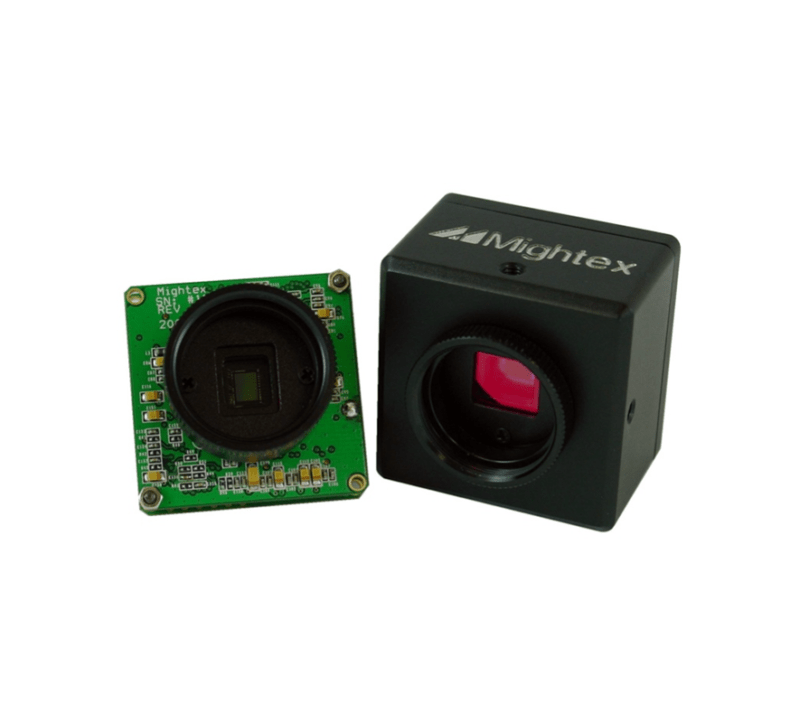
1.3 MP; Pixel Size 3.75x3.75 µm; Sensor Size 6.26x5.01 mm; Colour or B/W; 20-66 fps; Resolution 8, 12 bit; USB 2.0; Buffered; Progressive Scan; Board-level or Enclosed; Global Shutter Mightex’s C-Series compact USB 2.0 1.3 MP 1/3” CCD cameras with frame buffers are optimized for machine-vision applications, and they can be also used for a wide variety of applications (such as industrial inspections, digital microscopy and medical imaging) which require good quality cameras that are easy to use and cost-effective. C-Series compact 1/3” CCD cameras are available as colour or B/W versions, with 1.3 MP (1280x960) resolution and 8 or 12 bit, and can be ordered as “naked” board-level device or pre-mounted in an enclosure. Monochrome cameras often exhibit a 20% higher spatial resolution than their colour counterparts because no pixel interpolation is necessary. Without a Bayer colour filter on the sensor, monochrome cameras are also more sensitive than colour sensors, especially in near IR and UV regions. C-Series 1/3” CCD cameras have built-in frame buffers, global shutter, external trigger-in, strobe-out, and a powerful camera engine that supports multiple cameras. The frame rate can be as high as 20 fps in full resolution and up to 84 fps using ROI mode. A user-friendly GUI based application software and an SDK are provided for custom software development. In addition, a DirectShow driver and a TWAIN driver are available to easily link the cameras with users’ applications. A USB command set protocol and a Linux driver are also provided for non-Windows based applications. Available models are: CGN-C013-U: colour, board-level CGE-C013-U: colour, enclosed CGN-B013-U: B/W, board-level CGE-B013-U: B/W, enclosed Note: Board-level cameras are designed for OEM applications, when a system-level enclosure is usually provided. In order to avoid electro-static discharge (ESD) related damages, workforce handling a board-level camera should be properly grounded. ESD related damages are considered as mishandling and are not covered by product warranty. For lab use, it is strongly recommended to choose an enclosed camera instead of a board-level one. Key Features: Colour or Black&White (B/W, Monochrome) Built-in Frame Buffer 32 MByte (24 Frames at Full Resolution) Support Simultaneous Image Capturing From Multiple Cameras Higher Sensitivity Than CMOS Cameras B/W Cameras Feature Higher Sensitivity (Especially in Near IR and UV) Board-level or Enclosed Versions Available Ultra-compact Active Imaging Pixels: 1.3 MP, 1280x960 Pixel Size: 3.75 x 3.75 µm Sensor Size: 6.26 x 5.01 mm (1/3” Diagonal) 8 or 12 bit Progressive Scanning System Frame Rate: 20 to 66 fps Global Shutter 4-pin GPIOs Interface: High-speed USB 2.0 (480 Mbit/s), No Need for External Power Supply Digital Output, No Need for Frame Grabber Full-featured SDK DirectShow & TWAIN Drivers Linux Driver Available USB Command Set for Non-Windows-based Applications External and Software Trigger Strobe Output for External Flash ROI and Pixel Skipping OEM Versions Available Applications: Digital Microscopy; Machine Vision; Medical Imaging; Semiconductor Equipment; Test Instruments; Document Scanners; 2D Barcode Readers; Web Camera and Security Video; High-quality ID Photos
REQUEST PRICING AND AVAILABILITY
- Get your individual quote.
- Technical compatibility review included.
- Volume discounts available.
No obligation. Direct access to our engineering team.
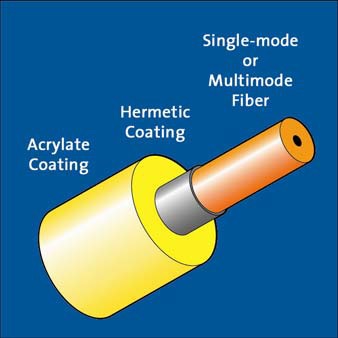
720 to >1060 nm; Core dia. 4.0 to 5.3 µm; Cladding Dia. 125 µm; Coating Dia. 245 µm; Dual Acrylate Coating; High-index, Bend Insensitive Consistent glass with excellent reliability: Corning's HI series of high-index single mode (SM) fibers is used across telecommunications, aerospace, and industrial markets in applications such as wavelength division multiplexing (WDM) couplers, splitters, and pump pigtails. The high-index fibers are manufactured with Corning's outside vapor deposition (OVD) process which results in durable, highly consistent glass and excellent reliability. When used as component pigtails, HI series fibers allow for efficient fiber coupling within photonic products. The fibers also offer reduced bend attenuation due to their high core index of refraction. Corning’s HI series of high-index single mode fibers includes products like HI 780, HI 780C, HI 980, RC HI 980, HI 1060, RC HI 1060, HI 1060 FLEX and RC HI 1060 FLEX. For more information please refer to the Corning® HI high-index SM fibers datasheets. For the HI 780 specialty fiber series, a re-engineered version, HI 780C, is available, which delivers nonadiabatic taper loss during component manufacturing. HI 780C is a coupler-optimized design that allows for steeper tapers and shorter couplers with lower losses. Key Features: Outstanding Consistency and Uniformity Patented Outside Vapor Deposition (OVD) Process Dual Acrylate Coating System Provides Excellent Protection and Superior Mechanical Robustness Excellent Geometry Control High Core Index of Refraction: 1.459 to 1.471 Efficient Coupling High Proof Test for Increased Reliability in Tight Bend Configurations High Numerical Aperture: 0.14, 0.21 RC HI 980/1060/1060 FLEX Provide 80 μm Diameter for Miniature Packaging HI 1060 FLEX Provides Ultra-low Bending Loss, Low Excess Loss, Low Splice Loss to SMF-28e+® and ER 1550C3 Fibers Applications: Photonic Products and Fused-fiber Couplers; Component Fiber for Erbium-doped Fiber Amplifiers (EDFAs), Couplers, Other Dense Wavelength Division Multiplexing (DWDM) Components; Pigtails for Pump Laser Diodes; Short Wavelength Laser and Light-emitting Diode (LED) Sources; Splitters and Combiners; Sensors and Gyroscopes; CATV Couplers; Ultra-compact Components Requiring Small Bend Radii
REQUEST PRICING AND AVAILABILITY
- Get your individual quote.
- Technical compatibility review included.
- Volume discounts available.
No obligation. Direct access to our engineering team.
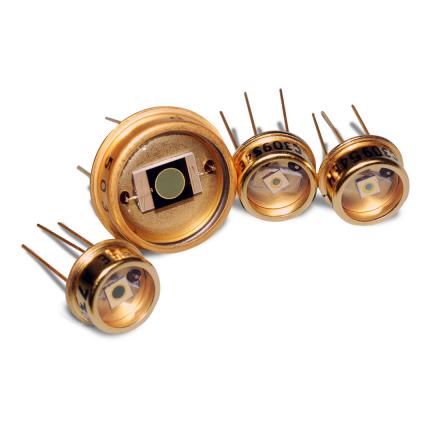
Active Area Diameter 0.8-3 mm; Responsivity 25-36 A/W; Capacitance 2-10 pF; NEP 14-20 fW/√Hz; Dark Current 50, 100 nA; Package TO-5, TO-8Excelitas’ 1064 nm long-wavelength enhanced Silicon Avalanche Photodiodes (APDs) C30954EH, C30955EH and C30956EH are made using a double-diffused “reach-through” structure. The design of these photodiodes is such that their long-wave response (i.e. >900 nm) has been enhanced without introducing any undesirable properties.The C30954EH, C30955EH and C30956EH long-wavelength enhanced APDs have quantum efficiency of up to 40 % at 1060 nm. At the same time, the diodes retain the low-noise, low-capacitance, and fast rise and fall times characteristics.To help simplify many design needs, these APDs are also available in Excelitas’ high-performance hybrid preamplifier module type C30659 series, as well as the preamplifier and TE cooler incorporated module type LLAM series. In addition, these APDs are also available with built-in thermo-electric cooler for easier temperature control.The C30954EH long-wavelength enhanced silicon avalanche photodiode (Si APD) provides a 0.8 mm active area diameter in a TO-5 package.The C30955EH long-wavelength enhanced silicon avalanche photodiode (Si APD) provides a 1.5 mm active area diameter in a TO-5 package.The C30956EH large-area, long-wavelength enhanced silicon avalanche Photodiode (Si APD) provides a 3 mm active area diameter in a TO-8 package.Key Features:Active Area Diameter: 0.8, 1.5, 3 mmHigh Quantum Efficiency at 1060 nm: ≤40%Enhanced Long-wave Response: >900 nmFast Response Time: 2 nsWide Operating Temperature RangeLow Capacitance @100 kHz: 2 to 10 pFResponsivity @1060 nm: 25 to 36 A/WDark Current: 50, 100 nASpectral Noise Current: 0.5 pA/√HzNEP @1060 nm: 14 to 20 fW/√HzVop Range: 275 to 425 VHermetically Sealed Packages: TO-5, TO-8RoHS CompliantTEC Option AvailableCustomization Available Upon RequestApplications: Range Finding; LiDAR (Light Detection and Ranging); YAG Laser DetectionPlease note that Excelitas products are available from us only in Denmark, Finland, Iceland, Norway, and Sweden.
REQUEST PRICING AND AVAILABILITY
- Get your individual quote.
- Technical compatibility review included.
- Volume discounts available.
No obligation. Direct access to our engineering team.