
OZ Optics

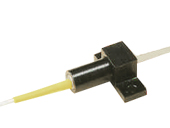
Pigtail/Receptacle Versions; Fiber Type SM, MM or PM; Tilt Adjustment Feature for Many Couplers; Pigtail Versions Optional with Pre-configured Connectors (P)FPD fiber to photodiode couplers are available for virtually any photodiode on the market, using either SM, MM or PM fiber. The coupler design is both rugged and flexible, allowing customers to do their own alignment if desired. For OEM applications, miniature pigtail style fiber to photodiode couplers are available that do not use the tilt adjustment technique. These feature both a smaller size and lower cost.Our fiber to photodiode couplers come in three basic designs. The most common design consists of two baseplates (one holding the photodiode and the other one containing the focusing optics and the connector for the input fiber), separated by a resilient O-ring. OZ Optics’ patented tilt adjustment technique is used to achieve the maximum coupling efficiency (typical >80% for SM fibers, depending on fiber and photodiode characteristics) even for very small spot sizes of <10 µm. For the second design, the fiber, lens and photodiode are glued into a single assembly without the tilt adjustment technique. The third and final design uses no lens at all. The fiber is simply butted against the photodiode. Both of these designs are intended for OEM applications. For optimum coupling efficiency, stability, and minimum backreflection, we recommend using pigtail style fiber to photodiode couplers, available with a wide variety of fiber types and cable sizes, also preterminated with different types of connectors. Receptacle style versions are typically only available for multimode applications, or large active area photodiodes. AMS Technologies welcomes opportunities to fiber couple into your specific photodiode. Please contact us with details of the fiber required and the photodiode specifications, and we will determine the best, most cost effective method of fiber coupling. Key Features: High Coupling Efficiency Available in SM, PM and MM Versions Compact Housing InGaAs or Si Photodiodes Standard Contact us for Custom Specific Diodes Small Active Area Photodiodes for High Bandwidth Applications: Power Measurements; Optical Signal Measurements; Optical Power Control Devices; Fiber Optic Sensors; Data Transmission Systems
REQUEST PRICING AND AVAILABILITY
- Get your individual quote.
- Technical compatibility review included.
- Volume discounts available.
No obligation. Direct access to our engineering team.
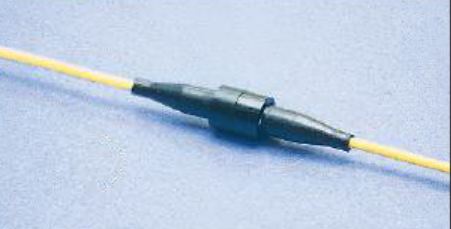
Pigtail Style, Optional Removable Filter; Fiber Type SM, PM, MM; 440 to 1625 nm; Connector Type NTT-FC/PC, ST, SC, LC, MU, other; Attenuation 5 to 30 dB OZ Optics’ (R)ND-11 series of expanded beam style neutral density fixed attenuators are ideal for multi mode applications and for applications where attenuating fibers are not available or usable. These pigtail-style attenuators provide mode independent fixed attenuation when used with multi mode fibers. The insertion loss will not depend on how the light is launched into the fiber. This is a significant advantage over other attenuator designs. The attenuators consist of a set of collimating and focusing optics and a central baseplate containing the filter. The expanded beam design permits higher power handling than plug style attenuators. The filters themselves can be either permanent (ND-11 series) or removable (RND-11 series). This provides great flexibility for experimentation. Key Features: Mode Independent Attenuation Level Rugged and Compact Size Pigtail Style Removable Filter Versions (RND-11) Wide Wavelength Range Single Mode, Polarization Maintaining, and Multi Mode Fiber Versions Expanded Beam Technology for Flexible Design Applications: CATV, LAN and Telecommunications; Receiver Padding; Test and Measurement; Optical Power Equalization; Research & Design
REQUEST PRICING AND AVAILABILITY
- Get your individual quote.
- Technical compatibility review included.
- Volume discounts available.
No obligation. Direct access to our engineering team.
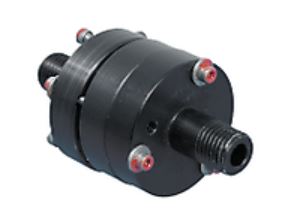
Receptacle Style, Optional Removable Filter; Fiber Type MM; 440 to 1625 nm; Connector Type NTT-FC/PC, ST, SC, other; Attenuation 5 to 30 dB OZ Optics’ (R)ND-200 series of expanded beam style neutral density fixed attenuators are ideal for multi mode applications and for applications where attenuating fibers are not available or usable. These receptacle-style attenuators provide mode independent fixed attenuation when used with multi mode fibers. The insertion loss will not depend on how the light is launched into the fiber. This is a significant advantage over other attenuator designs. The attenuators consist of a set of collimating and focusing optics and a central baseplate containing the filter. The expanded beam design permits higher power handling than plug style attenuators. The filters themselves can be either permanent (ND-200 series) or removable (RND-200 series). This provides great flexibility for experimentation. Key Features: Mode Independent Attenuation Level Rugged and Compact Size Receptacle Style Removable Filter Versions (RND-200) Wide Wavelength Range Suitable for Multi Mode Fibers Expanded Beam Technology for Flexible Design Applications: CATV, LAN and Telecommunications; Receiver Padding; Test and Measurement; Optical Power Equalization; Research & Design
REQUEST PRICING AND AVAILABILITY
- Get your individual quote.
- Technical compatibility review included.
- Volume discounts available.
No obligation. Direct access to our engineering team.
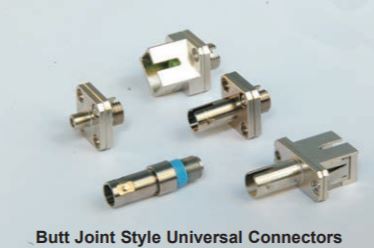
Universal Adapters; Connector Type (Super, Ultra) NTT-FC/PC, SMA 905/906, AT&T-ST, (Angled) SC, Universal; Fiber Type Single Mode (Hybrid Patchcord, Lens Style), Multi Mode (Lens Style) OZ Optics’ AA series of universal connectors and hybrid patchcords are designed for mating two patchcords that have different connectors on their ends. Butt joint style universal connectors feature different female receptacles on either side. Patchcords are simply plugged into either side, and the fiber ends butt together in the middle. These connectors offer an inexpensive and reliable way to connect matching single mode, multi mode, or polarization maintaining patchcords with differing fiber terminations. Connectors with a universal ferrule adaptor design are also available, for connectors that have 2.5 mm diameter ferrules, or 1.25 mm diameter ferrules. These receptacles are best suited for temporary measurements and give added flexibility. Hybrid patchcords have a female receptacle on one side and a male connector on the other side. A small length of fiber lies within the device to transmit the light. Male-to-male hybrid patchcords are also available. Lens style universal connectors are ideal for connecting fibers that have different optical characteristics. They consist of an input receptacle, a collimating lens, a focusing lens and the output receptacle. Light from the input fiber is first collimated, then focused back into the output fiber. The alignment is precisely controlled using OZ Optics’ patented alignment technique. Lens style universal connectors are tilt adjustable to compensate for any offsets between the fiber cores and the connector housings. Please note that universal connectors will not couple light efficiently from a multi mode fiber into a single mode fiber. High losses are unavoidable in this situation, since multi mode fibers have both larger numerical apertures and larger core sizes. Key Features: Mates Patchcords With Different Connector Types Connectors With Different Ferrule Sizes Supported Minimizes Losses Between Fibers With Different Core Sizes And Numerical Apertures Male To Female (Hybrid) Connector Versions Rugged And Compact Design Low Insertion and Return Losses Applications: Patch Panel Interconnects; Fiber Distribution Hubs; Test And Measurement Stations; Optical Delivery Systems
REQUEST PRICING AND AVAILABILITY
- Get your individual quote.
- Technical compatibility review included.
- Volume discounts available.
No obligation. Direct access to our engineering team.

1527-1610 nm; Output Power 13-27 dBm; Termination Receptacle Style, FC/PC, FC/APC, ST, SC, SCA, LC, MU; C, C+L Band; Spectrum Flatness 1.0-2.0 dB OZ Optics’ ASE (Amplified Spontaneous Emission) broadband low coherence light sources are ideal instruments for optical component spectral measurement and system compliance testing in manufacturing and R&D environments. The new generation of ASE sources have no high-frequency ripples, which makes them very useful for sensor interrogation applications. ASE broadband light sources are available to cover the C-band, L-band, or both the C & L bands together. These are available with either a flattened spectral output for demanding applications, or a non-flattened response for less demanding or cost-sensitive applications. A range of output powers are available. The output light is accessed via a female fiber connector receptacle on the front panel. A variety of standard connector types are available. Custom connectors can also be accommodated. ASE broadband light sources are available in bench-top, rackmount or OEM module form factors. The basic version of the source features a built-in microprocessor for applications that require output power adjustment. RS-232 and USB interfaces are included, with the addition of a GPIB interface offered as an option. Key Features: High Output Power: 13 dBm (20 mW) to 27 dBm (500 mW) Wide Spectral Bandwidth Operating Wavelength Range (Typ.): 1527 to 1610 nm (Unflattened), 1531 to 1607 nm (Flattened) Spectrum Flatness (Typ.): 1.0 to 2.0 dB Covers C Band, L Band, or Both High Power Stability: 0.02 dB (1 h) Un-polarized Output Light Minimum Output Isolation: 45 dB Minimum Return Loss: 55 dB Termination: Receptacle Style, FC/PC, FC/APC, ST, SC, SCA, LC, MU Interfaces: RS232 and USB, GPIB Optional High Performance-to-cost Ratio Optional Built-in Attenuator and Optical Power Monitor Custom Design Flexibility Operating Temperature Range: 0 to +40°C Applications: Optical Component Testing; Telecom System Compliance Testing; EDFA Gain Spectrum Measurements; Optical Fiber Sensors and Sensing Systems; WDM by Spectral Slicing; Biomedical Imaging; Coherent Communication Systems
REQUEST PRICING AND AVAILABILITY
- Get your individual quote.
- Technical compatibility review included.
- Volume discounts available.
No obligation. Direct access to our engineering team.

1529-1562 nm; Output Power 13 dBm; Termination Receptacle Style, FC/PC, FC/APC, ST, SC, SCA, LC, MU, None; C Band; Spectrum Flatness <±0.5 dB OZ Optics’ ASE-11 (Amplified Spontaneous Emission) broadband low-coherence light source is an ideal instrument for optical component spectral measurement and system compliance testing in manufacturing and R&D environments. The ASE-11 source comes with a flat spectrum with peak-to-peak ripples less than 1 dB over 1529 nm to 1562 nm, which makes it very useful for optical signal-to-noise ratio and sensor interrogation applications. The unit comes with a nominal 13 dBm output power and it is provided with an internal or external monitor port. The output light is accessed via a pigtailed 9/125 μm single mode fiber. A variety of standard connector types are available. Custom connectors can also be accommodated. The unit is packaged in a low-profile OEM box with built-in driver. Key Features: High Output Power: 13 dBm Flat Spectral Bandwidth With Ripple <±0.5 dB Operating Wavelength Range: 1529 to 1562 nm Covers C-band Spectrum Flatness: <±0.5 dB High Power Stability: 0.02 dB (1 h) Un-polarized Output Light High Performance-to-cost Ratio Optional Built-in Attenuator Pump TEC and Current Driver Included Output Isolation: 45 dB Return Loss: 55 dB Termination: Receptacle Style, FC/PC, FC/APC, ST, SC, SCA, LC, MU, None Internal or External Monitor Port Operating Temperature Range: 0 to +40°C Dimensions: 200 x 200 x 50 mm Applications: OSNR Measurement; Optical Components Testing; Telecom System Compliance Testing; Optical Fiber Sensors and Sensing Systems; WDM; Biomedical Imaging; Coherent Communication Systems
REQUEST PRICING AND AVAILABILITY
- Get your individual quote.
- Technical compatibility review included.
- Volume discounts available.
No obligation. Direct access to our engineering team.
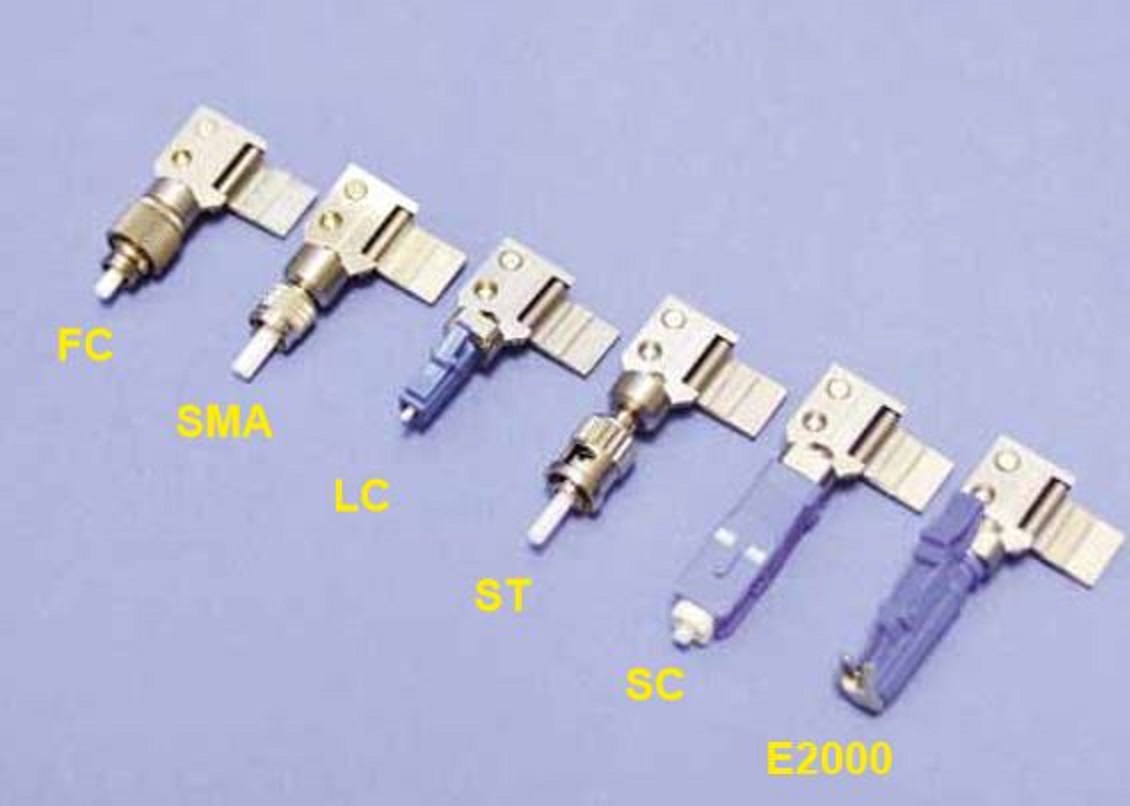
Bare Fiber Adapters; Magnetic and Spring Clamp Versions; Connector Type FC, SMA905, ST, SC, LC, E2000; Ferrule Hole Size 80 to 250 µm; Reusable and Easy to Clean OZ Optics’ BARE series of bare fiber adapters provide a simple and effective way to use unterminated fibers with commercial receptacles. Simply strip, clean and cleave your fiber and insert into the bare fiber adapter. The BARE series adapters are recommended for power meter connections, temporary system repairs or wherever a quick fiber connection is required. OZ Optics has recently improved the bare fiber adapter design to now use a magnetic clamping mechanism. The new design gently yet firmly holds the fiber in place without harming soft acrylate coatings and is even easier for operators to use. The magnetic clamp applies no stress to the fiber, which makes it ideal for PM fiber related measurements including extinction ratio (ER), polarization dependent loss (PDL) and polarization mode dispersion (PMD). Bare fiber adapters with spring clamp accommodate up to 900 µm OD jacketed fiber. Bare fiber adapters with magnetic clamp accommodate 250 to 400 µm OD jacketed fiber. 900 µm OD tight buffer and custom jacket sizes are available. (Please contact AMS Technologies). Key Features: Easy to Use Reusable and Easy to Clean Magnetic Clamp Applies no Stress to Fiber Variety of Connector Types & Fiber Sizes Applications: Briefly Connect to Light Sources, Power Meters, OTDRs, Extinction Ratio Meters, a.s.o.; Test Unterminated Fiber and Fiber Spools; Installation and Repair Work
REQUEST PRICING AND AVAILABILITY
- Get your individual quote.
- Technical compatibility review included.
- Volume discounts available.
No obligation. Direct access to our engineering team.
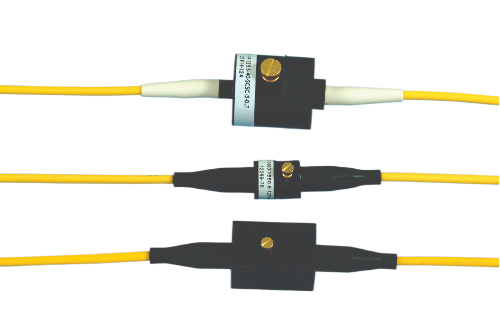
Blocking, Pigtail Style; Fiber Type SM, MM, PM; 350 to 2050 nm; Connector Type NTT-FC/PC, ST, SC, LC/PC, other; Attenuation up to 80 dB OZ Optics’ BB-100/400/500/700-11 series of compact PC board mountable blocking pigtail style variable attenuators with low backreflection are designed to meet Telcordia standards. These attenuators can be used for 1300 nm and 1550 nm as well as for C, L and S bands, with minimal changes in the insertion loss. Mounting holes provide easy attachment to PC boards and patch panels. The mounting hole patterns and attenuator sizes can be modified to meet customer requirements The attenuators consist of two collimating lenses, prealigned for optimum coupling efficiency. A threaded radial screw is used to block the collimated beam between the two lenses. Because the attenuator works by directly blocking the beam, it is polarization insensitive. A seal cap is used to seal the junction against temperature and humidity effects. The attenuator can even withstand immersion in water for extended periods of time. Variable attenuators are offered with single mode, multi mode, or polarization maintaining fibers. Key Features: Rugged and Compact Size Wide Wavelength Range Single Mode, Multi Mode and Polarization Maintaining Fiber Versions Low PDL and Wavelength Dependency High Power Handling Wide Attenuation Range Low Backreflection Designed to Meet Telcordia Requirements Applications: Optical Power Equalization and Power Control for WDMs and Multi-channel Optically Amplified Networks; Telecommunications; CATV; LAN; Test and Measurement; Receiver Padding; Optical Sensors
REQUEST PRICING AND AVAILABILITY
- Get your individual quote.
- Technical compatibility review included.
- Volume discounts available.
No obligation. Direct access to our engineering team.
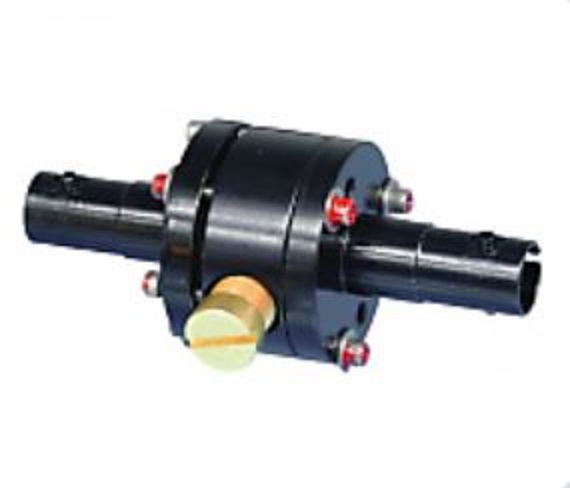
Blocking, Receptacle Style; Fiber Type SM, MM, PM; 350 to 2050 nm; Connector Type (Receptacle) NTT-FC/PC, ST, SMA 905, SC; Attenuation 2 dB to 80 dB OZ Optics’ BB-200 series of blocking receptacle style variable attenuators consist of two baseplates with lenses. The two baseplates are aligned for optimum coupling efficiency using a patented alignment technique. A threaded radial screw is used to block the collimated beam between the two lenses. Rotating the screw changes its position within the collimated beam, thus varying the power level coupled into the receiver fiber. Because the attenuator works by directly blocking the beam, it is polarization insensitive. Because of limitations in receptacle tolerances, receptacle style attenuators are not recommended for single mode or polarization maintaining applications requiring low losses and good repeatability. Instead, please refer to the OZ Optics BB-100/400/500/700-11 series of blocking pigtail style variable attenuators. Key Features: Compact, Rugged Housing High Resolution Wide Wavelength Range (350 to 2050 nm) Wide Variety of Connectors Available Polarization Insensitive Applications: CATV, LAN and Telecommunications Use; Receiver Padding; Test and Measurement; Optical Power Equalization
REQUEST PRICING AND AVAILABILITY
- Get your individual quote.
- Technical compatibility review included.
- Volume discounts available.
No obligation. Direct access to our engineering team.
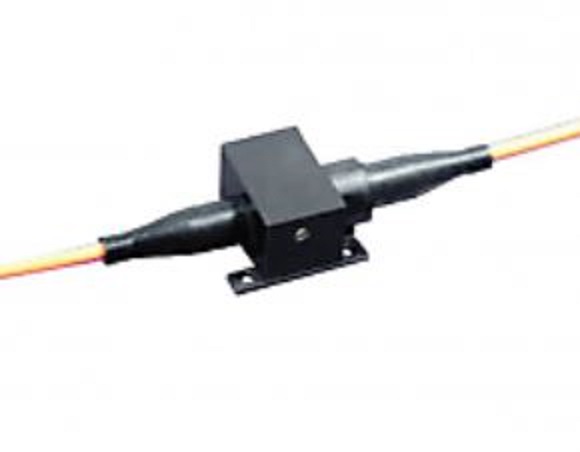
Neutral Density Filter, Pigtail Style; Fiber Type SM, MM, PM; 800 to 1625 nm; Connector Type NTT-FC/PC, ST, SC, LC/PC, other; Attenuation IL to 40 dB OZ Optics’ BB-500-11-ND series of compact PC board mountable, pigtail style variable attenuators are designed to meet Telcordia requirements. These attenuators with low backreflection can be used for 1300 nm and 1550 nm, as well as for C, L and S bands, with minimal changes in the insertion loss. Mounting holes provide easy attachment to PC boards and patch panels. The mounting hole patterns and attenuator sizes can be modified to meet customer requirements.The attenuators consist of two baseplates, each baseplate containing a fiber followed by a collimating lens. The attenuator is prealigned for optimum coupling efficiency using a patented tilt alignment technique. A variable neutral density filter is used to provide more uniform attenuation in multi mode applications than the blocking screw technique. The attenuation is controlled by a turn screw on the side of the attenuator, which controls the position of the filter. Variable attenuators based on the neutral density filter are ideal for multi mode fiber applications where one may be concerned about modal noise. When blocking style attenuators are used with multi mode fiber, some modes are blocked, while others are transmitted. This can produce 1 dB or greater modal noise fluctuations with coherent sources. A variable attenuator using a neutral density filter is not as strongly affected by modal noise. However, neutral density filter attenuators offer lower attenuation range (around 40dB) and can only handle about 50mW of power. While generally used for multi mode applications, OZ Optics can also produce single mode and polarization maintaining versions. Key Features: Neutral Density FilterRugged and Compact Size Wide Wavelength Range Single Mode, Polarization Maintaining and Multi Mode Fiber Versions Low Polarization Dependent Loss (PDL) Low Wavelength Dependence Mode Insensitive Attenuation Low Backreflection Designed to Meet Telcordia Requirements Applications: Optical Power Equalization and Power Control for WDMs and Multi-channel Optically Amplified Networks; Telecommunications; CATV; LAN; Test and Measurement; Receiver Padding; Optical Sensors
REQUEST PRICING AND AVAILABILITY
- Get your individual quote.
- Technical compatibility review included.
- Volume discounts available.
No obligation. Direct access to our engineering team.
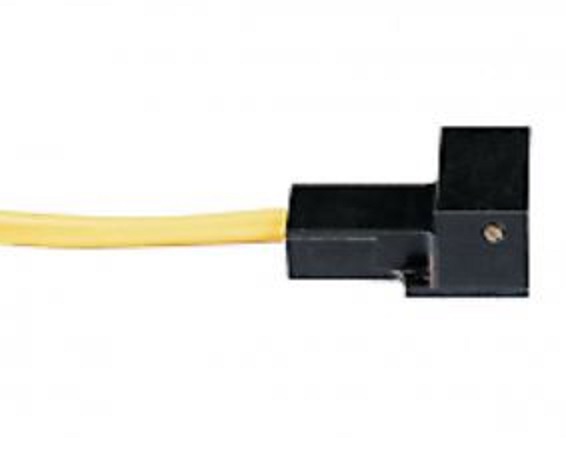
Reflective Style, Manually (Screw) Controlled; Fiber Type SM, MM, PM; 400 to 1625 nm; Connector Type NTT-FC/PC, ST, SC, LC/PC, other; Attenuation up to 40, 60 dB OZ Optics’ BB-600-11 series of compact PC board mountable, reflective style, variable attenuators with low backreflection can be used for C, L and S wavelength bands, with minimal changes in insertion loss. Reflector style housings are ideal for applications where the input and output fibers must be attached to the same side of the attenuator. Mounting holes provide easy attachment to PC boards and patch panels. The BB-600-11 series of reflector style attenuators contain either a variable neutral density filter or a blocking plate depending on the attenuator version selected. The blocking style is ideal for high power (over 50 mW) applications, while the neutral density filter provides more uniform attenuation in multi mode applications. The attenuation is controlled by a turn screw on the side of the attenuator, which controls the position of the filter or plate. Key Features: Neutral Density Filter or High-power Versions Available Rugged and Compact Wide Wavelength Range Single Mode and Multi Mode Fiber Versions Low PDL and Wavelength Dependence Mode Independent Attenuation in Multi Mode Applications with Neutral Density Filter Version Wide Attenuation Range Low Backreflection Applications: Optical Power Equalization and Power Control for WDMs and Multi-channel Optically Amplified Networks; Telecommunications; CATV; LAN; Test and Measurement; Receiver Padding
REQUEST PRICING AND AVAILABILITY
- Get your individual quote.
- Technical compatibility review included.
- Volume discounts available.
No obligation. Direct access to our engineering team.

Single and Dual Source; 633-1625 nm; Reflectance Dynamic Range -1--70 dB; Fiber Type SM, MM; 8° Angled NTT-FC/APC Receptacle OZ Optics’ BM series of backreflection meters measure the total accumulated optical return loss that is reflected back through a device or fiber under test. The measured reflections are caused by Rayleigh scattering, sudden changes in the refractive index within the device under test (DUT), or from connector ends. BM series meters are available as portable handheld devices (BM-100 and BM-200) or in a benchtop form factor (BM-1000 and BM-2000). The BM series backreflection meters are configured with an FC/APC connector on the output port, to minimize unwanted reflections. The meters have either one or two built-in laser diodes (plus a choice of SLEDs or LEDs for benchtop models) for return loss measurement at specific wavelengths. An optional detector can be added to the unit for insertion loss measurements. Reference patchcords for calibration are available. BM series meters cover a wide range of available wavelengths, thus providing measurement capabilities for non-telecom applications as well as telecom. BM-100/200 portable meters' wavelengths range from 8050 nm to 1625 nm, while the BM-1000/2000 benchtop meters are offered with special wavelengths, ranging from 633 nm to 1625 nm. The BM-1000/2000 benchtop backreflection meters feature a colour touchscreen display with a simple graphical user interface. The units come with a built-in memory that allows the user to store measured DUT test results. The BM series backreflection meters can be operated remotely via the built-in USB interface. A universal AC/DC power supply is included with all units. Reference patch cords for calibration are available. Adapter patch cords are also available, to allow the meter to be used with devices having different connectors. Key Features MB-100/200 Handheld Backreflection Meters: Built-in Single and Dual Laser Diode Source Built-in Single and Dual Laser Diode Source Dual Wavelength Source Available Sensitivity: Down to -70 dB Wide Range of Available Wavelenghts: 850 nm to 1625 nm Reflectance Dynamic Range: -1 dB to -70 dB Built-in USB Communications Port Fiber Type: Single Mode (SM), Multi Mode (MM) Receptacle: 8" Angled NTT-FC/APC Rugged and Compact Design High Resolution Optional Insertion Loss Measurement Capability Additional Key Features MB-1000/2000 Benchtop Backreflection Meters: Unique Wavelength Offerings for Speciality Applications Wide Range of Available Wavelengths: 633 nm to 1625 nm Broadband SLED for Imprived Stability Sensitivity: Down to -75 dB Touchscreen Display Built-in Memory Applications: Backreflection Measurement of Components; OCT Device Testing; Insertion Loss Measurement; End-to-end Loss Measurement; Quality Control; New Product Development; Component or System Troubleshooting; Network Installation
REQUEST PRICING AND AVAILABILITY
- Get your individual quote.
- Technical compatibility review included.
- Volume discounts available.
No obligation. Direct access to our engineering team.
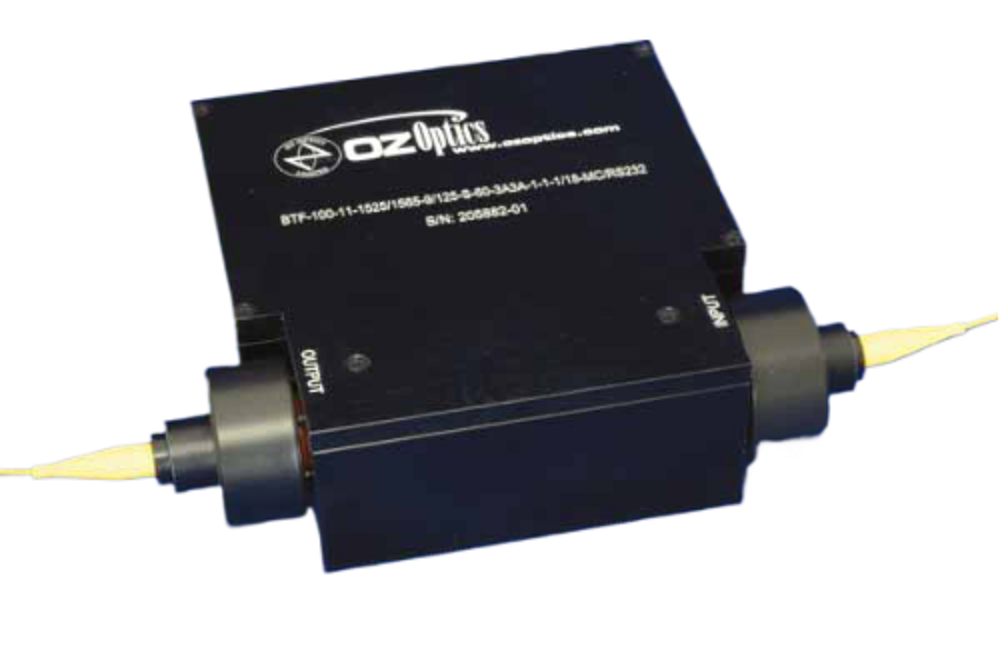
Polarization Insensitive; 1100 to 1650 nm; Bandwidth 1 to 18 nm; Insertion Loss 3 dB; PDL <0.3 dB; Fiber Type SM, PM; Connector Type FC/PC, ST, SC, LC, MU, None OZ Optics’ BTF-100 series of motorized adjustable variable bandwidth tunable filters are pigtailed components with built-in control electronics that allow both the wavelength and bandwidth of the filter to be controlled through an electrical interface. The device contains two independently variable tunable bandpass filters in series. With the two filters tuned to cover slightly different wavelength ranges, the overall passband becomes the region where the two individual passbands overlap. The amount of overlap determines the width of the filter. Since each filter can be tuned over a range of wavelengths, both the center frequency and width of the passband can be controlled. Each individual filter consists of a multi-layer thin film bandpass filter, designed to give a flat top pass band, with steep roll-off shapes. The center wavelength of the filters is adjusted by changing the angle of incidence of the light as it impinges upon the filter. In the BTF-100 series of motor driven variable bandwidth tunable filter, each filter is independently rotated relative to the incoming light, in order to change the passband. OZ Optics uses a special technique to minimize polarization dependencies, allowing PDL effects to be kept below 0.3 dB, and making the spectral response virtually polarization independent. This feature makes the BTF-100 series ideal for today’s DWDM system applications. Variable bandwidth tunable filters using single mode (SM) and polarization maintaining (PM) fibers are offered. In general, OZ Optics uses polarization maintaining fibers based on the PANDA fiber structure when building polarization maintaining components and patch cords. However, OZ Optics can construct devices using other PM fiber structures. OZ Optics also carries some alternative fiber types in stock, please contact AMS Technologies for availability. If necessary, OZ Optics is willing to use customer supplied fibers to build devices. In addition to the BTF-100 series of motor driven variable bandwidth tunable filters, OZ Optics provides four further series of tunable filters – BTF-11 series of manually adjustable variable bandwidth tunable filters, TF-100 series of digital tunable filters, TF-100-11 series of motor driven tunable filters, and finally TF-11 series of manually adjustable polarization insensitive tunable filters. If you are looking for filters with a fixed wavelength, have a look at OZ Optics’ FF series of fixed filters. Key Features: 45 nm Tunable Wavelength Range 1 to 18 nm Continuously Adjustable Bandwidth Wavelength and Bandwidth Independently Tunable Flat-top Filter Shape Available for Wavelengths from 1100 to 1650 nm Polarization Insensitive High Resolution Single Mode (SM) and Polarization Maintaining (PM) Fiber Versions High Out-of-band Suppression High Input Power Handling Built-in Microcontroller With RS-232, IIC or SPI Interface Applications: WDM Channel Filtering; High-speed Transmission Testing; Signal Filtering; Laser Pulse Shaping; ASE Light Noise Suppression; Tunable Light Sources; Spectral Analysis; Fiber Optic Component Manufacturing; Quality Control and Measurement; Product Development; Automated Testing
REQUEST PRICING AND AVAILABILITY
- Get your individual quote.
- Technical compatibility review included.
- Volume discounts available.
No obligation. Direct access to our engineering team.
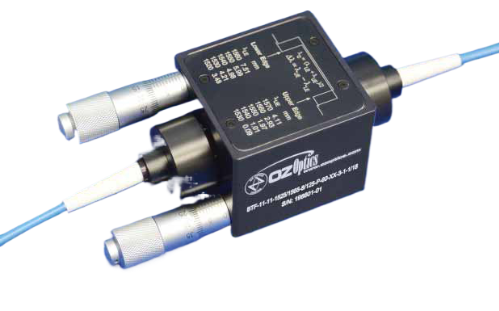
Polarization Insensitive; 1100 to 1650 nm; Bandwidth 1 to 18 nm; Insertion Loss 3 dB; PDL <0.3 dB; Fiber Type SM, PM; Connector Type FC/PC, ST, SC, LC, MU, None OZ Optics’ BTF-11 series of manually adjustable variable bandwidth tunable filters are pigtailed components with adjustment knobs that allow both the wavelength and bandwidth of the filter to be controlled. The devices contain two independently variable tunable bandpass filters in series. With the two filters tuned to cover slightly different wavelength ranges, the overall passband becomes the region where the two individual passbands overlap. The amount of overlap determines the width of the filter. Since each filter can be tuned over a range of wavelengths, both the center frequency and width of the passband can be controlled. Each individual filter consists of a multi-layer thin film band pass filter, designed to give a flat top pass band, with steep roll-off shapes. The center wavelength of the filters is adjusted by changing the angle of incidence of the light as it impinges upon the filter. In the BTF-11 series of variable bandwidth tunable filters, each filter is independently rotated relative to the incoming light, in order to change the passband. OZ Optics uses a special technique to minimize polarization dependencies, allowing PDL effects to be kept below 0.3 dB, and making the spectral response virtually polarization independent. This feature makes the BTF-11 series ideal for today’s DWDM system applications. Variable bandwidth tunable filters using single mode (SM) and polarization maintaining (PM) fibers are offered. In general, OZ Optics uses polarization maintaining fibers based on the PANDA fiber structure when building polarization maintaining components and patch cords. However, OZ Optics can construct devices using other PM fiber structures. OZ Optics also carries some alternative fiber types in stock, please contact AMS Technologies for availability. If necessary, OZ Optics is willing to use customer supplied fibers to build devices. In addition to the BTF-11 series of manually adjustable variable bandwidth tunable filters, OZ Optics provides four further series of tunable filters – BTF-100 series of motorized adjustable variable bandwidth tunable filters, TF-100 series of digital tunable filters, TF-100-11 series of motor driven tunable filters, and finally TF-11 series of manually adjustable polarization insensitive tunable filters. If you are looking for filters with a fixed wavelength, have a look at OZ Optics’ FF series of fixed filters. Key Features: 45 nm Tunable Wavelength Range 1 to 18 nm Continuously Adjustable Bandwidth Wavelength and Bandwidth Independently Tunable Flat-top Filter Shape Available for Wavelengths from 1100 to 1650 nm Polarization Insensitive High Resolution Single Mode (SM) and Polarization Maintaining (PM) Fiber Versions High Out-of-band Suppression High Input Power Handling Applications: WDM Channel Filtering; High-speed Transmission Testing; Signal Filtering; Laser Pulse Shaping; ASE Light Noise Suppression; Tunable Light Sources; Spectral Analysis; Fiber Optic Component Manufacturing; Quality Control and Measurement; Product Development
REQUEST PRICING AND AVAILABILITY
- Get your individual quote.
- Technical compatibility review included.
- Volume discounts available.
No obligation. Direct access to our engineering team.
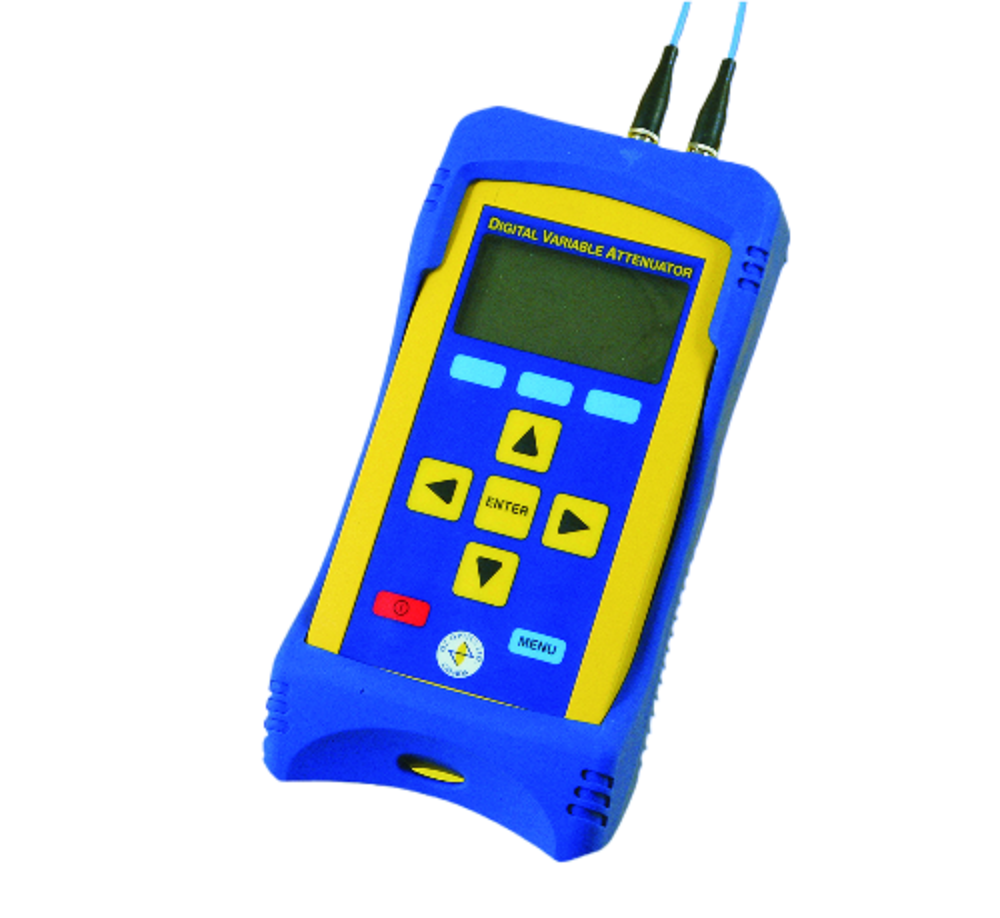
Hand-held Device; Fiber Type SM, MM, PM (PANDA); 350 to 2050 nm; Connector Type NTT-FC/PC, ST, SC, other; Attenuation IL to 40, 60 dB OZ Optics’ DA-100 series of compact, hand-held and rugged digital attenuators feature high resolution, high speed, high attenuation range and high power handling (blocking technique only). These CE approved attenuators have low insertion loss, low backreflection, low PDL and flat wavelength response. The DA-100 series of hand-held digital attenuators can be calibrated for up to four wavelengths, for C or L bands. Alternatively, the units can be calibrated for a continuous range. By using interpolation between the calibration wavelengths, the units are capable of providing accurate attenuation levels over a continuous, broad range of wavelengths. A computer interface allows users to access or remotely control the units through a PC. An optional, built-in rechargeable battery is available for field use, where AC power may not be readily accessible. OZ Optics provides digital attenuators that use either single mode, multi mode or polarization maintaining (PM) fiber. In general, OZ Optics uses polarization maintaining fibers based on the PANDA fiber structure when building polarization maintaining components and patchcords. However, OZ Optics can construct devices using other PM fiber structures. OZ Optics does carry some alternative fiber types in stock, so please contact AMS Technology for availability. If necessary, OZ Optics is willing to use customer supplied fibers to build devices. Key Features: CE Compliant, Hand-held Device Computer Interface (USB as Standard) Battery Option Available High Power Handling (up to 2 W) High Speed and Resolution- Wide Attenuation Range (from 350 to 2050 nm) Low PDL and Wavelength Dependency Low Insertion Loss and Backreflection Rugged and Compact Design Calibrated for Dual Wavelengths, (1300 to 1550 nm) or Calibrated for C and L Bands. Can also be Calibrated for up to Four Individual WavelengthsApplications: Bit Error Rate Testing; Trouble Shooting Receivers and Other Active Fiber Optic Components; Simulating Long Distance Fiber Transmission; Design of Fiber Optic Transmitter/Receiver Circuitry; Power Meter Linearity Checks; Power Setting
REQUEST PRICING AND AVAILABILITY
- Get your individual quote.
- Technical compatibility review included.
- Volume discounts available.
No obligation. Direct access to our engineering team.
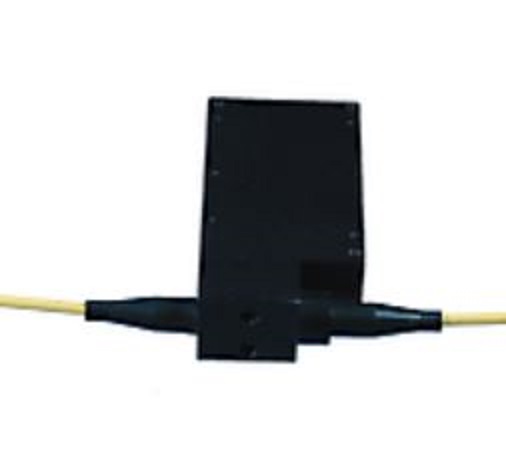
Electronically Controlled; Fiber Type SM, MM, PM (PANDA); 350 to 2050 nm; Connector Type NTT-FC/PC, ST, SC, other; Attenuation IL to 40, 60 dB OZ Optics DD series of compact PC board mountable motor driven variable attenuators with low backreflection offers excellent speed, repeatability, and accuracy. Single mode and polarization maintaining (PM) attenuators utilize a novel blocking style attenuation technique, while multimode attenuators use a variable neutral density filter to minimize mode dependent losses. Both types feature a homing sensor to calibrate the attenuator, removing the need to use external taps, and a jam-proof tuning mechanism.The PC version uses a reliable stepper motor that can be controlled by an external driver. The basic model allows direct access to the stepper motor, as well as a logic level output for HOME position information. The -DR option adds a high-speed driver circuit that accepts four logic level inputs to control the stepper motor. Finally, the -MC option features an embedded microcontroller with a programmed calibration curve. The units are addressable and support RS232, SPI, or I²C communication protocols.AMS Technologies and OZ Optics can also customize the design to fit your needs. There are smaller and faster versions if lower resolution is acceptable. Contact AMS Technologies for detailed specifications. Key Features: Stepper Motor Driven High Power Handling, High Speed and High Resolution Wide Attenuation Range (from 350 to 2050 nm) Wide Wavelength Range Low PDL and Wavelength Dependency Low Insertion Loss and Backreflection Rugged and Compact Design Computer Interface (-MC Version) SM, MM and PM Fiber Versions Available Applications: Active Gain Equalization in DWDM Systems; Local Power Monitoring and Feedback Attenuator Settings; Bit Error Testing; Trouble Shooting Receivers and Other Active Fiber Optic Components; Simulating Long Distance Fiber Transmission; Design of Fiber Optic Transmitter/Receiver Circuitry; Power Meter Linearity Checks; Power Setting and Power Control; OCT Systems
REQUEST PRICING AND AVAILABILITY
- Get your individual quote.
- Technical compatibility review included.
- Volume discounts available.
No obligation. Direct access to our engineering team.

980 to 1625 nm; Reflectance Range 2 to 60 dB; Fiber Type SM, MM, PM; PDL 0.05, 0.08 dB; Optical Max. Power Level Continuous 500 mW (MM), 50 mW (SM) OZ Optics’ DR-100 series of digital variable reflectors enables the user to generate a known level of return loss to evaluate system response. The unit allows testing the return loss sensitivity of devices such as laser diodes, transmitters, isolators and so on. By generating a precise reflection level, system performance (bit error rate, noise levels, isolator performance) can be evaluated. A built-in calibration table accurately defines intermediate degrees of reflection from 2 dB to as high as 60 dB for different wavelengths. DR-100 digital variable reflectors are offered using either single mode (SM), multi mode (MM), or polarization maintaining (PM) fibers. In general, OZ Optics uses polarization maintaining fibers based on the PANDA fiber structure when building polarization maintaining components and patch cords. However OZ Optics can construct devices using other PM fiber structures. OZ Optics also carries some alternative fiber types in stock, please contact AMS Technologies for availability. If necessary, OZ Optics is willing to use customer supplied fibers to build devices. For best results, the standard versions of the DR-100 series are designed to accept angled FC/PC connectors. Other connector types are possible with lower dynamic reflectance range. DR-100 digital variable reflectors can be controlled remotely via a USB interface. A universal AC/DC power supply is included with all units. The DR-100 digital variable reflectors can also be provided with a custom built-in fused coupler which directs a fraction of the reflected light to a second optical connector on the unit. The user can use this signal for monitoring the reflected power or determining the influence of reflected power on his device under test. For details, please contact AMS Technologies. Key Features: High Speed Wide Reflectance Range: 2 to 60 dB Low Insertion Loss High Resolution Rugged and Compact Design Wide Wavelength Range: 980 to 1625 nm Can Be Calibrated for Dual Wavelengths Wide Range of Connectors Polarization Insensitive USB Communications Interface Applications: Bit Error Rate Testing; Troubleshooting Receivers and Other Active Fiber Optic Components; Design of Fiber Optic Transmitter/Receiver Circuitry
REQUEST PRICING AND AVAILABILITY
- Get your individual quote.
- Technical compatibility review included.
- Volume discounts available.
No obligation. Direct access to our engineering team.
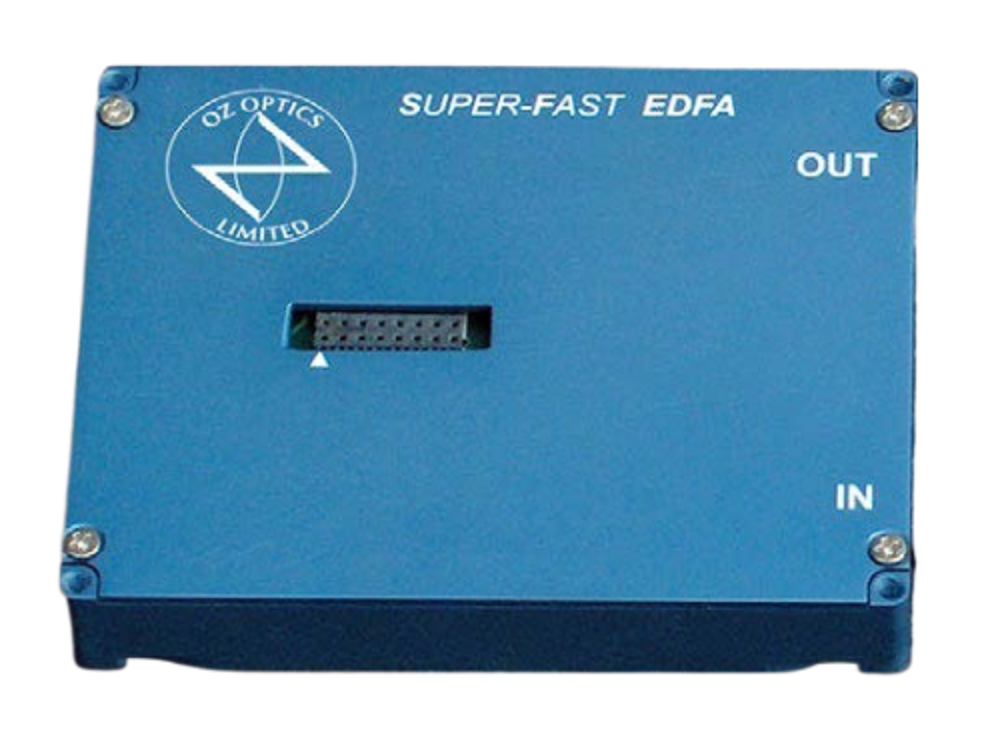
Super-fast, Auto Gain Controlled; Fiber Pigtail 9/125 µm; 1529.16-1558.58 nm; Input Power -19--11 dBm; Output Power 5-13 dBm OZ Optics’ super-fast Erbium-doped fiber amplifier module EDFA-11-9/125 was developed to address fast transient conditions with sub-μs suppression time. In a WDM transmission line, the addition or removal of channels may cause a transient, to which the EDFA must respond. In response to a sudden change of input power, an EDFA will exhibit transient response, i.e. overshoot or undershoot in its output signal. With a typical EDFA, this transient response can last on the order of 100 μs. OZ Optics’ super-fast Erbium-doped fiber amplifier module EDFA-11-9/125 features a typical transient suppression time of 50 ns and is designed to be used in the traditional C-band. During operation, the signal wavelengths must be confined to a 3.2 nm region for each optical amplifier, although the band may be anywhere within the C-band. The unit can work with up to four channels. Due to the nature of the narrowband operation, the transient suppression of the super-fast EDFA module is greatly improved, compared to a traditional EDFA. Key Features: Compact Design Super-fast, Auto Gain Controlled Operation Wavelength: 1529.16 nm to 1558.58 nm Input Power per Channel: -19 dBm to -11 dBm Output Power per Channel: 5 dBm to 13 dBm Sub-μs Transient Suppression Time: 50 ns Typ. Transient Undershoot/Overshoot: ≤±0.3 dB Auto Gain Control Over Wavelength and Signal Amplitude Low Noise: 5.5 dB Fixed 24 dB Gain, Independent of Wavelength and Signal Power Gain Flatness Within 3.2 nm Band (Relative to 24 dB): ±0.3 dB Polarization Dependent Gain: ≤0.3 dB Max. Polarization Mode Dispersion: 0.5 ps/√km Input/Output Return Loss (RL): 40 dB Residual Pump Power at Output: -25 dBm Fiber Pigtail: 9/125 µm, 1 m Length Connector Type: FC/APC Operating Temperature Range: 0°C to +70°C Dimensions: 90 x 70 x 14 mm Applications: ROADM Network; CATV/NETWORK Access; C-Band Channel Preamp
REQUEST PRICING AND AVAILABILITY
- Get your individual quote.
- Technical compatibility review included.
- Volume discounts available.
No obligation. Direct access to our engineering team.
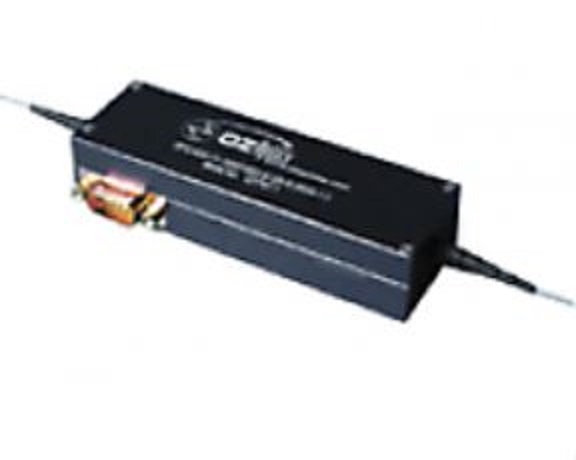
3 Stage Scramblers or 4 Stage Controllers Available; 1250 to 1650 nm (Others on Request); Insertion Loss <0.4 dB; Polarization Dependent Loss <0.06 dB; Fiber Type SM OZ Optics' EPC series of electrically driven polarization controllers provides a simple, efficient means to manipulate the state of polarization within a single mode (SM) fiber. Employing a novel mechanical fiber squeezing technique, the device is controlled by either three or four (depending on the model) input voltages that the user can vary over a ±5 V range to provide endless polarization control in a robust, easy to operate package. The EPC controllers’ rapid response speed easily handles changes in polarization caused by the external environment and is highly suitable for polarization scrambling for either averaging PDL effects or for making PMD or PDL measurements. Because the fiber within the device is continuous, all insertion losses, return losses, and PDL effects are limited only by the fiber itself. This makes it ideal for precise test and measurement applications. EPC polarization controllers are available in either a three or four channel configuration. The EPC-300 three-channel system is ideal for polarization scrambling applications such as for polarization averaging or PDL measurements. The added redundancy of the EPC-400 four-channel version opens the way to continuous polarization control, without having to occasionally reset the device when a controller reaches its limit. The unique design of the OZ Optics EPC series of polarization controllers means that they do not require any dedicated driver circuitry. There are no internal voltage multipliers or high voltage signals to worry about. Thus operation is safe and simple. Key Features: Negligible Insertion Losses Negligible Return Losses Negligible Polarization Dependent Losses (PDL) >100 Hz Response Speed Continuous Polarization Control Capability Low Voltage Applications: Polarization Scrambling; Polarization Stabilization; Polarization Mode Dispersion (PMD) Mitigation; Polarization Dependent Loss (PDL) Mitigation; PDL and PMD Measurement Systems; Interferometers and Sensors; OCT Systems
REQUEST PRICING AND AVAILABILITY
- Get your individual quote.
- Technical compatibility review included.
- Volume discounts available.
No obligation. Direct access to our engineering team.

Handheld Type; 400 to 2400 nm; Extinction Ratio Range 30, 35, 40 dB; Extinction Ratio Accuracy ±1 dB; Angular Accuracy ±0.5°; Adapter Type FC/PC, ST, E2000, SC, LC, MU, Universal 1.25/2.5 mm OZ Optics’ ER-100 series of polarization extinction ratio meters allows one to quickly measure the output extinction ratio of light from a fiber. A rotating polarizer measures the extinction ratio and the orientation of the transmission axis with respect to the key on the connector. As an option, neutral density filters can be added to the ER-100 extinction ratio meters to extend the maximum power range. These filters can be easily inserted and removed without disturbing your setup and allow power levels up to 2 W to be measured. The ER-100 meters operate in several modes. In real time mode, the meter gives the extinction ratio and alignment. In logging mode, the meter gives the worst-case extinction ratio over a given time span. This mode is ideal for QA measurements. In addition, the meter can provide a relative power readout, proportional to the input power in dB. This readout is updated at up to 650 times per second. The computer interface allows the unit to be used with computer control units, for alignment purposes. The combination of polarization and relative power functions allows the unit to be used for complete auto-alignment of polarization maintaining components. Key Features: Measures Extinction Ratio up to 40 dB (Over Specific Wavelength Ranges) Built-in USB Communications Interface Wide Wavelength Range: 400 to 1000 nm for Visible; 850 to 1650 nm and 1800 to 2400 nm for IR 0.01 dB Resolution in ER and 0.3° Resolution in Angle 1dB Accuracy in ER, 0.5° Accuracy in Angle Measures up to 2 W CW Input Power Rugged and Compact Design Logging Mode for Continuous Measurement Interchangeable Connector Adaptors Applications: Fiber Optic Component Manufacturing; Automated Alignment; Quality Control and Measurement; Product Development; Component or System Troubleshooting
REQUEST PRICING AND AVAILABILITY
- Get your individual quote.
- Technical compatibility review included.
- Volume discounts available.
No obligation. Direct access to our engineering team.

Benchtop Type; 450 to 2400 nm; Extinction Ratio Range 30, 35, 40 dB; Extinction Ratio Accuracy ±0.15, ±0.5 dB; Angular Accuracy ±0.5°; Adapter Type FC/PC, ST, E2000, SC, LC, MU, Universal 1.25/2.5 mm OZ Optics’ ER-1000 series of benchtop polarization extinction ratio meters allows one to quickly measure the output extinction ratio of light from a fiber. A rotating polarizer measures the extinction ratio (ER) and the orientation of the transmission axis with respect to the key on the connector. As an option, neutral density filters can be added to the ER-1000 extinction ratio meters to extend the maximum power range. These filters can be easily inserted and removed, without disturbing your setup and allow power levels up to 2 W to be measured. The ER-1000 meters operate in several modes. In real time mode, the meter gives the extinction ratio and alignment. In logging mode, the meter gives the worst-case extinction ratio over a given time span. This mode is ideal for QA measurements. In addition, the meter can provide a relative power readout, proportional to the input power in dB. This readout is updated at up to 650 times per second. The computer interface allows the unit to be used with computer control units, for alignment purposes. The combination of polarization and relative power functions allows the unit to be used for complete auto-alignment of polarization maintaining components. Key Features: Measures Extinction Ratio up to 50 dB (Over Specific Wavelength Ranges) Very Wide Wavelength Range: 450 to 900 nm for Visible; 850 to 1650 nm or 1800 to 2400 nm for IR ±0.15 dB ER Accuracy up to 30 dB, ±0.5° Accuracy in Angle 0.01 dB Resolution in ER and 0.3° Resolution in Angle Power Measurement up to 2 W Interchangeable Connector Adaptors Logging Mode for Continuous Measurement USB Communications Interface Touch Screen Display Built-in Memory for Store and Recall Functions Applications: Fiber Optic Component Manufacturing and Testing; PMC and PBS PER and Coupling Ratio Testing; PM Fiber Laser Diode Pigtailing; PM Fiber Patch Cord Production and Testing; PM Fiber Fusion Splice Testing; Automatic Alignment; Quality Control and Measurement; Product Development; Component and System Troubleshooting
REQUEST PRICING AND AVAILABILITY
- Get your individual quote.
- Technical compatibility review included.
- Volume discounts available.
No obligation. Direct access to our engineering team.
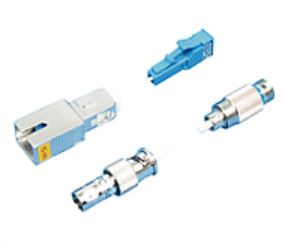
Plug, Receptacle & Loopback Types; 440 to 1625 nm; Attenuation 1 to 25 dB; Return Loss 50, 60 dB; Power Handling 50, 500 mW OZ Optics’ FA-300/400/500 line of low cost fixed attenuators are available in different configurations like hybrid male to female, bulkhead receptacle and loopback to best suit your particular application. Each configuration has its own strengths. The hybrid type is ideal for reducing the intensity of a signal just prior to going into a receiver. They are also available with different connector types on the input and output. The receptacle style is ideal when two male connectors need to be mated with a fixed attenuator. Finally, the loopback style attenuator is intended for patch panel installations. With its own technology to precisely attenuate signals in fibers, OZ Optics can create fixed attenuators within any standard fiber, with low polarization dependent loss (PDL) and high power handling. The resultant attenuating fiber is physically identical in appearance and behaviour to the original fiber, allowing it to be used to build male-female hybrid attenuators. Attenuating fiber can be made from either single mode and polarization maintaining (PM) fiber. PM attenuating fiber maintains polarization to better than 25 dB. Multimode fiber attenuators can also be made this way, provided the light travelling through the fiber is incoherent and uniformly excites the fiber modes. OZ Optics’ single mode plug type attenuators use attenuating fibers that are specially doped to reduce the intensity of the light. The fibers also feature a double cladding, with an absorbing dopant in the inner cladding layer, effectively suppressing light scattering into the cladding. Thus, the readings will not significantly depend on the application. This is a key advantage of the OZ Optics single mode hybrid style fixed attenuator (Note: Multi mode plug style attenuators do show cladding modes). These attenuators have been tested in accordance with Telcordia standards. Hybrid male-female attenuators are available with between 0.5 to 20 dB attenuation, in 0.1 dB increments. Higher attenuation levels and higher resolution attenuation steps are possible. Attenuators can be made for operating wavelengths from 488 nm to 1650 nm. Prototype and custom designs can be made quickly and in small volumes economically.Bulkhead receptacle style fixed attenuators also use attenuated doped fiber and are available in female to female configurations for FC, SC and ST types. Finally, OZ Optics multimode loopback attenuators use a special attenuating filter inside. This provides uniform attenuation, regardless of the source being used. Many other loopback style fixed attenuators on the market use a high loss splice to attenuate the light. In multimode fibers this method is not recommended because the attenuation of the splice will greatly depend on the launch conditions from the source. OZ Optics’ loopback style attenuators avoid this problem. Key Features: Low Backreflection Wide Wavelength Range Polarization Insensitive Compact and Rugged Housings Wide Range of Connectors/Receptacles Hybrid Style Attenuator Uses Attenuating Fiber Mode Independent Multi Mode Loopback Attenuators Designed to Meet Telcordia Requirements Applications: Optical Power Equalization; CATV, LAN and Telecommunications; Test and Measurement; Channel Balancing for WDM Systems; Receiver Padding; Optical Transmission Systems
REQUEST PRICING AND AVAILABILITY
- Get your individual quote.
- Technical compatibility review included.
- Volume discounts available.
No obligation. Direct access to our engineering team.