
GTL-FBG-TB-890 Tunable Fiber Bragg Gratings


REQUEST PRICING AND AVAILABILITY
- Get your individual quote.
- Technical compatibility review included.
- Volume discounts available.
No obligation. Direct access to our engineering team.
Product information "GTL-FBG-TB-890 Tunable Fiber Bragg Gratings"
Wavelength 600-2300 nm; Bandwidth 0.05-1.2 nm; Reflectivity 5-99%; SLSR >8 dB; Fiber Type SM, PM, Double Clad, LMA, Custom; Fiber Pigtail Length ≥0.5, Custom
Greitlex Photonics’ GTL-FBG-TB-890 tunable fiber Bragg gratings (FBGs) are a good solution for many applications – including those requiring a corrected central Bragg wavelength. An FBG’s central wavelength strongly depends on applied stress, with the mechanically induced strain linearly shifting the FBG’s central wavelength.
The tunable fiber Bragg grating wavelength’s relative strain sensitivity is 0.78 * 10-6 µstrain-1. GTL-FBG-TB-890 tunable fiber Bragg gratings are boxed and operated manually. Athermal performance with an adjustment range of 2 nm is also possible. The gratings are available as bare fibers or with a variety of optical connectors. These FBGs replace similar products from the former FORC Photonics.
The following configurations can be changed at the customer's request, please contact AMS Technologies to discuss a customized tunable fiber Bragg grating solution tailored to your project’s requirements.
Key Features:
- Wavelength Range: 600 nm to 2300 nm
- Wavelengths to Quick Order [nm]: 633, 780, 794, 797, 799, 801, 809, 830, 852, 895, 940, 976, 1030, 1057, 1060, 1064, 1080, 1125, 1150, 1178, 1240, 1270, 1310, 1484,1510 - 1580, 1650, 1900, 1908, 1952, 2300
- Fiber Type: Single Mode (SM), Polarization Maintaining (PM), Double Clad, LMA, Custom
- Thermal Wavelength Stability (0°C to +60°C): <0.18 nm
- Reflectivity: 5% to 99%
- Bandwidth (WFHM): 0.05 nm to 1.2 nm
- FBG Length: 1 mm to 20 mm
- Adjustment Range: 2 nm
- SLSR: >8 dB
- FBG Pigtail Length: ≥0.5 m
- FBG Recoating: On Customer Request
- Tensile Strength: >100 kpsi
- Optical Connector: Bare Fiber, FC/APC, LC/APC, Custom
- Package Dimensions: 66 x 18 x 16 mm
Applications: Where Corrected Central Bragg Wavelength is Necessary
Customers also viewed
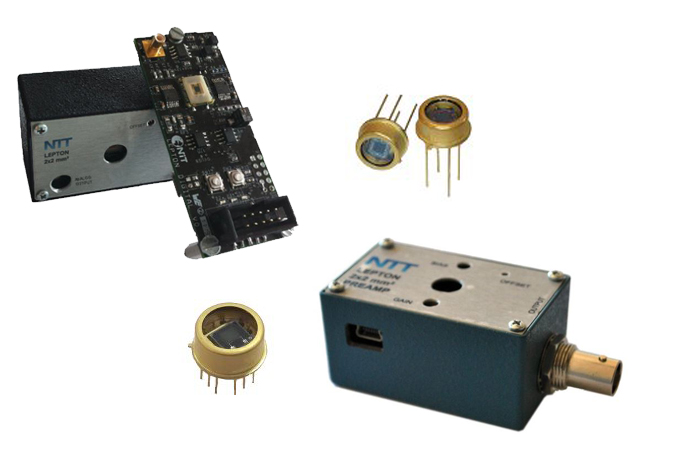
Wavelength Range 1.0-5.0 µm MWIR; Detector Size 1x1, 2x2 mm; Time Constant <2 µs; Responsivity 9x10³, 4.5x10³ V/W; Element Resistance 0.1-2.0 MΩ New Infrared Technologies’ (NIT) LEPTON Series of single-pixel VPD PbSe MWIR detectors are available uncooled as well as with integrated TECs (thermoelectric cooling elements), with different geometries, packaging solutions and preamplifier boards. LEPTON Series single-pixel detectors come in two standard sizes: 1 mm × 1 mm or 2 mm × 2 mm. LEPTON Series uncooled single-pixel PbSe MWIR detectors can be ordered packaged in SMD or TO-5 housings (with cap, hermetic) with sapphire window. These detectors are operational at room temperature and don’t require any cooling devices. LEPTON Series cooled single-pixel PbSe MWIR detectors are hermetically packaged in a TO-8 can housing with cap and sapphire window and include one or two thermoelectric cooler (TEC) stages for higher sensitivity as well as a thermistor. A calibration curve for the thermistor is available. NIT’s LEPTON Series also includes two low-noise preamplifier boards that are 5-V-powered via mini-USB connector: The LEPTON ANALOG PREAMP provides rotary switches to manually select the detector biasing voltage (4 steps from 1.25 V to 10 V) as well as the transimpedance gain (4 steps from 104 to 107 V/A). This preamp outputs a ±10 V analog voltage on a BNC connector. The LEPTON PREAMP WITH USB OUTPUT allows to digitally select the values for detector biasing voltage and transimpedance gain via software. Here, the output is a digital 14 Bit signal with a maximum sampling rate of 20 ksps. This preamp also features an analog output for the preamplifier stage on SMB or BNC connector. For more pixels, linear and two-dimensional array MWIR cameras are available from New Infrared Technologies – please refer to the LUXELL series of linear array MWIR cameras and TACHYON series of high-speed imaging MWIR cameras respectively. Key Features: Detector Sensing Material: VPD Polycrystalline PbSe Uncooled and TEC-cooled (1-stage, 2-stages) Versions Available Square Pixels, Available Pixel Geometries: 1 x 1 mm, 2 x 2 mm Packaging: SMD (10x10 mm) Non-hermetic, TO-5 (9.14 mm Dia.) Hermetic With Cap, TO-8 (15.24 mm Dia.) Hermetic With Cap Sapphire Window IR Detection Band: MWIR, 1.0 µm to 5.0 µm Peak Wavelength of Detection: 3.7 µm D* (λpeak) Uncooled: 2x10⁹ Jones Typical D* (λpeak, 1,000 Hz, 1.2 Hz) Cooled: 1x10¹⁰ Jones Time Constant: <2 µs Biasing Voltage: 5 V, 10 V Typical Element Resistance: 0.1 to 2.0 MΩ Responsivity (@Vb = 10 V): 9x10³ V/W (1x1 mm), 4.5x10³ V/W (2x2 mm) Power: 1 mW Read-out Electronics External (Not Included) Customizable Operating Temperature: +5 °C to +70 °C (SMD), -40 °C to +85 °C (TO-5, TO8) Amplifier Board Transimpedance Gain: 104 to 107 V/A, Adjustable Manually or per Software Amplifier Board Dark Current Cancellation: 1.24 µA to 1 mA, Adjustable Manually or per Software Amplifier Board Power Supply: 5 VDC, 60 mA (mini-USB Connector) Amplifier Board Output: Analog (±10 V), Digital (14 Bit) Amplifier Board Noise: 5 pA @1 kHz, 107 V/A Amplifier Board Dimensions: 75.90 x 35.10 x 28.70 mm (Analog), 89.30 x 35.10 x 26.30 mm (USB Output) Applications: Gas & Flame Detection; Laser Detection
REQUEST PRICING AND AVAILABILITY
- Get your individual quote.
- Technical compatibility review included.
- Volume discounts available.
No obligation. Direct access to our engineering team.

Wavelength 600-2300 nm; Bandwidth 0.1-1.2 nm; Reflectivity 0.5-99.9%; SLSR ~8, ~10 dB; Fiber Type SM, PM, Double Clad, LMA, Radiation Resistant, Custom; Fiber Pigtail Length ≥0.5, CustomFiber Bragg gratings (FBGs) have many applications in optical communication, laser technique and sensing systems. Greitlex Photonics’ series of specific application FBGs are widely used for applications like in-fiber mirrors or optical filters with narrowband optical spectrum. Fiber Bragg gratings also are one of the most popular elements in the field of fiber-optic sensing.Within Greitlex Photonics’ series of specific application fiber Bragg gratings (FBG) you find:Wavelength Locker FBGsWDM ITU Filter 100/200 GHz FBGsRaman Laser FBGsFabry-Perot Interferometer FBGsHard Environment FBGsRadiation Hard FBGsGTL-FBG-WL-810 wavelength locker fiber Bragg gratings are used as external reflectors for laser diodes. With the help of these FBGs it is easy to stabilize the wavelength generation of pump semiconductor lasers and single-frequency lasers. Low-reflection gratings with a full width at half maximum (FWHM) bandwidth of 0.3 nm to 0.8 nm and a reflectivity of 2% to 5 % are ideal for stabilizing pump power lasers. FBGs with FWHM bandwidths around 0.1 nm and reflections of 10% to 20% are used close to semiconductor laser crystals for creation of single-frequency sources. Greitlex Photonics provides wavelength locker FBGs with very accurate wavelength positions (up to ±0.02 nm).Greitlex Photonics’ GTL-FBG-WDM-810 series of WDM ITU Filter 100/200 GHz fiber Bragg gratings with narrow spectral bandwidth are good elements for filtering optical signals. Such FBGs are widely used as optical add/drop multiplexer in WDM systems. A high level of SLSR is allowed to avoid adjacent channel crosstalk in systems. These FBGs feature a flat-top reflection spectrum and steep spectral roll-down. Athermal packaging of the FBG with wavelength stability <0.16 nm for a temperature range of 0°C to +70⁰C is required for stable operation.Highly efficient multi-cascaded Raman lasers based on phosphosilicate fibers can be created at different wavelength using our GTL-FBG-RL-880 Raman laser fiber Bragg gratings. Compared to Germanium-doped fibers, an approximately three times larger Raman shift can be achieved.For many applications where very small temperature or strain changes have to be measured using acoustic waves, the sensitivity can be enhanced by using pairs of FBGs. A Fabry-Perot interferometer based on Greitlex Photonics’ GTL-FBG-FPI-810 Fabry-Perot interferometer fiber Bragg gratings is such a pair of FBGs, allowing to detect a small phase shift. By coating the fiber between the gratings with an electric, magnetic or acoustic enhancing coating, very small changes of these fields can be measured. For sensing purposes and to evaluate small vibration or acoustic signals via an interferometric method, it is often sufficient to work with a low-finesse Fabry-Perot cavity.GTL-FBG-HE-810 hard environment fiber Bragg gratings can be provided as separated or chains of FBGs with different wavelengths, allowing for multipoint temperature monitoring. Different types of single mode (SM) optical fibers and fiber coatings can be used for writing these gratings. High-temperature acrylate coated fibers apply for temperature ranges up to +150°C. Polyimide or metal (Cu, Al) coated fibers are used for high-temperature applications with maximum temperatures of +300°C and +500°C respectively. Using a steel tube protection, our hard environment FBGs can be applied up to +700°C.GTL-FBG-RH-880 radiation hard fiber Bragg gratings written in radiation resistant pure silica core fibers are ideal for applications in the atomic energy industry, aerospace and other radiation intense environments.All those FBGs replace similar products from the former FORC Photonics. Key Features:The following configurations can be changed at the customer's request, please contact AMS Technologies to discuss an application-specific, customized fiber Bragg grating solution tailored to your project’s requirements. GTL-FBG-WL-810 Wavelength Locker FBGs GTL-FBG-WDM-810 WDM ITU Filter 100/200 GHz FBGs GTL-FBG-RL-880 Raman Laser FBGs GTL-FBG-FPI-810 Fabry-Perot Interferometer FBGs GTL-FBG-HE-810 Hard Environment FBGs GTL-FBG-RH-880 Radiation Hard FBGs Wavelength Range [nm] 630 - 2300 1530 - 1565 (C Bands) or Custom 1510 - 1580 1240, 1270, 1484 600 - 2300 1000 - 2300 Wavelengths to Quick Order [nm] 30 values between 633 and 2300 - - - 30 values between 633 and 2300 - Fiber Type Single Mode (SM), Polarization Maintaining (PM), Custom Single Mode (SM) Corning SMF-28 Single Mode (SM), Polarization Maintaining (PM), Double-clad, LMA, Custom Single Mode (SM), Polarization Maintaining (PM), Radiation Resistant, Custom Single Mode (SM), Polarization Maintaining (PM), Double-clad, LMA, Custom Single Mode (SM), Polarization Maintaining (PM), Radiation Resistant, Custom Reflectivity [%] 2 - 5, 10 - 20 10 - 99, Flat-top Typical > 99.5 5 - 99.9 0.5 - 99 Bandwidth (WFHM) [nm] 0.3 - 0.8, 0.1 - 0.15 100/200 GHz on ITU For 100 GHz: @-0.5 dB >0.3 nm, @-20 dB 0.65 nm 0.15 - 1.2 0.3 - 0.8 0.15 - 0.8 0.3 - 0.5 Distance Between FBGs [mm] - - - 1 - 200, Custom - - Channel Isolation [dB] - -20 - - - - Insertion Loss [dB] - <0.15 - - - - Cladding Mode Loss [dB] - <0.5 (Only for Cladding Mode Suppressed Fiber) - - - - SLSR [dB] ~10 - ~8 - ~8 ~8 FBG Pigtail Length [m] ≥0.5, Custom FBG Recoating None, Acrylate, Polyimide, Aluminium, Copper, Custom None, Acrylate, Polyimide, Custom None, Acrylate, Polyimide, Aluminium, Copper, Custom Tensile Strength [kpsi] >100 - >100 Thermal Wavelength Stability (0°C - +70°C) [nm] - <0.16 - - - - Optical Connector Bare Fiber, FC/APC, LC/APC, Custom Package Dimensions LxWxH [mm] - 66 x 18 x 12 - - - - Applications: External Reflectors for Laser Diodes; Filtering Optical Signals; Optical Add/Drop Multiplexer in WDM Systems; Measuring Small Temperature or Strain Changes; Evaluating Small Vibration or Acoustic Signals; Multi-cascaded Raman Lasers; High-temperature Applications; Atomic Energy Industry; Aerospace
REQUEST PRICING AND AVAILABILITY
- Get your individual quote.
- Technical compatibility review included.
- Volume discounts available.
No obligation. Direct access to our engineering team.

Cut off Wavelength 650, 1000 nm; Mode Field Dia. 2.0, 4.3 µm; Zero-dispersion Wavelength 800 to 1000 nm; Optical Loss <30, <100 dB/kmGreitlex Photonics’ HN-PCF series is a new type of fibers, so-called micro-structured or photonic crystal fibers. This type of fibers features holes or inclusions of a material with different refractive index in the core and/or in the cladding.New dispersion and nonlinear properties can be observed in photonic crystal fibers. Most of the specific applications for micro-structured fibers require their own specific structure of the fiber. Greitlex Photonics has the capabilities to design and fabricate a broad variety of fiber structures according to customer orders.Other parameters are available on the request.The HN-PCF-800 fiber is specially designed for supercontinuum generation using Ti-sapphire ultra-fast femtosecond lasers, while the HN-PCF-1040 fiber is specially designed for supercontinuum generation using Yb-doped picosecond or femtosecond ultra-fast fiber lasers. They replace similar products from the former FORC Photonics. Key Features:Mode Field Diameter: 2.0, 4.3 µmZero-dispersion Wavelength: 800 to 1000 nmNonlinear Coefficient: 10, 90 1/W*kmOptical Loss: <30, <100 dB/kmCut off Wavelength: 650, 1000 nmApplications: Supercontinuum Generating Using Ti-sapphire or Yb-doped Ultra-fast Lasers
REQUEST PRICING AND AVAILABILITY
- Get your individual quote.
- Technical compatibility review included.
- Volume discounts available.
No obligation. Direct access to our engineering team.

Wavelength 600-2300 nm; Bandwidth 0.05-1.2 nm; Reflectivity 5-99%; SLSR >8 dB; Fiber Type SM, PM, Double Clad, LMA, Custom; Fiber Pigtail Length ≥0.5, CustomFiber Bragg gratings (FBGs) are sensitive to changes in temperature, their thermal sensitivity is about 6.7 ppm/K (+0.11 pm/K @1550 nm). Greitlex Photonics’ GTL-FBG-AP-850 athermal packaged fiber Bragg gratings are intended for passive compensation of the FBG’s thermal sensitivity by matching the case elements’ expansion with the FBG’s wavelength shift under the influence of temperature. This technology allows customers to achieve all advantages of fiber Bragg gratings, while preserving a high wavelength stability within a wide temperature range.The following configurations can be changed at the customer's request, please contact AMS Technologies to discuss a customized athermal packaged fiber Bragg grating solution tailored to your project’s requirements.These FBGs replace similar products from the former FORC Photonics. Key Features:Wavelength Range: 600 nm to 2300 nmWavelengths to Quick Order [nm]: 633, 780, 794, 797, 799, 801, 809, 830, 852, 895, 940, 976, 1030, 1057, 1060, 1064, 1080, 1125, 1150, 1178, 1240, 1270, 1310, 1484,1510 ÷ 1580, 1650, 1900, 1908, 1952, 2300Fiber Type: Single Mode (SM), Polarization Maintaining (PM), Double Clad, LMA, CustomThermal Wavelength Stability (0°C to +70°C): <0.16 nmReflectivity: 5% to 99%Bandwidth (WFHM): 0.05 nm to 1.2 nmFBG Length: 1 mm to 20 mmSLSR: ~8 dBFBG Pigtail Length: ≥0.5 mTensile Strength: >100 kpsiOptical Connector: Bare Fiber, FC/APC, LC/APC, CustomPackage Dimensions: 66 x 18 x 12 mmApplications: Passive Compensation of FBG Thermal Sensitivity; Applications Requiring High Wavelength Stability in a Wide Temperature Range
REQUEST PRICING AND AVAILABILITY
- Get your individual quote.
- Technical compatibility review included.
- Volume discounts available.
No obligation. Direct access to our engineering team.

The Ray1 and Ray1 EX SWIR cameras from Ray Imaging Solutions Ltd. are compact, high‑performance imaging solutions designed to deliver reliable short‑wave infrared (SWIR) data in demanding environments. Built around advanced colloidal quantum dot sensor technology, these cameras combine wide spectral sensitivity, integrated thermal management, and flexible software support into a robust, ready‑to‑deploy platform. Whether used in industrial inspection, scientific research, or machine vision systems, the Ray1 family offers a powerful balance between performance, usability, and form factor.Both models are engineered for seamless integration. With integrated cooling, standardized mounts, and common development interfaces, the Ray1 and Ray1 EX reduce the time and effort required to move from evaluation to deployment. The standard Ray1 covers the core SWIR band up to 1,700 nm, while the Ray1 EX extends sensitivity to 2,200 nm, enabling imaging capabilities well beyond visible and near‑infrared systems.Key featuresQuantum dot SWIR sensor technology The Ray1 series utilizes colloidal quantum dot sensor technology to deliver high sensitivity across the SWIR spectrum. This approach provides excellent performance at a competitive size and cost, making advanced infrared imaging accessible for a wide range of applications.Two spectral configurations for different needs The Ray1 offers sensitivity from 900 nm to 1,700 nm, ideal for standard SWIR inspection and imaging tasks. The Ray1 EX extends the wavelength range to 2,200 nm, enabling detection of additional material properties and phenomena that are invisible at shorter wavelengths.High‑quality VGA imaging Both cameras feature a VGA resolution of 640 × 512 pixels with a 15 µm square pixel size and a sensor area of 9.68 × 7.68 mm. With over 99.9 % operating pixels and a dynamic range of 65 dB, they provide clean, detailed images suitable for quantitative analysis.Integrated lens and flexible optics The Ray1 includes an integrated 25 mm lens with an adjustable f‑number from f/1.4 to f/22, delivering flexibility in depth of field and light control. A C‑mount interface and support for multiple lens options allow system designers to tailor the field of view and working distance, from close‑range inspection at 0.3 m to infinity.Thermoelectric cooling for stable performance An integrated thermoelectric cooler (TEC) minimizes dark noise and stabilizes sensor performance across varying temperatures. This is especially important for long measurement sessions and low‑light SWIR applications where image consistency is critical.Compact, rugged design With camera dimensions of just 68 × 70 × 60 mm, the Ray1 family fits easily into space‑constrained systems. The aluminum housing provides durability and efficient heat dissipation. The Ray1 configuration weighs approximately 665 g with lens, while the Ray1 EX weighs around 520 g.Efficient power and data interfaces Both models operate from a 12 V DC supply and consume approximately 5.5 W with TEC enabled. Data transfer is handled through USB 3.0 Micro‑B, supporting frame rates of up to 20 fps for responsive imaging and analysis.Cross‑platform software support Ray Imaging Solutions provides an SDK supporting C++, C#, and Python, ensuring easy integration into existing software environments. The cameras are compatible with Windows, Ubuntu, and NVIDIA Jetson platforms, making them suitable for both desktop and embedded systems.ApplicationsIndustrial inspection and process control, Semiconductor and electronics analysis, Scientific research and laboratory imaging, Security, surveillance, and environmental sensing What’s next?The Ray1 and Ray1 EX cameras are designed as long‑term platforms that can evolve alongside your application. Users can start with a standard configuration and later expand capabilities through alternative optics, embedded deployment on platforms such as NVIDIA Jetson, or integration into multisensor systems. As quantum dot technology continues to advance, Ray Imaging Solutions is well positioned to support future enhancements in sensitivity, efficiency, and software functionality.For developers, integrators, and researchers looking to unlock the advantages of SWIR imaging in a compact and accessible form, the Ray1 and Ray1 EX provide a strong foundation today—and a flexible pathway for innovation tomorrow.
REQUEST PRICING AND AVAILABILITY
- Get your individual quote.
- Technical compatibility review included.
- Volume discounts available.
No obligation. Direct access to our engineering team.