
FF Fixed Filters

REQUEST PRICING AND AVAILABILITY
- Get your individual quote.
- Technical compatibility review included.
- Volume discounts available.
No obligation. Direct access to our engineering team.
Product information "FF Fixed Filters"
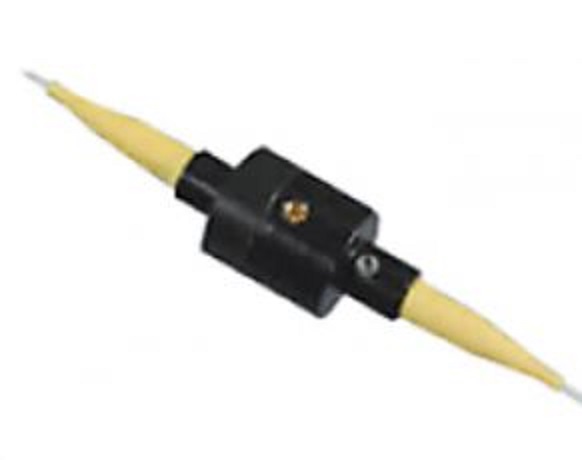
Pigtail or Removable Style; 400 to 2100 nm; Line Width 0.3 nm; Insertion Loss 0.6 dB; Fiber Type SM, MM, PM; Connector Type FC/PC, ST, SC, LC, MU, None
OZ Optics’ FF series of fixed filters transmit or block specific wavelengths of light as they travel through the optical fiber. Light from the input fiber is first collimated and passed through the filter. The beam is then focused into the output fiber.
Filter linewidths are normally defined in terms of full width at half maximum (FWHM). The standard filters used have a smooth, rounded transmission spectrum that is the result of a single Fabry Perot type cavity, simply made up of two reflectors separated by a fixed spacer of some thickness.
Other filter designs are available. For instance, flat top bandpass filters are made by stacking multiple cavities together. By increasing the number of cavities one can increase the roll-off slope therefore improving the out-of-band rejection level. Please contact AMS Technologies for custom filter designs that meet your requirements.
Fixed filters using single mode (SM), multi mode (MM) or polarization maintaining (PM) fibers are offered. In general, OZ Optics uses polarization maintaining fibers based on the PANDA fiber structure when building polarization maintaining components and patch cords. However, OZ Optics can construct devices using other PM fiber structures. OZ Optics also carries some alternative fiber types in stock, please contact AMS Technologies for availability. If necessary, OZ Optics is willing to use customer supplied fibers to build devices.
For tunable filters refer to OZ Optics’ TF-100 series of digital tunable filters, TF-100-11 series of motor driven tunable filters, TF-11 series of manually adjustable polarization insensitive tunable filters, BTF-11 series of manually adjustable variable bandwidth tunable filters or BTF-100 series of motorized adjustable variable bandwidth tunable filters.
Key Features:
- Narrow Line Widths
- Rugged and Compact Size
- Removable Filter Holder Designs
- Wide Wavelength Range
- Single Mode (SM), Multi Mode (MM) and Polarization Maintaining (PM) Fiber Versions
- Expanded Beam Technology
Applications: Dense Wavelength Division Multiplexing; CATV, LAN and Telecommunications Use; Test and Measurement
Downloads
Customers also viewed
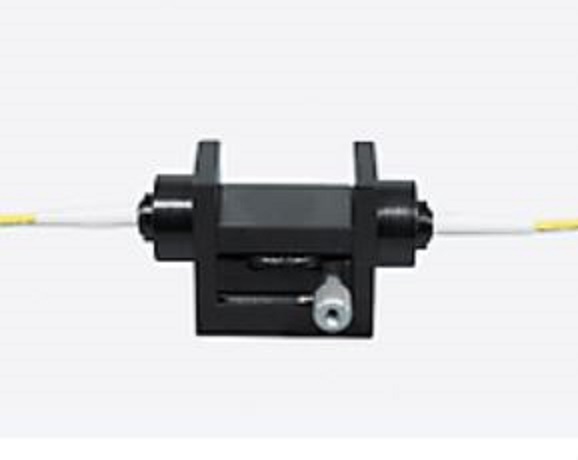
Polarization Insensitive; 1470 to 1620 nm; Line Width 1.1 nm, 0.3 nm Optional; Insertion Loss <2.5 dB; PDL <0.3 dB; Fiber Type SM, MM, PM; Connector Type FC/PC, ST, SC, LC, MU, None OZ Optics’ TF-11 series of manually adjustable polarization insensitive tunable filters consist of a collimating optical assembly, an adjustable narrow bandpass filter and a focusing optical assembly to collect the light again. The TF-11 series are pigtailed components with a rotating stage that allows for manual adjustment of the angle of incidence between the filter and the incident beam, thus controlling the wavelength at which the filter transmits. Filter linewidths are normally defined in terms of full width at half maximum (FWHM). The standard filters used have a smooth, rounded transmission spectrum that is the result of a single Fabry Perot type cavity, simply made up of two reflectors separated by a fixed spacer of some thickness. Other filter profiles are available. For instance, flat top bandpass filters are made by stacking multiple cavities together. By increasing the number of cavities one can increase the roll-off slope therefore improving the out-of-band rejection level. Please contact AMS Technologies for custom filter designs that meet your requirements. OZ Optics tunable filters utilize an optical technique to control polarization dependent loss (PDL). This new design reduces PDL to below 0.3 dB, while at the same time making the spectral response polarization insensitive. This feature makes the TF-11 series ideal for today's DWDM system applications. Tunable filters using single mode (SM), multi mode (MM) or polarization maintaining (PM) fibers are offered. In general, OZ Optics uses polarization maintaining fibers based on the PANDA fiber structure when building polarization maintaining components and patch cords. However, OZ Optics can construct devices using other PM fiber structures. OZ Optics also carries some alternative fiber types in stock, please contact AMS Technologies for availability. If necessary, OZ Optics is willing to use customer supplied fibers to build devices. In addition to the TF-11 series of manually adjustable polarization insensitive tunable filters, OZ Optics provides four further series of tunable filters – BTF-11 series of manually adjustable variable bandwidth tunable filters, TF-100 series of digital tunable filters, TF-100-11 series of motor driven tunable filters, and finally BTF-100 series of motorized adjustable variable bandwidth tunable filters. If you are looking for filters with a fixed wavelength, have a look at OZ Optics’ FF series of fixed filters. Key Features: Narrow Linewidth Polarization Insensitive Wide Wavelength Range Single Mode (SM), Multi Mode (MM) and Polarization Maintaining (PM) Fiber Versions High Resolution Applications: Dense Wavelength Division Multiplexing; Tunable Sources; Spectral Analysis; Quality Control and Measurement; Product Development; Fiber Optic Component Manufacturing
REQUEST PRICING AND AVAILABILITY
- Get your individual quote.
- Technical compatibility review included.
- Volume discounts available.
No obligation. Direct access to our engineering team.

Flexure Mechanism; Aluminum/Steel/Stainless Steel; Optic Size from 12.7 mm (0.5 inch) to 101.6 mm (4.0 inch); Different Thread Types The IXF series is a unique, monolithic flexure mount found nowhere else in the industry. Unlike other flexure designs, they have lockable 100TPI adjustment screws that have a rolled-cap design to guarantee that the flexure will not be forced past its elastic limit. Three versions are available: steel-bulkhead mounted, steel bulkhead/post mounted, and aluminum-bulkhead/post mounted. The steel-bulkhead mounted version (IXF1.0, IXF.75, and IXF.50) has 4-40 tapped holes on two sides and is electroless nickel plated. The steel-bulkhead/post version (IXF1.0i, IXF.75i, and IXF.50i) has the 4-40 tapped holes on only one side, and has 8-32 (M4) tapped holes on two edges, as well as lock screws for the fine pitch 100TPI adjustment screws. This model is also electroless nickel plated. For vacuum compatible and flight-ready applications, Siskiyou developed a method to produce a spring-loading effect in an aluminum version. The aluminum version (IXF1.0a, IXF.75a, and IXF.50a) has the same features and performance specifications as the steel bulkhead/post version.
REQUEST PRICING AND AVAILABILITY
- Get your individual quote.
- Technical compatibility review included.
- Volume discounts available.
No obligation. Direct access to our engineering team.