EPC-3000 OEM High-Speed Polarization Controller/Scrambler
Product information "EPC-3000 OEM High-Speed Polarization Controller/Scrambler"

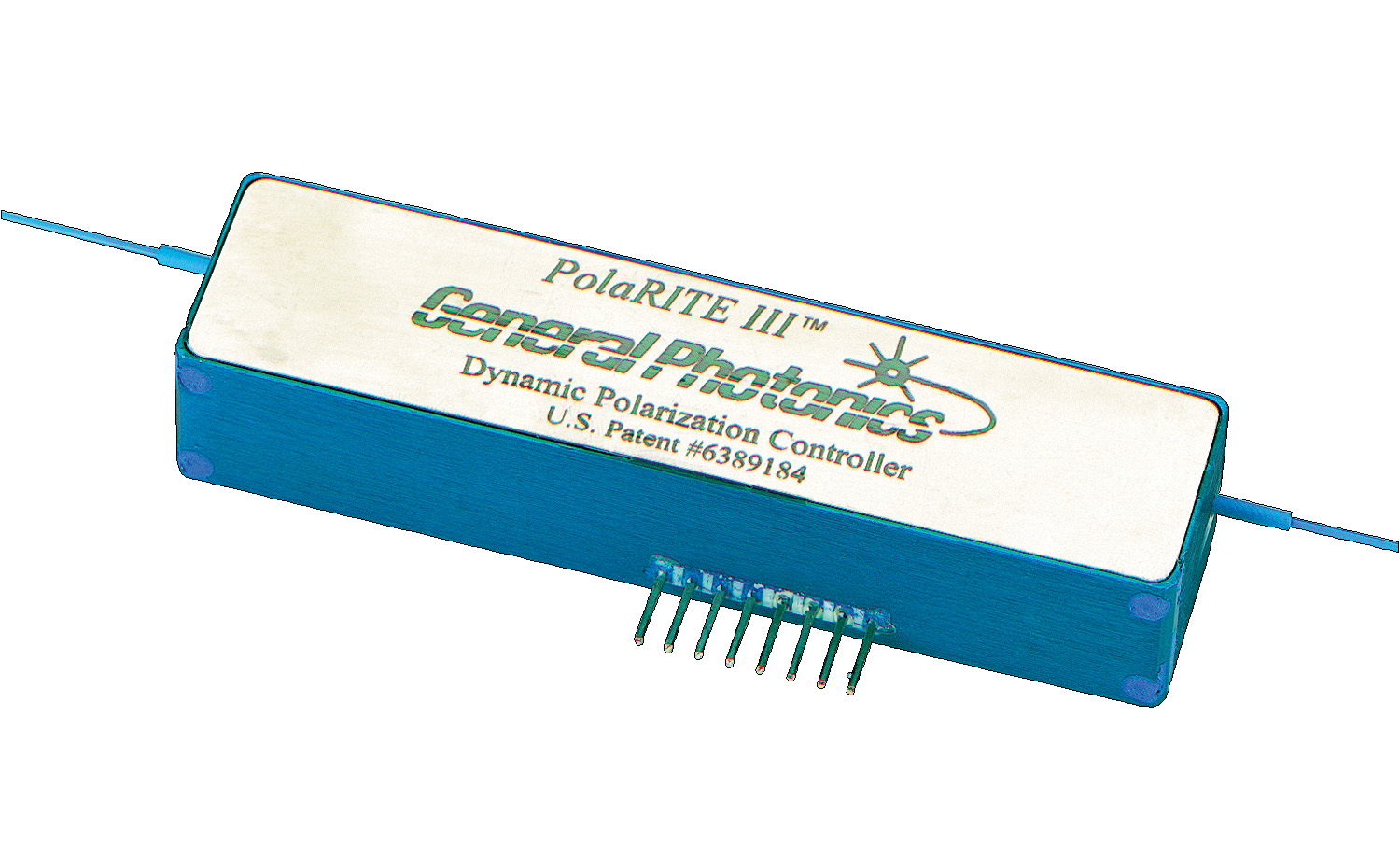
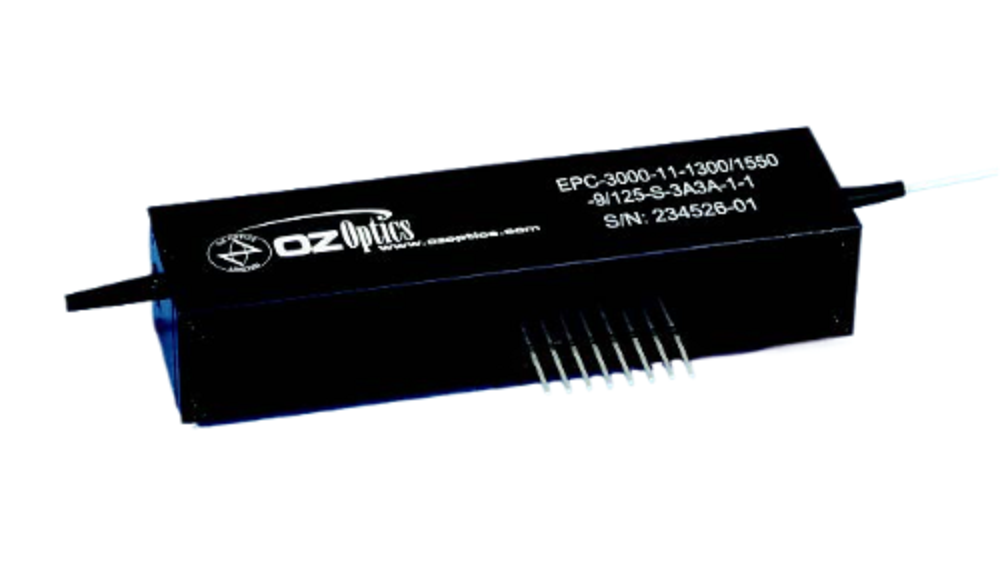
3 or 4 Control Channels; 1250-1650 nm, Other; Insertion Loss 0.05 dB; Polarization Dependent Loss <0.06 dB; Fiber Type SM, OtherOZ Optics' EPC-3000 high-speed electrically driven polarization controller provides a simple, efficient means to quickly manipulate the state of polarization within a single mode (SM) fiber. Employing a novel fiber squeezing technique, the device is controlled by either three or four (depending on the model) input voltages to provide endless polarization control and scrambling in a robust, easy to operate package.

The EPC-3000 controller's rapid response speed easily handles changes in polarization caused by the external environment and is highly suitable for polarization controlling and scrambling for either averaging PDL, PDG effects, or for making PMD, PDL or DOP measurements. Because the fiber within the device is continuous, all insertion losses, return losses, and PDL effects are limited only by the fiber itself. This makes the EPC-3000 ideal for precise test and measurement applications.

The polarization controller is available in either a three or four channel configuration. The three-channel system is ideal for polarization scrambling applications such as for polarization averaging, PDL or PDG measurements. The added redundancy of the four-channel version opens the way to continuous polarization control, without having to occasionally reset the device when a controller reaches its limit.

The innovative design of the OZ Optics EPC-3000 high-speed polarization controller provides an integrated module that allows users easily to implement the polarization controller in their systems with both analog and digital inputs.

Key Features:

  • Negligible Insertion Loss: 0.05 dB (Excluding Connectors)
  • Negligible Return Loss
  • Negligible Polarization Dependent Loss (PDL)
  • Continuous Polarization Control Capability
  • Compact and PCB Compatible
  • Up to 2 kHz Response Speed and 30 kHz at Resonance Frequency
  • Number of Control Channels: 3, 4
  • Voltage Range: 0 V to 140 V
  • Typ. Input Capacitance (Each Channel): 0.2 μF
  • -3dB Bandwidth: >30 kHz
  • Electrical Interface: 8-Pin Board Connector
  • Wavelength Range: 1260 nm to 1650 nm Standard, Other Wavelengths Available on Request
  • - Min. Retardation Range: 2π
  • Back Reflection: >60 dB (Excluding connectors)
  • Activation Loss: ±0.05 dB
  • Polarization Dependent Loss (PDL) <0.06 dB
  • Operating Temperature: -10°C to +50°C
  • Fiber Type: Standard 9/125 μm Single Mode Fiber, Other Fiber Types Available on Request
  • Dimensions: 83 mm x 19 mm x 16.5 mm

Applications: Polarization Scrambling; Polarization Stabilization; Polarization Mode Dispersion (PMD) Mitigation; Polarization Dependent Loss (PDL) Mitigation; Polarization Dependent Gain (PDG) Mitigation; PDL, DOP, and PMD Measurement Systems; Interferometers and Sensors; Fiber Lasers; Polarization Demultiplexing; Test Instrumentation

Information on the manufacturer (information obligations under the GPSR Product Safety Regulation)
OZ Optics Ltd.
219 Westbrook Rd
K0A 1L0 Ottawa, Ontario, Canada
Manufacturer "OZ Optics"
Located in Canada's capital city of Ottawa and established in 1985, OZ Optics Ltd. is a leading worldwide supplier of fiberoptic products for existing and next-generation optical networks such as components and test equipment. Target markets include telecommunications, cable television, medical, military, industrial, aerospace, petrochemical and educational sectors. OZ Optics is ISO 9001:2000 and Telcordia certified.
Related links of the manufacturer

Customers also viewed

PZ1 Fiber Stretchers
High Speed; Fiber Type SM, PM, RC; 780-1625 nm; Fiber Length 5-17 m; Fiber Stretch 0.035-0.21 µm/V; Fiber Leads 1 m, 0.9 mm OD Jacket; Connector Type Bare Fiber, FC/PC, FC/APC The PZ1 series are the high-speed members of Optiphase’s family of fiber stretchers. At the core of the PZ1 high-speed fiber stretchers is a fiber wound piezoelectric element for use in a wide range of optical interferometric measurement and sensing system applications. Optiphase’s expertise in the design, manufacture and use of all-fiber interferometers has produced a unique multi-layer winding approach resulting in an enhanced modulation function while maintaining a high operational frequency. PZ1 high-speed fiber stretchers are available with single mode (SM), commercial polarization maintaining (PM, Panda or Bowtie) or SM reduced cladding (RC) fiber types PZ1 high-speed fiber stretchers deliver a high performance to cost ratio, exceeding all other known competitive devices. The compact and low-profile form factor makes the PZ1 series easily configurable into small spaces. In addition, Optiphase fiber stretchers are unique in that they do not require proprietary drivers. For most low-voltage applications (<±15 V), Optiphase stretchers can be driven by standard electronics such as signal generators, op-amps or other laboratory equipment without modification. For more information on how to drive PZ1 high-speed fiber stretchers see the downloadable application note. Key Features: High Speed Compact Package Fiber Type: Single Mode (SM), Polarization Maintaining (PM )or Reduced Cladding SM (RC) Fiber Multiple Termination Choices Unique Multi-layer Winding Can Be Driven With General Purpose Electronics Operational Wavelength: 780 to 1625 nm Fiber Stretch: 0.035 to 0.21 µm/V Optical Path Displacement (n = 1): 0.05, 0.2, 0.3 µm/V Time Delay: 0.00017 to 0.001 ps/V Fiber Length: 5, 12.3, 17 m Inclusive Fiber Wind: 4 Layer (1 Layer PM Version Available) Optical Loss: ≤0.5 dB Maximum Voltage Range: ±500 V (Off Resonance, 1,000 V Peak-to-Peak) Fiber Leads: 1 m, 900 μm Loose Tube Connector Type: Bare Fiber, FC/PC, FC/APC Dimensions: 50.8 x 50.8 x 21.6 mm Applications: Open Loop Demodulation; Sensor Simulation; Variable Optical Delay; General Purpose Fiber Interferometry; Large-angle Modulation of Interferometric Phase
Product number: SW11360
Manufacturer:

REQUEST PRICING AND AVAILABILITY

- Get your individual quote.
- Technical compatibility review included.
- Volume discounts available.

No obligation. Direct access to our engineering team.
EPC Electrically Driven Fiber Polarization Controllers/Scramblers
3 Stage Scramblers or 4 Stage Controllers Available; 1250 to 1650 nm (Others on Request); Insertion Loss <0.4 dB; Polarization Dependent Loss <0.06 dB; Fiber Type SM OZ Optics' EPC series of electrically driven polarization controllers provides a simple, efficient means to manipulate the state of polarization within a single mode (SM) fiber. Employing a novel mechanical fiber squeezing technique, the device is controlled by either three or four (depending on the model) input voltages that the user can vary over a ±5 V range to provide endless polarization control in a robust, easy to operate package. The EPC controllers’ rapid response speed easily handles changes in polarization caused by the external environment and is highly suitable for polarization scrambling for either averaging PDL effects or for making PMD or PDL measurements. Because the fiber within the device is continuous, all insertion losses, return losses, and PDL effects are limited only by the fiber itself. This makes it ideal for precise test and measurement applications. EPC polarization controllers are available in either a three or four channel configuration. The EPC-300 three-channel system is ideal for polarization scrambling applications such as for polarization averaging or PDL measurements. The added redundancy of the EPC-400 four-channel version opens the way to continuous polarization control, without having to occasionally reset the device when a controller reaches its limit. The unique design of the OZ Optics EPC series of polarization controllers means that they do not require any dedicated driver circuitry. There are no internal voltage multipliers or high voltage signals to worry about. Thus operation is safe and simple. Key Features: Negligible Insertion Losses Negligible Return Losses Negligible Polarization Dependent Losses (PDL) >100 Hz Response Speed Continuous Polarization Control Capability Low Voltage Applications: Polarization Scrambling; Polarization Stabilization; Polarization Mode Dispersion (PMD) Mitigation; Polarization Dependent Loss (PDL) Mitigation; PDL and PMD Measurement Systems; Interferometers and Sensors; OCT Systems
Product number: SW10910
Manufacturer:

REQUEST PRICING AND AVAILABILITY

- Get your individual quote.
- Technical compatibility review included.
- Volume discounts available.

No obligation. Direct access to our engineering team.
mVOA Variable Optical Attenuators
MEMS-based, Coaxial Style; Fiber Type SM (SMF28ultra, ZBL, SM600/850/980), PM (HP850/908PM); 650 to 1670 nm; Fiber Length 50 to 100 cm; Attenuation up to 30 dB, 40 dB Sercalo Microtechnology’s mVOA series of coaxial ultra-small fiber optic variable optical attenuators (VOAs) is based on an electrostatic MEMS mirror. It comes in a hermetically sealed package with a diameter of only 3.5 mm, and the devices are manufactured with the latest techniques in laser welding for achieving better stability and improved reliability. A voltage between 0 and 6.5 V on the drive pin sets the optical attenuation. When power is removed, the VOA returns into its default state. There are two variants available with different default states: normally open (bright) or high attenuation (dark). The dark variant has better linearity and is used in applications where the light is cut at power off. The mVOA series is designed to conform to Telcordia 1221 reliability standards. No epoxy is present in the optical path. The optical collimator is assembled using laser welding techniques which results in long term stability and excellent reliability. The components withstand rugged environments and can directly be mounted on printed circuit boards. This ultra small mVOA series is compliant to ROHS requirements 2011/65/EU and ideally suited for gain control in amplifiers and transceivers. Key Features: Diameter 3.5 mm Laser Welded Package Reliable- 0 to 6.5 V ROHS compliant Applications: Telecom; Instrumentation; Test and Measurement
Product number: SW10565
Manufacturer:

REQUEST PRICING AND AVAILABILITY

- Get your individual quote.
- Technical compatibility review included.
- Volume discounts available.

No obligation. Direct access to our engineering team.
Alignment Solutions
Detector Type Proprietary CMOS; 350-1550 nm; Pixel Size 5.3 x 5.3, 5.86 x 5.86 µm; Position Resolution 1.5-2.5 µrad; Interface USB 3.0; Clear Aperture 36-100 mmDuma Optronics provides a complete series of optical and mechanical alignment solutions, including systems based on autocollimation and laser alignment. Alignment sensing provides simultaneous position and angle measurements for various applications. By combining autocollimation principles with laser alignment, this series of alignment solutions yields extreme accuracies in angular measurement and offers capabilities of inter-alignment between several lines of sight with resolutions in the microradian range. Laser Analyzing Electronic Autocollimator: A combination of electronic autocollimator, measuring minute optical reflections in the visible and NIR, with laser beam analysis providing beam direction and divergence as well. A proprietary version measures and compares reflections to angular directions of incoming beams. The laser analyzing electronic autocollimator is also available with an autofocus feature. Download datasheetAutocollimator HR: Extremely accurate large aperture autocollimator with a high resolution down to 0.01 sec. Download datasheetAlignMeter: A unique instrument for simultaneous measurements of attitude and position of incoming laser. AlignMeter allows simultaneous beam measurement of position (in µm) and angle (in µRad), where AngleMeter measures only incoming angles. Download datasheetLaser Analyzing Telescope: Beam characterization telescope for attitude measurements as well as degree of collimation, resolution down to 1 µrad. Download datasheetAngleMeter LA: Attitude measurements of incoming laser over extremely large angles. With its wide aperture, the AngleMeter LA measures angular laser deviations (in µRad) by monitoring the beam angle in two orthogonal directions, while Laser Analyzing Telescope will display beam divergence as well. Download datasheetKey Features: Complete Line of Laser Beam Alignment Solutions Combining Autocollimation Principles With Laser Alignment Extreme Accuracies in Angular Measurement Capabilities of Inter-alignment Between Several Lines of Sight Resolutions in the Microradian Range Full Beam Divergence and Attitude Characterization Available Unique Infrared IR Autocollimator up to 1550 nm Laser Analyzing Telescope Applications: Alignment of Laser Cavities; Straightness Measurement; Machine Alignment; Wide-bed Printers Alignment; Others
Product number: SW11077
Manufacturer:

REQUEST PRICING AND AVAILABILITY

- Get your individual quote.
- Technical compatibility review included.
- Volume discounts available.

No obligation. Direct access to our engineering team.