
FOBS-12N SM Splitters
REQUEST PRICING AND AVAILABILITY
- Get your individual quote.
- Technical compatibility review included.
- Volume discounts available.
No obligation. Direct access to our engineering team.
Product information "FOBS-12N SM Splitters"
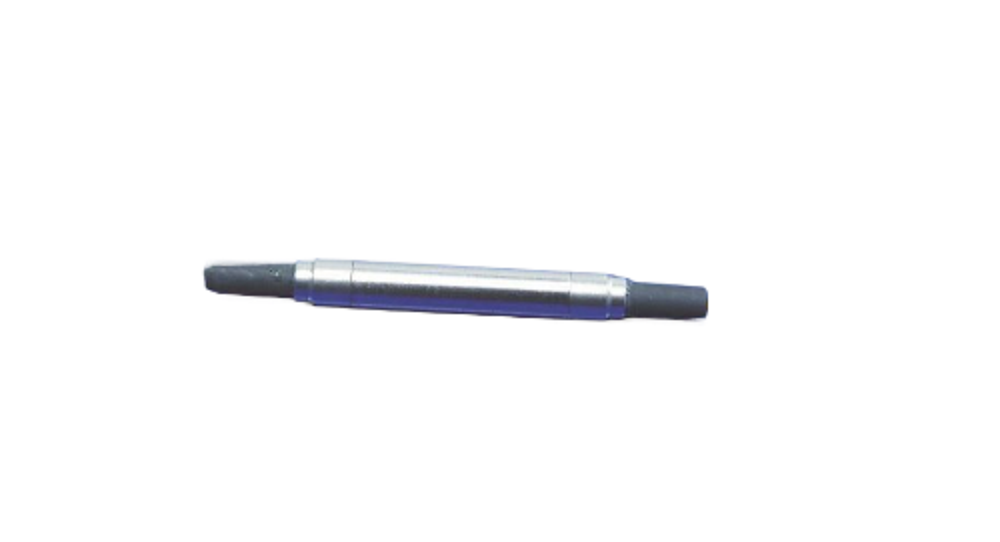
Single Mode Splitters, Miniature Size; 980 to 1550 nm; Splitting Ratio 50/50 to 98/2; Polarization Dependent Loss 0.1 dB; Directivity >50 dB
OZ Optics’ FOBS-12N series of miniature polarizing (single mode) fiber optic beam splitters are used to split the light traveling through a fiber into two fibers, or to split or combine orthogonally polarized light into separate fibers. These splitters feature a rugged miniature housing to fit into compact spaces in equipment and systems.
Light from a fiber is first collimated, then sent through a beam-splitting optic to divide it into two beams by either a fixed ratio or into two orthogonal polarizations. The resultant output beams are then coupled back into the output fibers. This flexible design allows splitters with different fiber types on the input and output ports. For example, light from a single mode fiber could be split into its two orthogonal states and then launched into two polarization maintaining fibers. Standard products for 1550 nm applications are readily available, while custom items can be made with rapid turnaround at low cost. Products for other wavelengths, such as 980 nm, 1300 nm, or 1480 nm are offered. Contact AMS Technologies for details and a quotation.
The FOBS-N12 series of polarizing beam splitters split incoming light into two orthogonal states. They can also be used to combine the light from two fibers into a single output fiber. When used as a beam combiner, each input signal will transmit along a different output polarization axis. By default, the output fibers on a polarizing splitter are aligned so that the output polarization from each fiber is in line with the stress rods of the fibers. If the input fiber is a polarization maintaining (PM) fiber, the input fiber is aligned such that light polarized parallel to the fiber’s stress rods is transmitted to port 1 of the splitter, while light polarized perpendicular to the stress rods is transmitted to port 2 of the splitter.
Key Features:
- Rugged Compact Design
- Broad Wavelength Range
- Low Insertion, Return & Polarization Dependent Losses
- High Extinction Ratio- Low Wavelength Dependent Loss (WDL)
Applications: EDFA Amplifiers; Raman Amplifier Combiners; Polarization Mode Dispersion Compensation; Polarization Extinction Ratio Measurements; Fiber Optic Sensors; Coherent Communication Systems; OCT Systems
Customers also viewed
Polarisation Maintaining Couplers & Combiners; 780 to 2005 nm; Splitting Ratio 50/50, 90/10, 95/5; Return Loss <50 dB; Directivity <55 dB Fusing and tapering the fibers together is a simple, rugged, compact method of splitting or combining optical signals. Typical excess losses are as low as 0.2 dB, while split ratio tolerances range from ±5% to ±0.5% at design wavelengths depending upon the splitting ratio. OZ Optics’ PM Fused Fiber Couplers are bidirectional and offer low backreflection and insertion losses. They exhibit a broad operating wavelength range of up to ±20 nm for 1550 nm region devices. Fused PM splitters are also available on smaller core fibers for 1064 nm, 980 nm and other wavelengths. (Nonstandard center wavelengths may require minimum order quantities or set up charges. Please contact AMS Technologies for assistance). A wide variety of options are available for fused PM splitters. Standard configurations are 1x2, 2x2, 1x3 (monolithic) and 1x4 (compact cascaded). A monolithic structure means that all fibers are fused together, while a cascaded device combines several 2x2 splitters to create a greater split count. OZ Optics can design and construct larger split counts or different split ratios upon request. OZ Optics has the capability to connectorize the fibers of fused splitters with all standard connectors such as FC, SC, ST, LC etc. and finishes (Super PC, Ultra PC, Angled PC [APC] etc.). As a component integrator, OZ Optics can construct additional components such as tunable filters, variable attenuators, or collimators directly onto the coupler fibers. In general OZ Optics uses polarization maintaining fibers based on the PANDA fiber structure when building polarization maintaining components. However OZ Optics can construct devices using other PM fiber structures and does carry some alternative fiber types in stock, so please contact AMS Technologies for availability. If necessary, OZ Optics is willing to use customer supplied fibers to build devices. Key Features:Wide Variety of Wavelengths 780 nm to 2005 nmLow Loss - Broad BandwidthGood UniformitySmall PackageHigh DirectivityWide Variety of Wavelengths 780 nm–2005 nm Applications: Optical Amplifiers; Fiber Lasers; Power Monitoring; Fiber Gyroscopes; Coherent Communications
REQUEST PRICING AND AVAILABILITY
- Get your individual quote.
- Technical compatibility review included.
- Volume discounts available.
No obligation. Direct access to our engineering team.

Patchcord;Polarization Maintaining;1300 nm;FC/APC;FC/APC;5 m
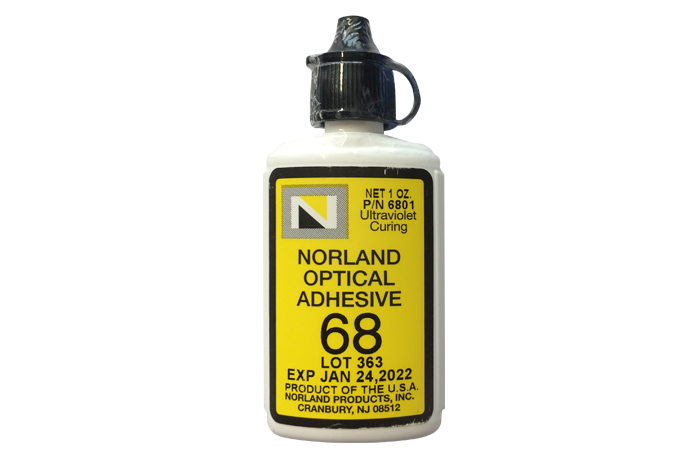
Refractive Index 1.54; 5000 cps Viscosity at 25°C Norland Optical Adhesive 68 ("NOA68")is a clear, colorless, liquid photopolymer that will cure when exposed to ultraviolet light. Since it is a one part system and 100% solids, it offers many advantages in bonding of optical materials where the bonding surface can be exposed to light. The use of NOA 68 eliminates premixing, drying and heat curing operations common to other optical adhesive systems. Curing time is remarkably fast, and is dependent upon the thickness applied and the amount of ultraviolet light energy available.NOA 68 is designed to give improved adhesion to many plastics such as acrylic, polycarbonate and cellulose acetate butyrate. In addition to plastics, NOA 68 has good adhesion to glass and metals and can be used to bond combinations of the three. Suggested uses for NOA 68 include bonding compound plastic lenses, laminating polarized film between glass or plastic, mounting plastic lenses in metal or plastic mounts and bonding cover glasses.Typical Properties of NOA 65 Solids 100% Elongation at Failure 80% Modulus of Elasticity (psi) 20,000 Tensile Strength (psi) 2,500 Hardness - Shore D 60 Shelf life of the liquid is at least 6 months from the date of shipment if stored in a cool (5-22° C), dark place in the original container. If refrigerated, allow the adhesive to come to room temperature prior to use.