BG-HEDFA High-Power EDFA

Product information "BG-HEDFA High-Power EDFA"

 Erbium-doped; Fiber Type Single Mode SMF 9/125 µm; 1528-1560 nm; Input Power 0 dBm Typ.; Output Power ≤27 dBm; Interface RS232

Beogold Technology's BG-HEDFA high-power EDFA offers an output optical power of up to 27 dBm and is widely used in optical fiber sensing and communications.

The BG-HEDFA high-power EDFA consists of a 980 nm or 1480 nm pump laser to provide energy and operates in AGC, ACC or APC mode. It provides high output power, a wide spectral range, and a variable gain range >20 dB. These EDFAs can work across the C-band.

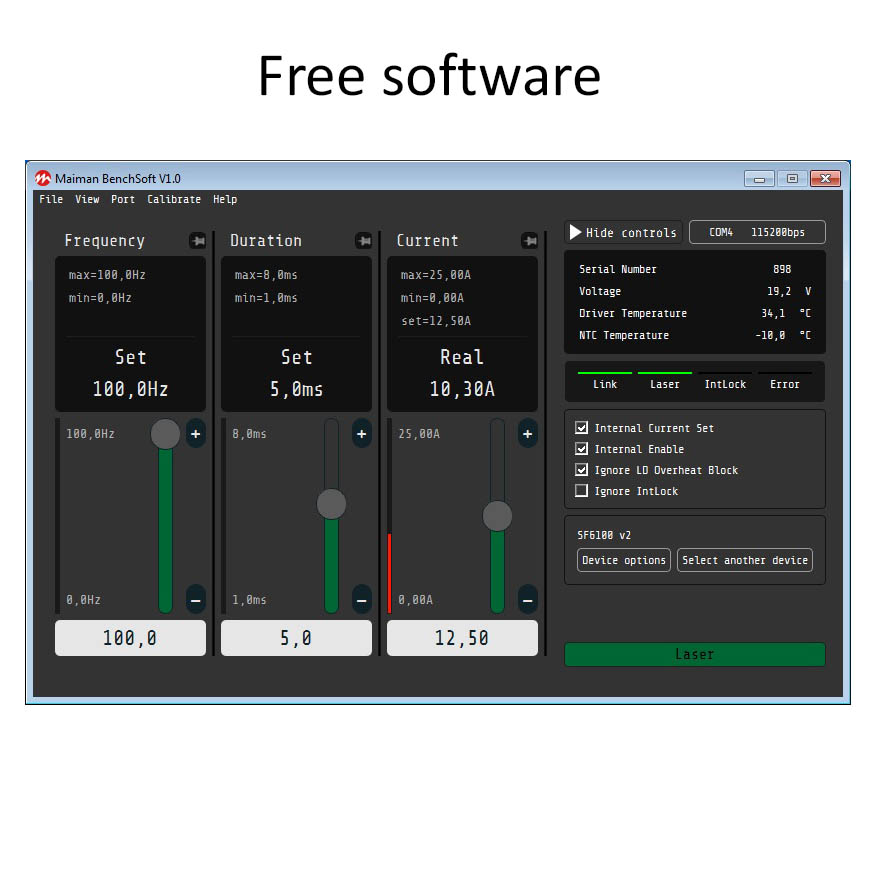
Powered by a + 5 VDC power supply, the BG-HEDFA features a user-friendly RS232 serial port as communications interface for easy internal configuration. Beogold’s BG-HEDFA high-power EDFA enables real-time parameter monitoring as well as remote management and control of the line.

Key Features:

  • Operating Wavelength: 1528 to 1560 nm
  • Low Noise Figure: 5.5 dB Max.
  • High Output Power: up to 27 dBm
  • Flexible Control Mode
  • Customizable Optical Output Power and Configuration
  • High Stability
  • High Reliability
  • Input Power: 0 dBm Typical
  • Min. Input/Output Isolation: 40 dB
  • Fiber Type: Single Mode (SM) SMF 9/125 µm, NA = 0.13
  • Fiber Length: Custom Design
  • Fiber Connector: FC/APC or Custom Design
  • Communication Interface: RS232 Serial Port
  • Power Supply: 5 VDC, <30 W
  • Operating Temperature: -20 °C to +60 °C
  • Dimensions: 238 x 120 x 15 mm

Applications: BOTDR; OTDR System; LIDAR; Nonlinear Optics Research; Fiber Optic Sensing; Air Monitoring

Information on the manufacturer (information obligations under the GPSR Product Safety Regulation)
Xiamen Beogold Technology Co., Ltd.
No.1300 Jimei Avenue, 11F Innovation Building
361024 Xiamen, China
Manufacturer "Beogold Technology"
Established in 2014, Beogold Technology is a fast-growing high-tech enterprise with its main focus on fiber amplification technology. Equipped with great R&D strength and market know-how, Beogold Technology focuses its product development on sensing communication and sensing applications, especially DWDM/SDH, DAS/DVS, DTS and LiDAR, offering high-performance, custom-design fiber amplifiers, optical fiber sensor modules and fiber lasers to meet the customer's specific functional and application requirements. BEOGOLD is headquartered in Xiamen, China with branches in Beijing and Tianjin.
Related links of the manufacturer

Customers also viewed

B-Series CMOS Cameras
0.36-5 MP; Pixel Size 2.2x2.2-6.0x6.0 µm; Sensor Size 1/3”-1/2” Diagonal; Colour or B/W; 3-310 fps; Resolution 8-12 bit; USB 2.0; Buffered; Progressive Scan; Dynamic Range >55-70 dB; Board-level or Enclosed Mightex’s B-Series USB 2.0 CMOS cameras with frame buffers are optimized for machine-vision applications, and they can also be used for a wide variety of other applications such as digital microscopy and medical imaging, where quality, ease of use, and cost-effectiveness are crucial. B-Series cameras are available as colour or B/W versions, with resolutions from Wide VGA (WVGA, 752x480) up to 5 MP (2592x1944) and 8, 10 or 12 bit, and they can be ordered as “naked” board-level device or pre-mounted in an enclosure. Monochrome cameras often exhibit a 20% higher spatial resolution than their colour counterparts because no pixel interpolation is necessary. Without a Bayer colour filter on the sensor, monochrome cameras are also more sensitive than colour sensors, especially in near IR and UV regions. Mightex’s B-Series cameras feature built-in frame buffers, global shutter (Wide VGA versions), external trigger-in, strobe-out, and a powerful camera engine that supports multiple cameras. The frame rate can be as high as 60 fps in full resolution and up to 600 fps using ROI mode (depending on colour or B/W and sensor resolution). In addition, a user-friendly GUI based application software and an SDK are provided for custom software development. A DirectShow driver and a TWAIN driver are included (except for 5 MP B/W versions), and a USB command set protocol is provided for non-Windows based applications. A Linux driver is also either included (5 MP and Wide VGA B/W versions) or available upon request. Available models are: BCN-C050-U/BCN-C050-US: 5 MP, colour, lens mount C/CS, board-level BCE-C050-U/BCE-C050-US: 5 MP, colour, lens mount C/CS, enclosed BCN-B050-U/BTN-B050-U: 5 MP, B/W, 8/12 bit, lens mount C or CS, board-level BCE-B050-U/BTE-B050-U: 5 MP, B/W, 8/12 bit, lens mount C or CS, enclosed BCN-C030-U/BCN-C030-US: 3 MP, colour, lens mount C/CS, board-level BCE-C030-U/BCE-C030-US: 3 MP, colour, lens mount C/CS, enclosed BCN-B013-U/BCN-B013-US: 1.3 MP, B/W, 8 bit, lens mount C/CS, board-level BCE-B013-U/BCE-B013-US: 1.3 MP, B/W, 8 bit, lens mount C/CS, enclosed BTN-B013-U/BTN-B013-US: 1.3 MP, B/W, 10 bit, lens mount C/CS, board-level BTE-B013-U/BTE-B013-US: 1.3 MP, B/W, 10 bit, lens mount C/CS, enclosed BCN-CG04-U/BCN-CG04-US: WVGA, colour, lens mount C/CS, board-level BCE-CG04-U/BCE-CG04-US: WVGA, colour, lens mount C/CS, enclosed BCN-BG04-U/BCN-BG04-US: WVGA, B/W, 8 bit, lens mount C/CS, board-level BCE-BG04-U/BCE-BG04-US: WVGA, B/W, 8 bit, lens mount C/CS, enclosed BTN-BG04-U/BTN-BG04-US: WVGA, B/W, 10 bit, lens mount C/CS, board-level BTE-BG04-U/BTE-BG04-US: WVGA, B/W, 10 bit, lens mount C/CS, enclosed Note: Board-level cameras are designed for OEM applications, when a system-level enclosure is usually provided. In order to avoid electro-static discharge (ESD) related damages, workforce handling a board-level camera should be properly grounded. ESD related damages are considered as mishandling and are not covered by product warranty. For lab use, it is strongly recommended to choose an enclosed camera instead of a board-level one. Key Features: Colour or Black&White (B/W, Monochrome) Board-level or Enclosed Versions Available Ultra-compact Active Imaging Pixels: 0.36 to 5 MP, 752x480 to 2592x1944 Pixel Size: 2.2 x 2.2 to 6.0 x 6.0 µm Sensor Size (Diagonal): 1/3” to 1/2” Dynamic Range: >55 to 70 dB Buffered, 32 MByte On-board Memory (3 to 23 Frames at Full Resolution, Depending on Sensor) 8, 10 or 12 bit Gray Level Progressive Scanning System Frame Rate: 3 to 310 fps True Global Shutter (Wide VGA Versions) Supports Simultaneous Image Capturing From Multiple Cameras 4-pin GPIOs Arbitrary ROI Supported (Wide VGA Versions) Interface: High-speed USB 2.0 (480 Mbit/s), No Need for External Power Supply Digital Output, No Need for Frame Grabber Custom Programmable With SDK Provided DirectShow & TWAIN Drivers Linux Driver (5 MP and Wide VGA B/W Versions) USB Command Set Protocol for Non-Windows-based Applications External and Software Trigger Strobe Output for External Flash Precise Frame Rate Setting (Wide VGA Versions) ROI (Not Wide VGA Versions) and Pixel Skipping/Binning OEM Versions Available Applications: Machine Vision and Stereo Vision; Medical Imaging; Semiconductor Equipment; Test Instruments; High-quality ID Photo Capture; Document Scanners; Digital Microscopy; Web Camera and Security Video
Product number: SW11205
Manufacturer:

REQUEST PRICING AND AVAILABILITY

- Get your individual quote.
- Technical compatibility review included.
- Volume discounts available.

No obligation. Direct access to our engineering team.
EDFA-11-9/125 EDFA Module
Super-fast, Auto Gain Controlled; Fiber Pigtail 9/125 µm; 1529.16-1558.58 nm; Input Power -19--11 dBm; Output Power 5-13 dBm OZ Optics’ super-fast Erbium-doped fiber amplifier module EDFA-11-9/125 was developed to address fast transient conditions with sub-μs suppression time. In a WDM transmission line, the addition or removal of channels may cause a transient, to which the EDFA must respond. In response to a sudden change of input power, an EDFA will exhibit transient response, i.e. overshoot or undershoot in its output signal. With a typical EDFA, this transient response can last on the order of 100 μs. OZ Optics’ super-fast Erbium-doped fiber amplifier module EDFA-11-9/125 features a typical transient suppression time of 50 ns and is designed to be used in the traditional C-band. During operation, the signal wavelengths must be confined to a 3.2 nm region for each optical amplifier, although the band may be anywhere within the C-band. The unit can work with up to four channels. Due to the nature of the narrowband operation, the transient suppression of the super-fast EDFA module is greatly improved, compared to a traditional EDFA. Key Features: Compact Design Super-fast, Auto Gain Controlled Operation Wavelength: 1529.16 nm to 1558.58 nm Input Power per Channel: -19 dBm to -11 dBm Output Power per Channel: 5 dBm to 13 dBm Sub-μs Transient Suppression Time: 50 ns Typ. Transient Undershoot/Overshoot: ≤±0.3 dB Auto Gain Control Over Wavelength and Signal Amplitude Low Noise: 5.5 dB Fixed 24 dB Gain, Independent of Wavelength and Signal Power Gain Flatness Within 3.2 nm Band (Relative to 24 dB): ±0.3 dB Polarization Dependent Gain: ≤0.3 dB Max. Polarization Mode Dispersion: 0.5 ps/√km Input/Output Return Loss (RL): 40 dB Residual Pump Power at Output: -25 dBm Fiber Pigtail: 9/125 µm, 1 m Length Connector Type: FC/APC Operating Temperature Range: 0°C to +70°C Dimensions: 90 x 70 x 14 mm Applications: ROADM Network; CATV/NETWORK Access; C-Band Channel Preamp
Product number: SW11789
Manufacturer:

REQUEST PRICING AND AVAILABILITY

- Get your individual quote.
- Technical compatibility review included.
- Volume discounts available.

No obligation. Direct access to our engineering team.
BG-ASE C-Band Flattened ASE Light Source
1526-1563 nm; Output Power ≤17 dBm; Termination SM Fiber Pigtail, FC/APC Connector; Spectrum Flatness 1 dB Typ.; Full Temperature Power Stability ≤5% Beogold Technology's BG-ASE low-coherence broadband ASE (amplified spontaneous emission) light source is designed for industrial manufacturing and laboratory R&D applications. BG-ASE’s unique ATC and APC circuit control technology ensures very stable output power. The flattened ASE light source features high output power, low polarization and wide spectral width. The device is small and of high stability and reliability. With 5 VDC power supply and upper computer software, the user can read and set the module parameters via R232 communication serial port in real time. Module and benchtop structures are available for different needs. Key Features: Operating Wavelength Range: 1526 nm to 1563 nm Excellent Spectrum Flatness: 1 dB Typical (@ Room Temperature) Small Output Ripple High Adjustable Output Power: ≤17 dBm High Output Power Stability: ≤0.03 dB (Short Term), ≤0.2 dB (Long Term) Full Temperature Power Stability: ≤5% High Reliability Module and Benchtop Structures Available Customized Output Power and Configuration Operating Temperature Range: -45 °C to +85 °C Fiber Connector: SM Fiber Pigtail (Module), FC/APC or Customized (Benchtop) Communication Interface: RS232 (Module), RS232 Console or RJ45 (Benchtop) Power Supply: 5 VDC (Module), 220 VAC (Benchtop) Dimensions: 90 x 70 x 15 mm (Module), 260.6 x 162.8 x 76 mm (Benchtop) Applications: Fiber Optic Sensing; Component Test and Measurement; Medical and Biological Imaging; Fiber Optic Telecommunication
Product number: SW11533
Manufacturer:

REQUEST PRICING AND AVAILABILITY

- Get your individual quote.
- Technical compatibility review included.
- Volume discounts available.

No obligation. Direct access to our engineering team.
IFA-100 Interferometric Fiber Analyser
500 to 1000 nm; Refractive Index Accuracy ±0.0001; Spatial Resolution 500 nm; Fiber Type SM, MM, PM, Other; Fiber Diameter 40 to 400 µm Interfiber Analysis’ IFA-100 multi-wavelength interferometric optical fiber analyzer can measure the refractive index profile of an optical fiber without the need for a cleave at wavelengths from 375 to 2000 nm. By scanning the fiber from the side, the IFA-100 unit allows for scanning and measuring the optical refractive index profile (RIP) along the fiber’s length with sub-micron spatial resolution. The measurement is independent of cumbersome fiber preparation like cleaving and allows for measuring the evolution of the refractive index profile over a given length of fiber. The equipment uses a broadband light source and can determine the refractive index profile at any wavelength between visible and near infrared. The refractive index or index of refraction (IOR) is a property of any material. For optically transmitting materials, such as for fibers and waveguides, it is reflected in the reduced speed of light when travelling through any media other than vacuum. Fibers and waveguides use a distribution of the IOR within their cross section to guide and reflect light, and knowledge of this distribution allows many other critical performance parameters to be calculated, such as mode fields, group and phase propagation constants and fiber dispersion. Based on Interfiber Analysis’ IFA-100 multi-wavelength interferometric optical fiber analyzer, AMS Technologies offers refractive index measurement services for product development, incoming inspection and forensic analysis on optical fibers. Key Features: Multi-wavelength: 500 to 1000 nm No Cleave Required Sub-µm Spatial Resolution: About 500 nm Applicable to Any Fiber Type Fast Measurement Refractive Index Accuracy: ±0.0001 Fiber Diameter: 40 to 400 µm Fiber Material: Silica Glass, Non-silica Glass, Plastic Concentricity Error Measurement: ±200 nm Core Non-circularity Error Measurement: ± 0.4% Fiber Type: Single Mode (SM), Multi Mode (MM), Polarization Maintaining PM), Micro-Structured (PCF), Multicore, Rare-earth, Cladding-pumped, Large Mode Area (LMA), Low Bend Loss, High-Δ, etc. Applications: Measuring Splices, Tapers or Couplers of Any Fiber Type; Test and Measurement; Telecommunication; Lasers
Product number: SW11078
Manufacturer:

REQUEST PRICING AND AVAILABILITY

- Get your individual quote.
- Technical compatibility review included.
- Volume discounts available.

No obligation. Direct access to our engineering team.