
SL Series Fiber Optic MEMS Switches

REQUEST PRICING AND AVAILABILITY
- Get your individual quote.
- Technical compatibility review included.
- Volume discounts available.
No obligation. Direct access to our engineering team.
Product information "SL Series Fiber Optic MEMS Switches"
Latching; 1x2 to 1x16; Fiber Type SM, MM, PM; 1240 to 1640 nm; Insertion Loss 0.5 to 1.6 dB; Crosstalk 60 dB; Switching Time 1 to 10 ms
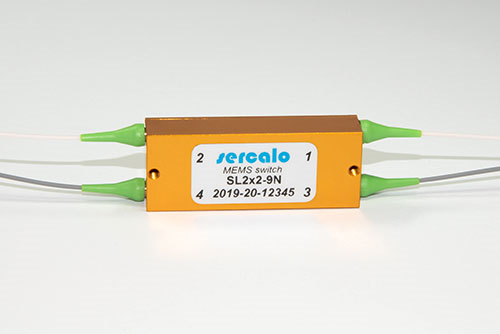
Sercalo Microtechnology’s SL series are fast, latching opto-mechanical MEMS switches for the most demanding applications in fiber optic communication networks. They maintain the last switching state after power is removed and are available in configurations 1x2, 2x2, 1x4, 1x8 and 1x16 with a variety of driver options and a capacitive position sensor (SLTS variants). SL series switches are the best choice where highest reliability and self test capability are required.
The SL series’ highly reliable switching mechanism uses integrated micro-mirrors that can be moved in or out of the optical path by electrostatic actuation. This latching mechanism offers the best repeatability and long term stability, has a very fast response time down to below 1 ms for some models and only 0.5 to 1.6 dB insertion loss.
The underlying MEMS technology permits to obtain low insertion loss combined with high crosstalk between channels. With their miniature package, withstanding rugged environments and well suited for direct mounting on printed circuit boards, the SL series switches offer solid state reliability, accurate precision and fast response time and are qualified according to Telcordia GR 1221.
Powered by a voltage between 4.0 and 5.25 VDC on the supply pin, the LS series switch’s state is selected with a CMOS or TTL signal on the selector pins. A high pulse during at least 2 ms on one of the selector pins toggles the switch into either cross state or bar state. At 0 V on the selector pins or at power off, the switch remains in the last selected state. The switching mechanism offers the reliability of a solid state device; it neither wears out nor degrades over time. Even after billions of cycles the switching quality stays constant.
1x8 and 1x16 models communicate over a UART interface with TTL or RS-232 voltage levels and over a secondary SMBus/I2C or USB interface.
Key Features:
- Reliable
- Insertion Loss (IL): 0.5 to 1.6 dB
- Response Time: 1 to 10 ms
- Low Polarization Dependent Loss (PDL)
- Crosstalk: 60 dB
- Miniature Size
- Latching
Applications: Protection Switching; Optical Reconfiguration; WDM; Source Selection; Monitoring; Wavelength Provisioning; Optical Network Protection/Restoration; Instrumentation; Test and Measurement
Customers also viewed
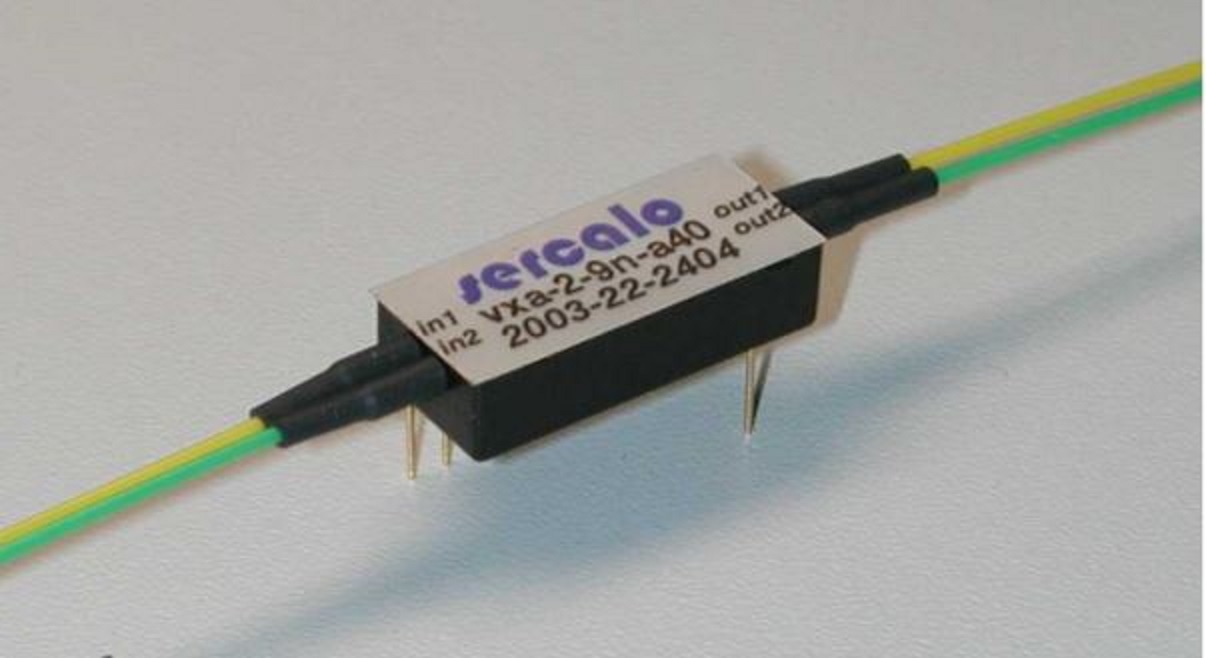
Sercalo Microtechnology's VXA series of miniature MEMS variable optical attenuators (VOAs) has been discuntinued by the supplier. For replacement and new projects, please refer to the mVOA series of ultra-small or VXP1 series of miniature MEMS variable optical attenuators (VOAs). MEMS-based, Pigtail Style, Transmission Mode; Single/Dual Types; Fiber Type SMF28; 1240 to 1640 nm; Attenuation up to 30 dB Sercalo Microtechnology's VXA series of miniature MEMS variable optical attenuators (VOAs) is ideal for fiber optic communication systems and submodules. The non-latching attenuators work in transmission mode and allow for the continuous adjustment of the attenuation with a 0 to 5 V control voltage. The highly reliable attenuation mechanism is based on a micromechanical shutter – a silicon MEMS chip, on which a mirror can be moved in and out of the optical path by electrostatic actuation – and features below 2 ms response time and below 1 dB insertion loss. The VXA variable optical attenuators are composed of an optical subsystem and an electrical driver interface. VXA series is available in single (VXA1) and dual (VXA2) variants and normally open or normally closed designs. The plastic package is one of the smallest in the industry and optimized for low cost production while maintaining high reliability comparable to a solid-state device. The component is designed to meet Telcordia 1221 quality standards. The standard VXA attenuator achieves minimum insertion loss at 0 V input voltage. The VXAxOF variant is normally closed, i.e. at 0 V the attenuation is maximum and is reduced with increasing input voltage. Key Features: Small Size (23 x 10 x 6 mm) Low PDL Very Fast 0 to 5 V Control Single or Dual Channel Applications: Power Management in DWDM Transceivers; Amplifier Gain Control; Optical Subsystems; Array Integration
REQUEST PRICING AND AVAILABILITY
- Get your individual quote.
- Technical compatibility review included.
- Volume discounts available.
No obligation. Direct access to our engineering team.
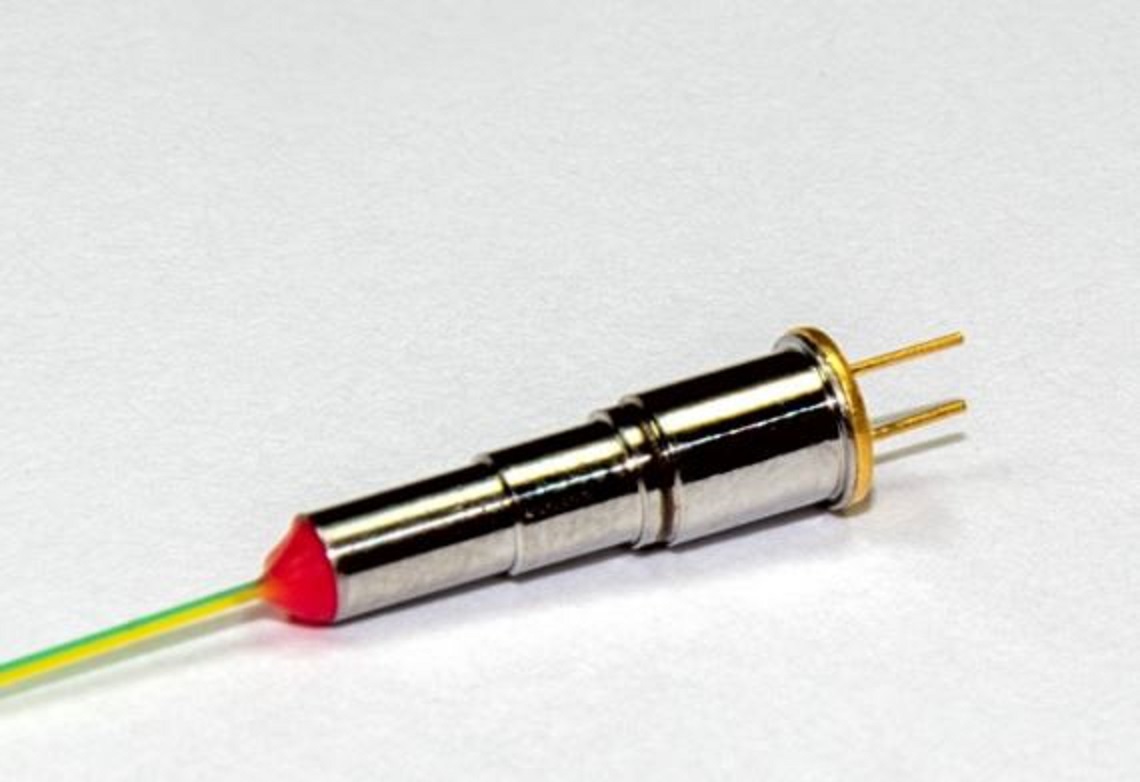
MEMS-based, Coaxial Style; Fiber Type SM (SMF28ultra, ZBL, SM600/850/980), PM (HP850/908PM); 650 to 1670 nm; Fiber Length 50 to 100 cm; Attenuation up to 30 dB, 40 dB Sercalo Microtechnology’s mVOA series of coaxial ultra-small fiber optic variable optical attenuators (VOAs) is based on an electrostatic MEMS mirror. It comes in a hermetically sealed package with a diameter of only 3.5 mm, and the devices are manufactured with the latest techniques in laser welding for achieving better stability and improved reliability. A voltage between 0 and 6.5 V on the drive pin sets the optical attenuation. When power is removed, the VOA returns into its default state. There are two variants available with different default states: normally open (bright) or high attenuation (dark). The dark variant has better linearity and is used in applications where the light is cut at power off. The mVOA series is designed to conform to Telcordia 1221 reliability standards. No epoxy is present in the optical path. The optical collimator is assembled using laser welding techniques which results in long term stability and excellent reliability. The components withstand rugged environments and can directly be mounted on printed circuit boards. This ultra small mVOA series is compliant to ROHS requirements 2011/65/EU and ideally suited for gain control in amplifiers and transceivers. Key Features: Diameter 3.5 mm Laser Welded Package Reliable- 0 to 6.5 V ROHS compliant Applications: Telecom; Instrumentation; Test and Measurement
REQUEST PRICING AND AVAILABILITY
- Get your individual quote.
- Technical compatibility review included.
- Volume discounts available.
No obligation. Direct access to our engineering team.