
Duo-lateral Position Sensing Detectors

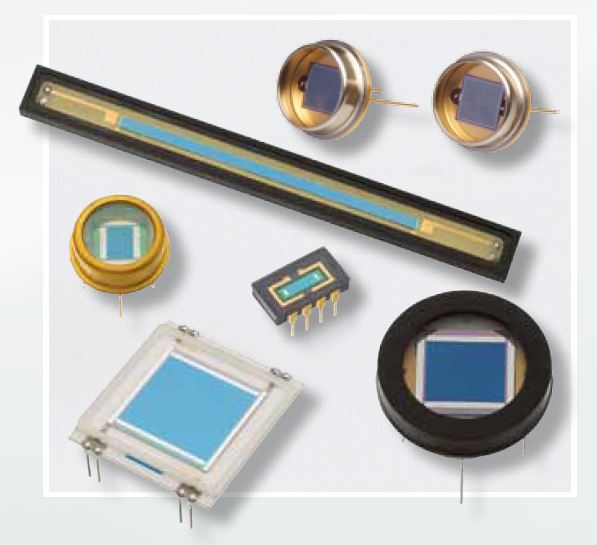
Product information "Duo-lateral Position Sensing Detectors"

OSI Optoelectronics’ super linear duo-lateral position sensing detectors (PSDs) feature state of the art duo-lateral technology to provide a continuous analog output proportional to the displacement of the centroid of a light spot from the center, on the active area.

As continuous position sensors, these detectors are unparalleled, offering position accuracies of 99% over 64% of the sensing area. These accuracies are achieved by duo-lateral technology, manufacturing the detectors with two separate resistive layers, one located on the top and the other at the bottom of the chip. One- or two-dimensional position measurements can be obtained using these sensors.

A reverse bias should be applied to these detectors to achieve optimum current linearity at high light levels. The maximum recommended power density incident on the duo-lateral PSDs is 1 mW/cm2. For optimum performance, the incident beam should be perpendicular to the active area, with a spot diameter of less than 1 mm.

Key Features:

  • Duo Lateral Structure
  • One-dimensional (SL Variants) and Two-dimensional (DL, DLS Variants) Versions
  • High Speed Response
  • Super Linear
  • Ultra High Position Accuracy: Up to 99%
  • Low Capacitance
  • Low Dark Current
  • Wide Dynamic Range
  • High Reliability
  • Metal or Ceramic Package


Applications: Pulse Detectors; Optical Communications; Bar Code Readers; Optical Remote Control; Medical Equipment; High-speed Photometry; Beam Alignment; Position Sensing; Angle Measurement; Surface Profiling; Height Measurements; Targeting; Guidance Systems; Motion Analysis

Information on the manufacturer (information obligations under the GPSR Product Safety Regulation)
OSI Optoelectronics
12525 Chadron Ave
CA 90250 Hawthorne, United States
Manufacturer "OSI Optoelectronics"
OSI Optoelectronics is a leading provider of advanced optoelectronics and electronic assemblies. These technical elements are key to enabling critical functions such as analytics and monitoring, test and measurement, communication and tracking, and imaging in a wide variety of industries, including: Aerospace & Defense, Medical & Life Sciences, Automation & Industrial Production and Automotive & Consumer Electronics.
Related links of the manufacturer

Customers also viewed

Bismuth-doped Optical Fibers
Cut off Wavelength 980, 1350 nm; Numerical Aperture 0.09 to 0.27; Core Dia. 3.5 to 14 µm; Cladding Dia. 125 µm; Background Loss <10 to <30 dB/kmGreitlex Photonics’ series of Bismuth-doped single mode (SM) optical fibers feature core diameters of 5.6 and 6.5 µm. The Bismuth-Phosphorus co-doped fiber BPDF-SM-6/125-1320 is specially designed for amplifiers, lasers or superfluorescent fiber sources operating at 1270 to 1370 nm, while the Bismuth-Germanium co-doped fiber BGDF-SM-7/125-1430 series is specially designed for amplifiers, lasers or superfluorescent fiber sources operating at 1370 to 1490nm. It replaces similar products from former FORC Photonics. Key Features: Bismuth-doped Fibers Phosphorus or Germanium Co-doped Core Diameter: 5.6, 6.5 µm Core Absorption: 0.3, 0.5 dB/m Cladding Diameter: 125 µm Cut off Wavelength: 1050, 1100 nm Core Numerical Aperture: 0.14 Typ. Peak Gain: >0.2 dB/m Applications: Amplifiers; Lasers; Superfluorescent Fiber Sources
Product number: SW11013
Manufacturer:

REQUEST PRICING AND AVAILABILITY

- Get your individual quote.
- Technical compatibility review included.
- Volume discounts available.

No obligation. Direct access to our engineering team.
QSMJ High Power SM Patch Cables
Single Mode Patchcords; 200 to 2000 nm; Fiber Type SM High Power; Optional Cooling Fins OZ Optics’ QSMJ series of single mode fiber optic patchcords is specifically designed for high-power applications. These patchcords feature special high-power SM fibers, carefully prepared fiber endfaces and specially designed fiber optic connectors to ensure maximum power handling for your application. In standard connectors the fibers are glued into place, and the fiber is polished flush with the connector ferrule tip. When used with high power lasers, heat generated at the tip of the fiber causes the surrounding epoxy to break down and give off gases. These gases, in turn, burn onto the tip of the fiber, causing catastrophic damage to the fiber and perhaps the entire system. In contrast, OZ Optics’ high-power connectors feature an air-gap design, where the fiber extends into free space by 1.1 to 1.5 mm, providing an epoxy-free region where thermal energy is safely dissipated without burning the surrounding material. OZ Optics offers an adjustable focus feature in both SMA and FC connector designs to allow optimum coupling efficiency, which is critical in high power applications. A unique feature of the adjustable focus connector design is that one can adjust the distance the ferrule and fiber protrudes from the connector housing. The connector also has a built-in residual spring mechanism that allows one to safely connect two fibers together. Our engineers have extensive working knowledge with both continuous output (CW) and pulsed laser applications and can help you select the best system for your application. Please contact AMS Technologies for further assistance. Key Features: Operating Wavelengths 200 to 2000 nm SM Fibers Unique Connector Design for Precise Fiber to Fiber Coupling Minimizes Thermal Damage Able to Withstand Temperatures up to +500 °C Compatible with SMA905 and FC Connectors Different Fiber Endface Finishes Available for Higher Power Applications Stainless Steel Armored Cabling for Maximum Safety High Power Anti-reflection Coatings Available Applications: Laser Marking, Cutting and Welding; Materials Processing; High Power Spectroscopy; Non-linear Optics; Laser Surgery; Light Detection and Ranging (LIDAR)
Product number: SW10531
Manufacturer:

REQUEST PRICING AND AVAILABILITY

- Get your individual quote.
- Technical compatibility review included.
- Volume discounts available.

No obligation. Direct access to our engineering team.