
APCH/SPCH Hard Polymer Clad MM Fibers

Product information "APCH/SPCH Hard Polymer Clad MM Fibers"

Multi Mode; 190 to 2200 nm; Core Diameter 200 to 1500 µm; Cladding Diameter 230 to 1550 µm; Coating Tefzel (Natural & Blue); Numerical Aperture 0.37

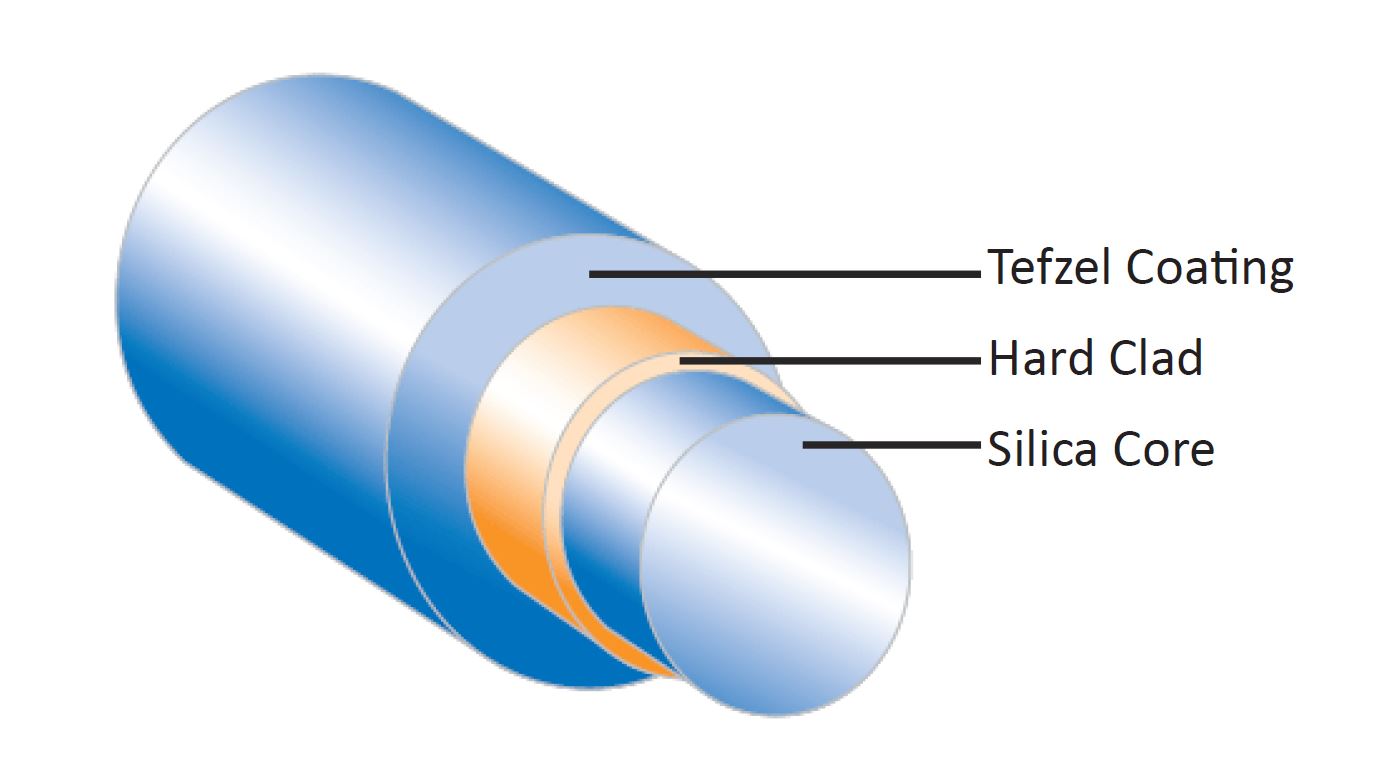
Fiberguide’s Anhydroguide™ (APCH) and Superguide™ (SPCH) series of silica core, hard clad fibers feature a hard polymer cladding instead of a silica cladding. This hard polymer cladding enables a higher numerical aperture (NA, 0.37) than a silica cladding and reduces cost. Hard clad fibers like the APCH/SPCH series are the ideal choice for disposable medical products.

While the APCH series features a low hydroxyl ion concentration (low OH) and works in the visible to IR range, SPCH variants with high hydroxyl ion concentration are suitable for the UV to visible range. Options include natural (-Z) or blue (-C) Tefzel coatings.

As an option, fibers can be provided with a broad selection of shaped tips – standard configurations as well as custom designed shapes. Shaped tip fibers provide optimum control over beam delivery and/or increased efficiency of light collection.

Some fiber types can also be end capped to achieve higher coupled power into a fiber core by reducing the power density at the air / silica interface, commonly the point of laser damage. End cap diameters and lengths are offered for select numerical apertures and fiber cores size, but can be easily customized for a variety of fiber types and specialized applications.

Additionally, all fiber types can be equipped on demand with Fiberguide’s patented RARe Motheye anti-reflective technology that enhances fiber transmission performance and significantly increases the damage threshold for your application over a large wavelength range.

Key Features:

  • Step Index Multi Mode Fibers
  • Pure Fused Silica Core / Hard Polymer Cladding
  • Coating: Tefzel (Natural or Blue)
  • Core / Cladding Sizes: 200/230 to 1500/1550 µm
  • Wavelengths: SPCH (High OH) 190 to 1250 nm, APCH (Low OH) 400 to 2200 nm
  • Numerical Aperture (NA): 0.37
  • Recommended Bend Radius: Short Term 100 x Clad Diameter, Long Term 200 x Clad Diameter
  • 100% Proof Test Using 4-Axis Bend Method
  • Tefzel (Natural & Blue) certified to NAMSA Class VI


Applications: Bio-Analytical Sensing; Medical Laser; Dental Curing; Spectroscopy; Nuclear Plasma Sensing; Photodynamic Therapy

Manufacturer "Molex (former Fiberguide Industries)"
Molex is a manufacturer of electronic components intended to offer interconnect solutions for aerospace, automotive, defense, HVAC, diagnostics, and data center industries. The company's electronic components include electronic, electrical, sensors, and fiber optic connectivity systems, electrical and fiber-optic interconnection products and systems, switches, cable assemblies, antennas, and integrated products. In 2020, Molex acquired Fiberguide Industries, Inc. a leading US provider of fiberoptic solutions to the OEM markets since 1977. The comprehensive product line is based on ISO 9000:2000 and includes standard and custom high optical transmission multimode, singlemode and graded-index optical fibers from UV to NIR, optical fiber assemblies and discrete components. Fiberguide´s products are used in applications such as medical, sensing, laser delivery systems and smoke and particle detection.
Related links of the manufacturer

Customers also viewed

MPC-201 Polarization Controller
980-1620 nm; Multiple Polarization Control Modes; IL <0.6 dB; PDL <0.1 dB; PMD <0.2 ps; AL <0.1 dB; RL >50 dB Controlling the state of polarization (SOP) of an optical signal has never been easier – General Photonics’ MPC-201 multifunction polarization controller has four operational modes for complete polarization control: variable rate polarization scrambling, manual polarization adjustment, polarization modulation, and externally triggered random SOP generation. Four different polarization scrambling methods enable the SOP to a) trace out a spiral pattern about a static or rotating axis with a nearly uniform SOP variation rate for system stress tests (Tornado scrambling); b) generate a continuous trace with a Rayleigh distribution of SOP variation rate, for emulation of the SOP variation in a fiber link (Rayleigh scrambling); c) generate a continuous trace with uniform sphere coverage for PDL measurement (Triangle scrambling); or d) evenly cover the Poincaré sphere with discrete, random points at a uniform rate (Discrete scrambling). In the SOP modulation mode, each polarization control axis can be selectively controlled with a sine, square, or triangle wave of user defined frequency and amplitude. Each polarization control axis can also be controlled manually, by setting the input voltage either from the front panel controls or through a remote control interface. In externally triggered scrambling mode, discrete, random SOPs are generated in response to a trigger input, a feature desirable for recirculating loop applications or other applications requiring synchronization with other devices. Finally, the MPC-201 can emulate the Agilent 11896A polarization scrambler function, allowing it to act as a plug-in replacement for this popular but discontinued device, while offering many more advanced features. The MPC-201 polarization controller puts the user in control. Key Features: Multiple Polarization Control Modes Tornado Scrambling (Quasi-uniform Rate Distribution): 0.00 to 2,000 Revolutions/s Real Fiber SOP (State of Polarization) Variation Emulation (Rayleigh Rate Distribution): 0.00 to 2,000 rad/s Discrete Random States SOP Scrambling: 0.00 to 20,000 Points/s Triangle Polarization Scrambling: 0.00 to 2,000 x 2π rad/s Agilent 11896A Scrambling Emulation: Speed Settings 1 to 8, Matched to 11896A Settings SOP Modulation Operating Wavelength Range: 1260 to 1620 nm, 980 to 1310 nm Manual Polarization Control: 4 Channels, 0 to 4π Each Channel Low Insertion Loss (IL): <0.5 dB With Connectors Low Polarization Dependent Loss (PDL): <0.05 dB With Connectors Low Polarization Mode Dispersion (PMD): <0.1 ps With Connectors Low Activation Loss (AL): <0.05 dB With Connectors Return Loss: >50 dB With Connectors Optical Power Handling: 1,000 mW Bright OLED Display Applications: Recirculating Loop Studies; Automated Testing; Real Fiber Emulation; SOP Variation Emulation; PMD Emulation; Polarization Scrambling; System Polarization Studies; PDL/DOP Measurement
Product number: SW11271
Manufacturer: